
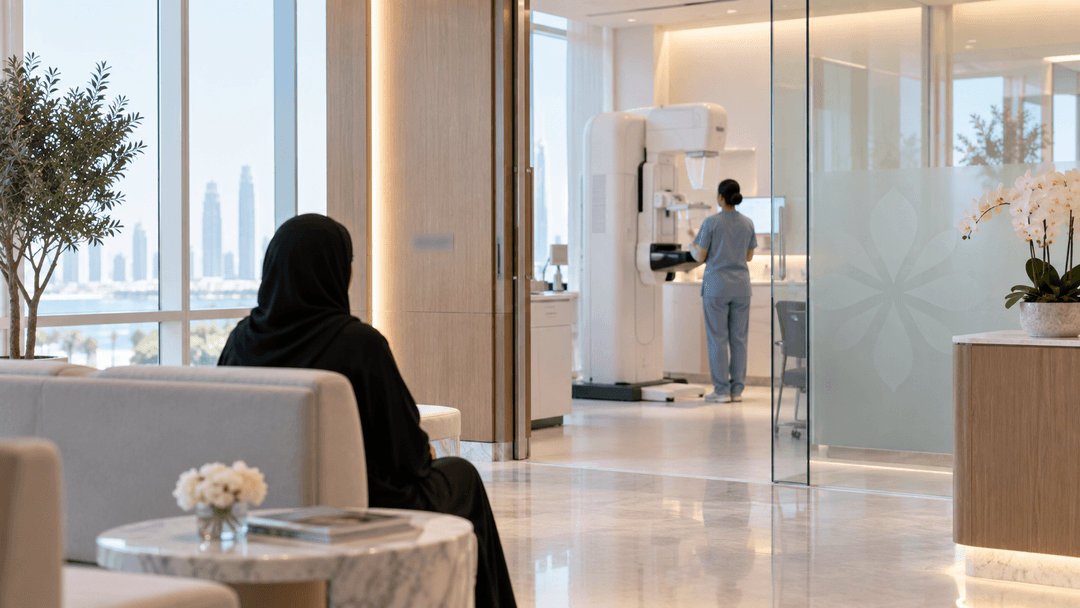
DHA’s 40-plus mammogram rule puts asymptomatic breast screening back on clinic agendas
UAE doctors say feeling well does not rule out breast cancer. Clinics, insurers and patients need clearer mammogram pathways.
How Zavis verifies this coverage
Editorial standards, source rules, methodology, and review provenance are public.
UAE doctors are warning that breast cancer can be present before a woman feels a lump, a message that turns routine mammography into an operating issue for Dubai clinics, Abu Dhabi insurers and patients across the northern emirates.
The immediate trigger is a Gulf News report published on 6 October 2026. Dr Dima Abdul Jabbar, consultant medical oncologist and director of Burjeel Breast Center at Burjeel Cancer Institute, said screening is designed to find cancer before symptoms appear. Dr Rajul Matkar, specialist obstetrician and gynaecologist at Dubai London Clinics & Hospitals, put the point more directly.
“A mammogram is not looking for a lump.”
Dr Rajul Matkar, specialist obstetrician and gynaecologist
For operators, the issue is less clinical awareness than execution. A patient who feels fine is harder to convert into a screening appointment than a patient with pain, discharge or a palpable mass. That makes recall lists, payer eligibility checks and same-week radiology access part of the breast cancer pathway.
Dubai clinics have a two-year screening benchmark
In Dubai, the relevant regulator is the Dubai Health Authority (DHA). DHA’s Periodic Health Screening Guideline, issued on 11 March 2024 and effective from 11 May 2024, advises breast cancer screening for females aged 40 years and over with a mammogram every 2 years.
That creates a measurable cohort for Dubai providers. Primary care clinics, obstetrics and gynaecology practices, and diagnostic centres can identify women aged 40 and above who have no mammogram recorded in the past 24 months. COOs should treat this as a registry problem, with referral slots and results follow-up built into the workflow.
The CFO question is price and coverage. Published private-sector offers vary by provider and package design. Mediclinic lists mammogram plus breast ultrasound at AED 725, Canadian Specialist Hospital lists a breast cancer screening package at AED 525, and Al Zahra Hospital Dubai lists mammogram, breast ultrasound and consultation at AED 1,200. Novomed says screening mammograms in Dubai and Abu Dhabi typically range from AED 300 to AED 1,200, depending on 2D or 3D imaging, diagnostic status and consultation inclusion.
- Clinics should separate screening mammograms from diagnostic imaging in booking scripts.
- Front desks should check policy terms before quoting patients with Daman, Thiqa, Sukoon or other UAE insurers.
- Radiology teams should define how abnormal screens move to ultrasound, MRI, biopsy or breast surgery referral.
- Marketing teams should avoid lump-led messaging for women aged 40 and above.
Abu Dhabi and northern emirates need different routing
In Abu Dhabi and Al Ain, the relevant regulator is the Department of Health Abu Dhabi (DOH), with public health messaging led by the Abu Dhabi Public Health Centre. ADPHC’s breast cancer page says women aged 40 to 75 should have a mammogram every 2 years, and says screening is available through the Comprehensive Screening Program, IFHAS, for Thiqa cardholders.
DOH’s breast cancer screening standard also sets a higher-risk pathway. Women with prior chest radiation between ages 10 and 30, prior breast cancer, lobular carcinoma in situ, atypical ductal hyperplasia, strong family history, genetic predisposition or a calculated 5-year invasive breast cancer risk of 1.7% or more may need annual mammography, MRI or genetic counselling.
In Sharjah, Ajman, Ras Al Khaimah, Fujairah and Umm Al Quwain, operators should anchor patient advice to the Ministry of Health and Prevention (MOHAP) and Emirates Health Services pathways. MOHAP has published a National Guideline for Breast Cancer Screening and Diagnosis. Clinics should check the current MOHAP document and payer network rules before promising a screening interval or reimbursement outcome.
Why this matters beyond October campaigns
The Gulf News story is useful because it attacks a persistent patient assumption: no lump means no cancer. ADPHC states that most people have no symptoms in the early stages of cancer, and lists warning signs that still need review, including a breast or underarm lump, nipple changes, discharge, redness, dimpling or swelling.
For CMOs, the practical lesson is that Breast Cancer Awareness Month campaigns should sell a date, not fear. The strongest call to action is simple: women aged 40 and above should ask when their last mammogram was, whether their insurer covers screening, and where the result will be followed up if it is abnormal.
For medical directors, the liability point is equally direct. A normal mammogram does not close the case if a patient later reports a new change. Dense breasts, tumour biology and imaging limits mean diagnostic escalation may still be needed.
Patients and referring clinicians can use the UAE Open Healthcare Directory to find licensed oncology providers, breast clinics and diagnostic centres across Dubai, Abu Dhabi, Sharjah and the rest of the UAE.
Zavis Intelligence
Healthcare Industry Desk
Contributing to UAE healthcare industry coverage
Related coverage



FAQ
What is happening in UAE healthcare industry?
UAE doctors say feeling well does not rule out breast cancer. Clinics, insurers and patients need clearer mammogram pathways.