
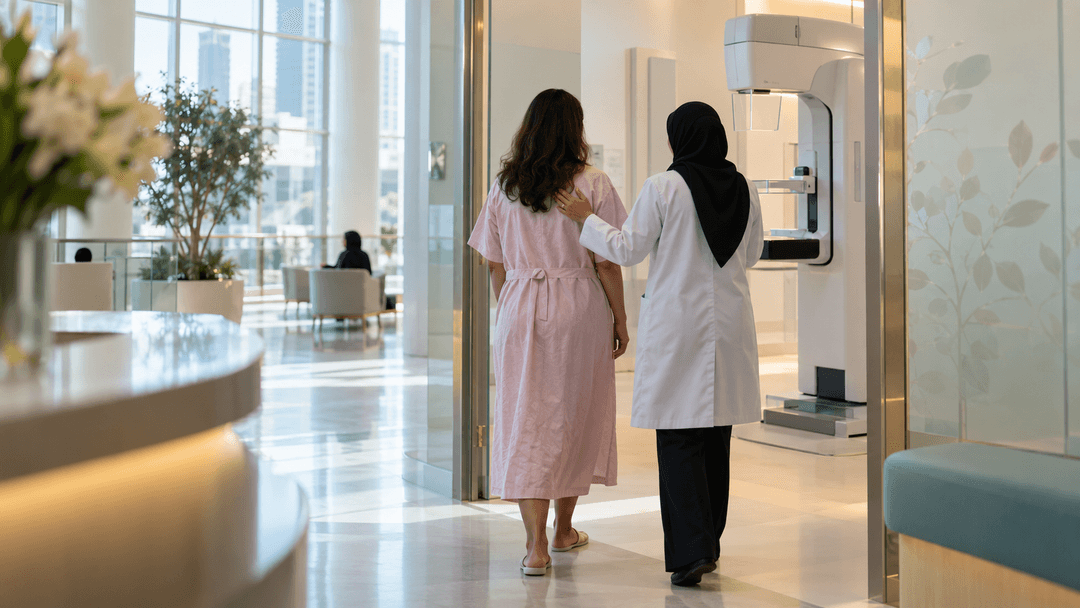
DHA’s age-40 mammogram rule puts symptom-free breast cancer screening back on clinic agendas
UAE doctors warn that breast cancer can be present without a lump. Clinics and insurers need clear recall, pricing and coverage workflows.
How Zavis verifies this coverage
Editorial standards, source rules, methodology, and review provenance are public.
UAE doctors are urging women without breast lumps or pain to keep mammogram appointments because early breast cancer can be visible on imaging before it can be felt, according to a Gulf News report updated on 6 October 2026.
The operational issue for UAE providers is direct. Screening is aimed at people who feel well. That makes recall systems, payer pre-authorisation, radiology capacity and patient messaging as important as the scan itself. For Dubai operators, the relevant regulator is the Dubai Health Authority (DHA). For Abu Dhabi and Al Ain, it is the Department of Health Abu Dhabi (DOH). In Sharjah, Ajman, Umm Al Quwain, Ras Al Khaimah and Fujairah, the national reference point is the Ministry of Health and Prevention (MOHAP).
What the doctors said
Gulf News quoted Dr Dima Abdul Jabbar, Consultant Medical Oncologist and Director of Burjeel Breast Center at Burjeel Cancer Institute, saying the purpose of breast screening is to identify cancer before symptoms appear or a mass can be felt. The report also cited Dr Annu Susan George, Consultant Medical Oncology at Medcare Hospital Sharjah, and Dr Rajul Matkar, specialist obstetrician and gynaecologist at Dubai London Clinics & Hospitals, on the value of detecting microcalcifications, asymmetries and tissue changes before a lump develops.
"Screening is specifically for people who don't have symptoms," Dr Rajul Matkar, specialist obstetrician and gynaecologist, told Gulf News.
The practical warning is that a normal physical examination is a weak substitute for imaging in the target group. Mammography can detect ductal carcinoma in situ, often described as stage 0 breast cancer, and other small changes that are invisible to touch. Gulf News also noted an important limit: dense breast tissue can obscure cancers, so some patients may need ultrasound, MRI or contrast-enhanced mammography after clinical review.
Dubai and Abu Dhabi rules to check
DHA’s Dubai Periodic Health Screening Guideline, issued on 11 March 2024 and effective from 11 May 2024, advises females aged 40 years and over to attend breast screening with a mammogram every two years. The same DHA document says earlier screening may be appropriate when there is family history or a known inherited genetic mutation.
DOH’s Standard for Breast Cancer Screening uses the same age threshold for average-risk women: breast awareness and consultation, plus mammography every two years from age 40. For increased-risk women, DOH lists clinical breast examination every 6-12 months, annual mammography, MRI when indicated and referral to genetic counselling for strong familial or genetic risk.
For COOs, this creates a checklist rather than a campaign slogan:
- Flag women aged 40+ in the EMR for two-year mammogram recall unless a clinician sets a different interval.
- Separate screening mammograms from diagnostic workups triggered by a lump, discharge, skin change or nipple change.
- Capture breast density, family history and prior images in the radiology workflow.
- Document informed consent and follow-up plans, especially in Abu Dhabi where DOH requires screening outcomes and positive breast cancer cases to be reported.
Pricing and payer exposure
Self-pay pricing is now visible enough for CFOs to benchmark. Published UAE package prices reviewed for this article range from AED 300 for a mammogram at Emirates Hospitals Group to AED 375 at Mediclinic Middle East, where a mammogram plus ultrasound is listed at AED 725. Cleveland Clinic Abu Dhabi lists a breast cancer screening package from AED 1,700, including initial digital consultation, mammography and digital follow-up.
Insurance coverage should be checked against the patient’s plan before the appointment. DOH states that Thiqa reimbursement follows the DOH Thiqa preventive list, while non-Thiqa payment follows the individual insurance product. In Dubai, DHA’s cancer coverage mandate for the Essential Benefits Plan applies to eligible insured Dubai residents diagnosed with cervical, breast or colorectal cancer, subject to the criteria in the policy document. Screening benefits can still vary by plan, network and medical necessity language.
For patients, the message is simple: age 40 is the point to ask about routine screening even without symptoms. For clinics, the commercial task is more specific: publish transparent screening prices, confirm payer rules before imaging, and close the loop on abnormal results within the documented recall pathway. Operators looking for licensed oncology and breast care providers can start with the UAE Open Healthcare Directory and then verify the provider licence with DHA, DOH or MOHAP before referral.
Zavis Intelligence
Healthcare Industry Desk
Contributing to UAE healthcare industry coverage
Related coverage


FAQ
What is happening in UAE healthcare industry?
UAE doctors warn that breast cancer can be present without a lump. Clinics and insurers need clear recall, pricing and coverage workflows.