UAE has 15 GLP-1 studies on record but only 1 is recruiting or active now
Across the GCC, recruiting or active GLP-1 studies rose 20% since the last edition to 12, out of 37 registered studies with a Gulf site.
How Zavis verifies this coverage
Editorial standards, source rules, methodology, and review provenance are public.
Key findings
- UAE has 15 registered GLP-1 studies on record, with 1 recruiting or active now
- GCC studies recruiting or active rose 20% since the last edition to 12
- US FDA approved 8 GLP-1 submissions in 90 days, including 3 efficacy supplements
- All 9 GLP-1 presentations listed as current US shortages are liraglutide
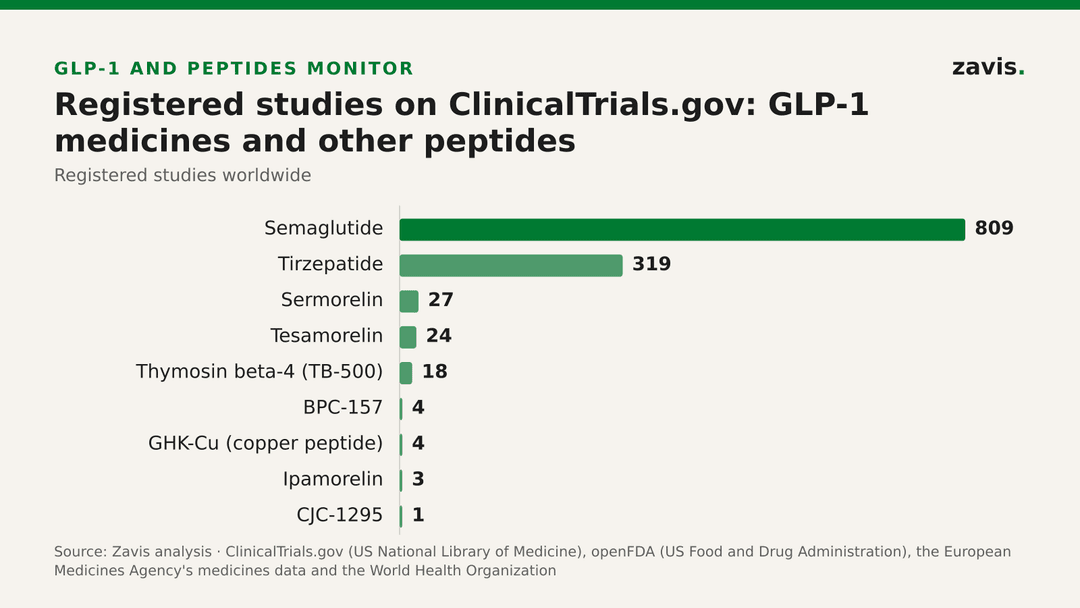
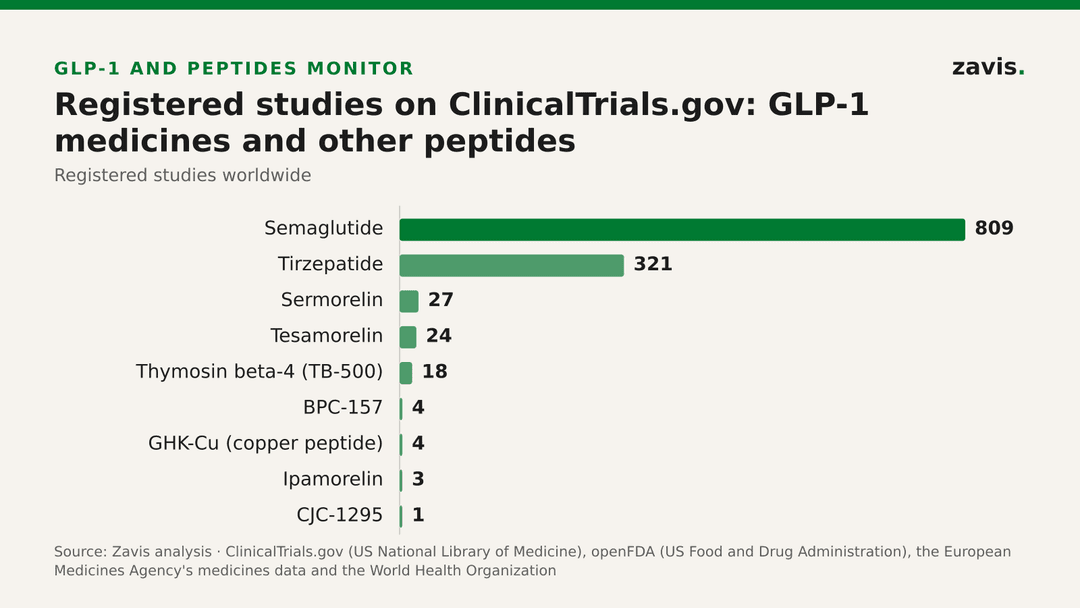
- Five peptides with no US approval on record have 30 registered studies combined, against 809 for semaglutide
The UAE has 15 registered studies of GLP-1 and related incretin medicines with a site in the country, but only 1 is recruiting or active now. That is the finding of a Zavis analysis of the ClinicalTrials.gov registry, which is run by the US National Library of Medicine and was read on 23 November 2026. Neither number has changed since the last edition of the Zavis GLP-1 and Peptides Monitor.
This matters to hospitals and clinics that run research and to patients looking for a local trial place. A study on record is not one that patients can join today. Obesity rates give context. World Health Organization figures put adults with obesity in the UAE at 31.6% in 2024, on an age-standardised basis.
Across the GCC, the Zavis analysis counts 37 registered studies with a site in a Gulf country, up 5.7% since the last edition. Of these, 12 are recruiting or active now, up 20%. The number recruiting now is 7, unchanged.
Where Gulf research is open now
Saudi Arabia has 17 registered studies on record, with 7 recruiting or active. Kuwait has 8, with 4 recruiting or active. Qatar has 2, with 1. The registry shows no studies of these medicines with a site in Bahrain or Oman.
The UAE's one active study is NCT07613307. It is a Phase 3 study of orforglipron, with Eli Lilly and Company as lead sponsor, and it is recruiting at sites in the UAE and Saudi Arabia. Saudi Arabia also hosts two Phase 3 survodutide studies sponsored by Boehringer Ingelheim, both recruiting, and Novo Nordisk semaglutide studies listed as not yet recruiting. In Kuwait, Dasman Diabetes Institute is lead sponsor of every active study in the table except one, which The Cleveland Clinic leads.
By medicine, semaglutide has the most GCC studies, with 14 all time and 4 recruiting or active. Liraglutide follows with 9 and tirzepatide with 5.
On obesity, Qatar has the highest share of adults with obesity in the GCC at 42%, followed by Kuwait at 40.4% and Saudi Arabia at 40.1%. Bahrain stands at 34.9%. Of the six GCC states, only Oman, at 30.5%, has a lower rate than the UAE.
| Registry ID | Medicines | Lead sponsor | Phase | Status | GCC countries |
|---|---|---|---|---|---|
| NCT07931573 | semaglutide | Novo Nordisk A/S | Phase 3 | Not yet recruiting | Saudi Arabia |
| NCT07931599 | semaglutide | Novo Nordisk A/S | Phase 3 | Not yet recruiting | Saudi Arabia |
| NCT07614412 | semaglutide | Ministry of Health, Saudi Arabia | Phase 2 | Not yet recruiting | Saudi Arabia |
| NCT07613307 | orforglipron | Eli Lilly and Company | Phase 3 | Recruiting | United Arab Emirates, Saudi Arabia |
| NCT07574723 | tirzepatide | Dasman Diabetes Institute | Not applicable | Recruiting | Kuwait |
| NCT07096908 | tirzepatide | Dasman Diabetes Institute | Phase 4 | Recruiting | Kuwait |
| NCT06885736 | Class named, no medicine | Dasman Diabetes Institute | Not applicable | Recruiting | Kuwait |
| NCT06632457 | survodutide | Boehringer Ingelheim | Phase 3 | Recruiting | Saudi Arabia |
| NCT06632444 | survodutide | Boehringer Ingelheim | Phase 3 | Recruiting | Saudi Arabia |
| NCT06571383 | semaglutide | Novo Nordisk A/S | Phase 4 | Active not recruiting | Saudi Arabia |
| NCT06374875 | Class named, no medicine | The Cleveland Clinic | Phase 4 | Recruiting | Kuwait |
| NCT02879409 | liraglutide | Weill Cornell Medical College in Qatar | Not applicable | Active not recruiting | Qatar |
What the US and EU approved
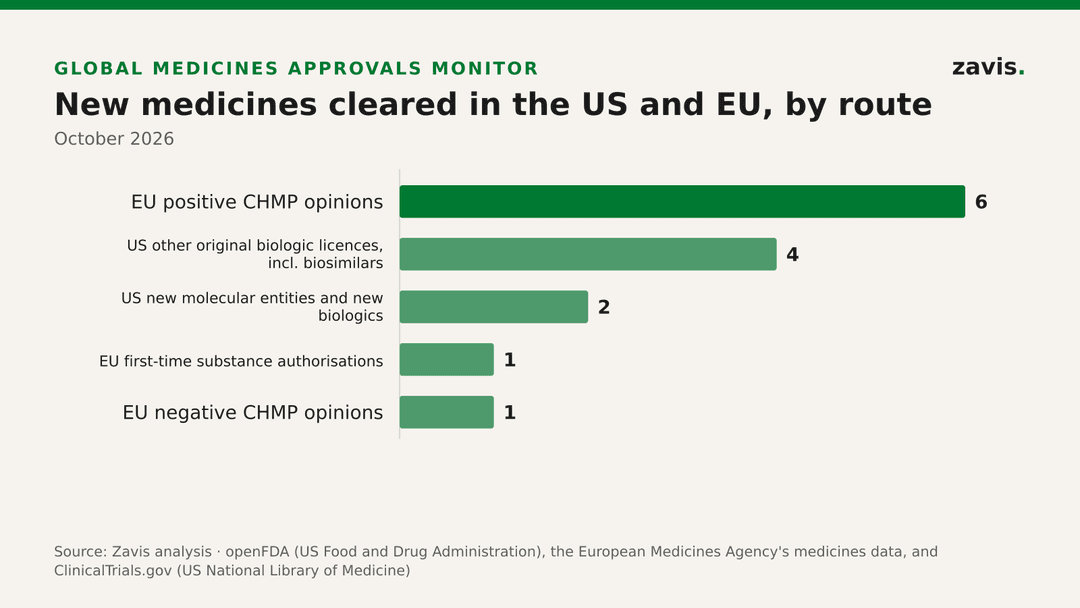
The US Food and Drug Administration approved 8 submissions for GLP-1 medicines in the 90 days to 23 November, according to Zavis analysis of the agency's public openFDA records. These include original applications and supplements, and the count has not changed since the last edition. Of the 8, 3 were efficacy supplements, which cover new or changed uses. They went to 2 medicines, both tirzepatide: Mounjaro on 27 August 2026 and Zepbound on 26 August 2026.
The period also brought 1 original generic approval: liraglutide, under application ANDA216476, on 16 November 2026. Ozempic and synthetic exenatide received labeling supplements.
In the European Union, 13 GLP-1 and related medicines are authorised through the centralised procedure, according to the European Medicines Agency's medicines data. Of these, 4 were first authorised in the last 12 months: Liraglutide STADA and Ablymico on 15 July 2026, Kayshild on 26 March 2026 and Kyinsu on 24 November 2025. One medicine, Foundayo, has an EU committee opinion awaiting a marketing authorisation decision. Its active substance is orforglipron hemicalcium. Orforglipron is also the medicine in the UAE's one active study. The register lists Lyxumia and Bydureon as withdrawn.
| Date | Medicine | Application | Approval | Category | Submissions |
|---|---|---|---|---|---|
| 16 November 2026 | Liraglutide (liraglutide) | ANDA216476 | Original generic approval | Not stated | 1 |
| 2 October 2026 | Exenatide synthetic (exenatide) | ANDA206697 | Supplement | Labeling | 3 |
| 27 August 2026 | Ozempic (semaglutide) | NDA209637 | Supplement | Labeling | 1 |
| 27 August 2026 | Mounjaro (tirzepatide) | NDA215866 | Supplement | Efficacy | 2 |
| 26 August 2026 | Zepbound (tirzepatide) | NDA217806 | Supplement | Efficacy | 1 |
The US shortage list
The US FDA drug shortage list shows 9 GLP-1 presentations as current shortages and 5 as to be discontinued. Neither count has changed since the last edition. All 9 current shortages are liraglutide injection presentations. They include Victoza, Saxenda and unbranded liraglutide. The entries marked to be discontinued include liraglutide presentations and Rybelsus semaglutide tablets.
The list describes the US market. It does not show supply in the UAE or the GCC.
| Medicine | Presentation | Status | Last updated |
|---|---|---|---|
| Liraglutide Injection | Victoza, Injection, 6 mg/1 mL (NDC 0169-4060-12) | Current | 22 September 2026 |
| Liraglutide Injection | Liraglutide, Injection, 6 mg/1 mL (NDC 0143-9144-03) | Current | 14 October 2026 |
| Liraglutide Injection | Liraglutide, Injection, 6 mg/1 mL (NDC 0480-3667-20) | Current | 22 September 2026 |
| Liraglutide Injection | Liraglutide, Injection, 6 mg/1 mL (NDC 71288-563-84) | Current | 27 August 2026 |
| Liraglutide Injection | Victoza, Injection, 6 mg/1 mL (NDC 0169-4060-13) | Current | 22 September 2026 |
| Liraglutide Injection | Liraglutide, Injection, 6 mg/1 mL (NDC 0480-3667-22) | Current | 22 September 2026 |
| Liraglutide Injection | Saxenda, Injection, 6 mg/1 mL (NDC 0169-2800-15) | Current | 22 September 2026 |
| Liraglutide Injection | Liraglutide, Injection, 6 mg/1 mL (NDC 71288-563-85) | Current | 27 August 2026 |
| Liraglutide Injection | Liraglutide, Injection, 6 mg/1 mL (NDC 0143-9144-02) | Current | 14 October 2026 |
| Liraglutide Injection | Saxenda, Injection, 6 mg/1 mL (NDC 0169-2800-15) | To Be Discontinued | 25 August 2026 |
| Liraglutide Injection | Liraglutide, Injection, 6 mg/1 mL (NDC 0480-7250-46) | To Be Discontinued | 14 May 2026 |
| Semaglutide Tablet | Rybelsus, Tablet, 7 mg (NDC 0169-4307-30) | To Be Discontinued | 4 June 2026 |
| Semaglutide Tablet | Rybelsus, Tablet, 14 mg (NDC 0169-4314-30) | To Be Discontinued | 4 June 2026 |
| Semaglutide Tablet | Rybelsus, Tablet, 3 mg (NDC 0169-4303-30) | To Be Discontinued | 4 June 2026 |
Little registered research behind five peptides
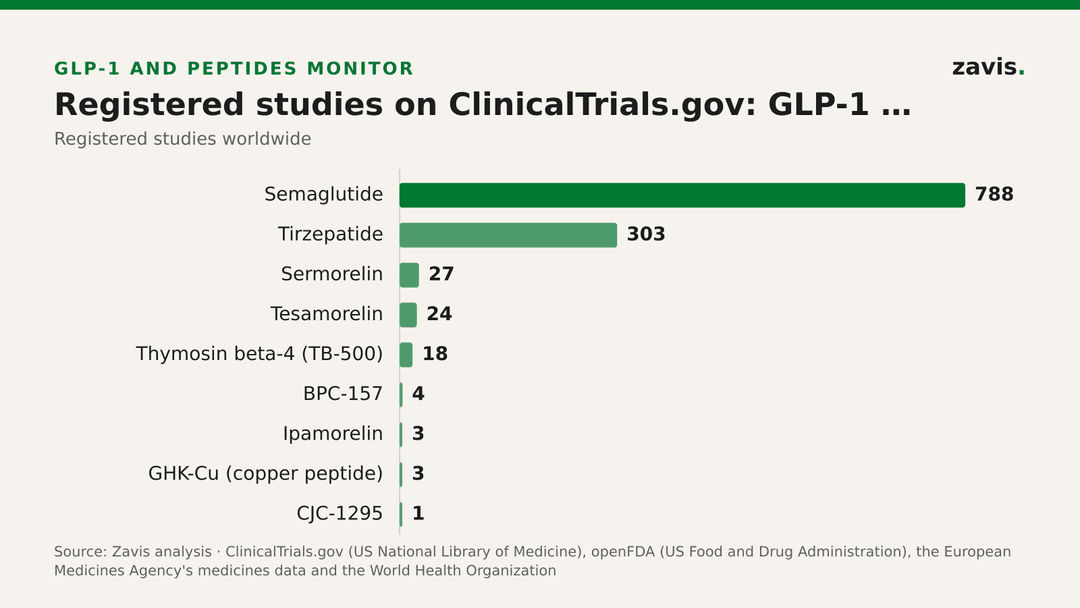
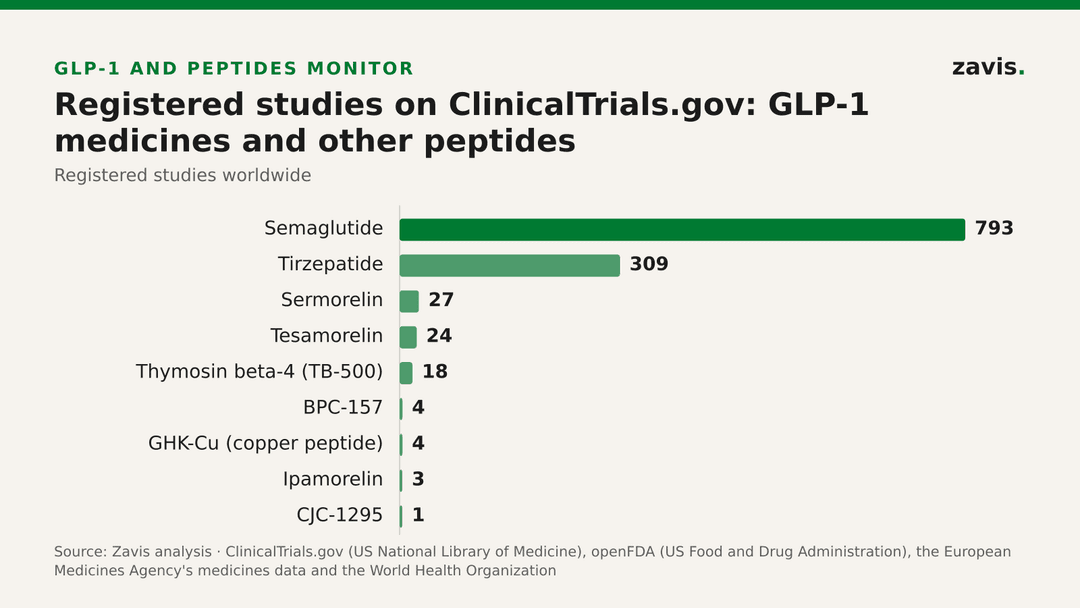
Five peptides with no US approval on record have 30 registered studies worldwide combined, up 3.4% since the last edition. They are thymosin beta-4 (TB-500), BPC-157, ipamorelin, GHK-Cu and CJC-1295. Semaglutide alone has 809 registered studies, up 2.7%, and tirzepatide has 321.
Thymosin beta-4 (TB-500) has 18 registered studies, 8 of them with results posted. BPC-157 and GHK-Cu have 4 each. Ipamorelin has 3 and CJC-1295 has 1. None of those four has results posted on the registry. By comparison, semaglutide has 112 studies with results posted. Tesamorelin and sermorelin, two peptides with a US approval on record, have 24 and 27 registered studies.
A registered study shows research activity. It is not evidence that a substance works or is safe. Counts are matched by name and can include studies where the substance is a comparator. Peptides may also appear under names other than those counted.
| Substance | Registered studies worldwide | With results posted | US approval on record (Drugs@FDA) |
|---|---|---|---|
| Semaglutide | 809 | 112 | Yes |
| Tirzepatide | 321 | 48 | Yes |
| Tesamorelin | 24 | 10 | Yes |
| Sermorelin | 27 | 11 | Yes |
| Thymosin beta-4 (TB-500) | 18 | 8 | No |
| BPC-157 | 4 | 0 | No |
| Ipamorelin | 3 | 0 | No |
| GHK-Cu (copper peptide) | 4 | 0 | No |
| CJC-1295 | 1 | 0 | No |
What it means
For operators: the UAE has 15 registered studies on record but 1 recruiting or active. Across the GCC, active studies have grown since the last edition. Sites that want to host research can track new registrations by sponsor and medicine on the public registry.
For insurers: the US approved 3 efficacy supplements in 90 days, and the EU has 4 GLP-1 and related medicines first authorised in the last 12 months. These records show changes in approved uses and products in those markets. They are worth watching as a guide to future questions about coverage.
For patients: check a study's status on ClinicalTrials.gov before asking to join it, because most UAE studies on record are not recruiting. Check whether a peptide has a US approval on record before relying on claims about it. Decisions about any medicine belong with a licensed doctor.
Sources
Zavis Data Science Desk
Data & Analytics
The Zavis Data Science Desk publishes the monthly Zavis indices at zavis.ai/intelligence/data. They are bui...