Just 1 of 19 matched new substances from US and EU regulators had a Gulf trial site
Camizestrant was the only one, with 2 registered studies at sites in the UAE. The US approved 9 new molecular entities and new biologics in September, 6 of them under priority review.
How Zavis verifies this coverage
Editorial standards, source rules, methodology, and review provenance are public.
Key findings
- 20 new substances were cleared or recommended in the US and EU in September 2026
- Of 19 matched new substances, 1 had a registered study at a GCC site: camizestrant
- The UAE had 2 registered studies of September's new substances; Saudi Arabia had 1
- The US approved 9 new molecular entities and new biologics, 6 under priority review
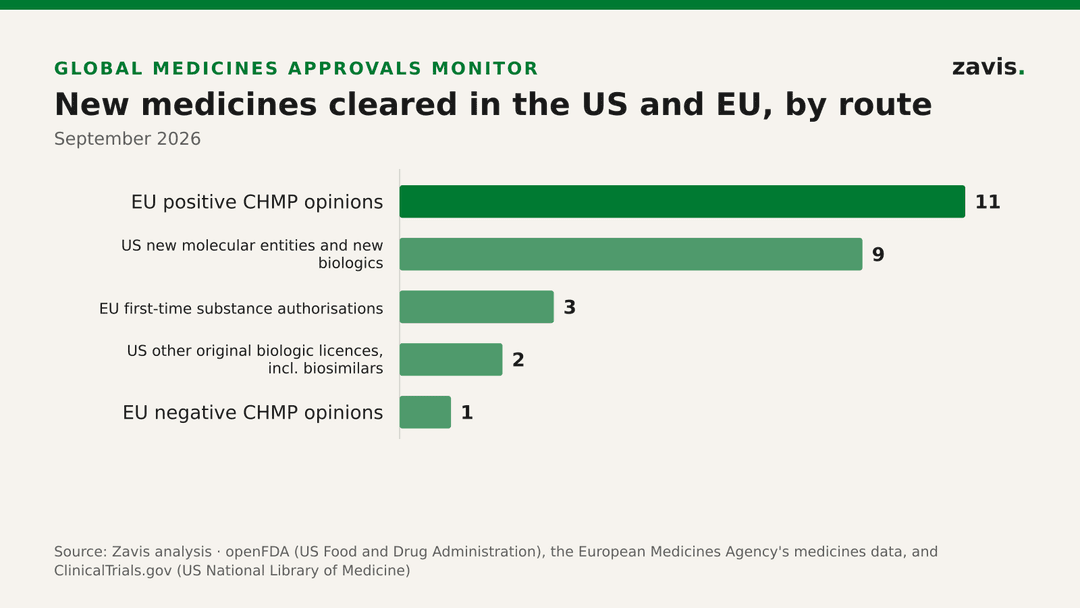
- The EU's CHMP adopted 11 positive opinions and 1 negative opinion
US and EU regulators cleared or recommended 20 new substances in September 2026, according to the Zavis Global Medicines Approvals Monitor. Of the 19 that Zavis analysis could match to the US public trials registry, just 1 had a registered study with a site in a GCC country. That substance is camizestrant, approved in the US as Etcamah. The other 18 had no registered study at a GCC site.
This matters to Gulf hospitals, insurers and patients. Almost every new medicine reaching the region this autumn will arrive with evidence gathered elsewhere. Clinicians will have little local trial experience to draw on, and payers will have no regional study data to weigh when they decide on coverage.
The count of 20 covers US new molecular entities and new biologics, EU first-time authorisations, and positive opinions from the European Medicines Agency's human medicines committee (CHMP) for substances new to EU central authorisation. One new substance could not be matched to ClinicalTrials.gov, so it was not checked for Gulf sites. Vaccines, cell therapies and blood products are not matched.
| Route | September 2026 | August 2026 |
|---|---|---|
| US new molecular entities and new biologics | 9 | 7 |
| US other original biologic licences, incl. biosimilars | 2 | 0 |
| EU first-time substance authorisations | 3 | 2 |
| EU positive CHMP opinions | 11 | 0 |
| EU negative CHMP opinions | 1 | 0 |
The one new medicine tested in the Gulf
Camizestrant had 2 registered studies with a GCC site, Zavis analysis of ClinicalTrials.gov shows. Both are Phase 3 studies, and both list a site in the United Arab Emirates. One of them, NCT05952557, also lists a site in Saudi Arabia and is marked "Active not recruiting". The other, NCT07647328, lists only the UAE and is marked "Recruiting".
The UAE therefore had 2 studies of September's new substances, and Saudi Arabia had 1. Qatar, Kuwait, Bahrain and Oman had none. Camizestrant was also the only matched new substance with a registered study at a UAE site.
| Substance | Registry ID | GCC countries | Phase | Status |
|---|---|---|---|---|
| camizestrant | NCT07647328 | United Arab Emirates | Phase 3 | Recruiting |
| camizestrant | NCT05952557 | United Arab Emirates, Saudi Arabia | Phase 3 | Active not recruiting |
The search has limits. A study registered only under a code name, or only in a registry other than ClinicalTrials.gov, would be missed. The results show which studies list a Gulf site in the US registry. They do not show every study ever run in the region.
US approvals: 9 new medicines, 6 under priority review
The US Food and Drug Administration approved 9 new molecular entities and new biologics in September, up from 7 in August, according to the Zavis analysis of openFDA records. Of these, 6 were approved under priority review. The FDA also issued 2 other original biologic licences, including biosimilars, against 0 in August. Original generic drug approvals came to 50 for the month.
Camizestrant, sponsored by AstraZeneca and approved under standard review, had the most registered studies in the US table, at 17. The condition its studies name most often is ER-Positive HER2-Negative Breast Cancer. Tavapadon (Juvmo) from AbbVie came next with 11 registered studies, mostly naming Parkinson Disease. Insulin efsitora alfa (Onswik) from Eli Lilly had 5, mostly naming Type 2 Diabetes.
Most of the rest list rare conditions in their registered studies. Zilganersen (Zanvastro) from Ionis Pharms names Alexander Disease. Apitegromab (Isembyld) from Scholar Rock names SMA. Zilurgisertib (Atebrioz) from Mirum names Fibrodysplasia Ossificans Progressiva (FOP), and tiratricol (Emcitate) names Allan-Herndon-Dudley Syndrome. Floretyrosine (Pixclara) from Telix names Glioma (Any Grade) in the Brain. Lirafugratinib (Lyrfigtu) from Elevar names FGFR2 Gene Fusion/Rearrangement. None of these had a registered study with a GCC site.
| Medicine | Sponsor | Review | Condition most named in its registered studies | Registered studies | Studies with a GCC site |
|---|---|---|---|---|---|
| Zanvastro (zilganersen) | Ionis Pharms | Priority | Alexander Disease | 2 | 0 |
| Etcamah (camizestrant) | AstraZeneca | Standard | ER-Positive HER2-Negative Breast Cancer | 17 | 2 |
| Isembyld (apitegromab) | Scholar Rock | Priority | SMA | 7 | 0 |
| Pixclara (floretyrosine) | Telix | Priority | Glioma (Any Grade) in the Brain | 2 | 0 |
| Lyrfigtu (lirafugratinib) | Elevar | Priority | FGFR2 Gene Fusion/Rearrangement | 1 | 0 |
| Onswik (insulin efsitora alfa) | Eli Lilly | Standard | Type 2 Diabetes | 5 | 0 |
| Juvmo (tavapadon) | AbbVie | Standard | Parkinson Disease | 11 | 0 |
| Atebrioz (zilurgisertib) | Mirum | Priority | Fibrodysplasia Ossificans Progressiva (FOP) | 1 | 0 |
| Emcitate (tiratricol) | Rare Thyroid | Priority | Allan-Herndon-Dudley Syndrome | 5 | 0 |
The condition most named in a medicine's registered studies is not the same as its approved indication.
EU authorisations: 3 substances cleared for the first time
The EU granted 6 central marketing authorisations for human medicines in September, Zavis analysis of the European Medicines Agency's medicines data shows. Of these, 3 were the first EU central authorisation of the substance, up from 2 in August, and 2 were generics and biosimilars.
The three first-time substances were leriglitazone (Nezglyal) from Minoryx Therapeutics, in the therapeutic area Adrenoleukodystrophy, with Orphan and Exceptional circumstances designations; icotrokinra (Icotyde) from Janssen-Cilag International, in Psoriasis; and ensitrelvir (Zokovea) from Shionogi, in COVID-19 virus infection. Ensitrelvir had 8 registered studies. None of the three had a registered study with a GCC site.
| Medicine | Holder | Therapeutic area | Designations | Registered studies | Studies with a GCC site |
|---|---|---|---|---|---|
| Nezglyal (leriglitazone) | Minoryx Therapeutics | Adrenoleukodystrophy | Orphan, Exceptional circumstances | 2 | 0 |
| Icotyde (icotrokinra) | Janssen-Cilag International | Psoriasis | None | 4 | 0 |
| Zokovea (ensitrelvir) | Shionogi | COVID-19 virus infection | None | 8 | 0 |
The EU committee's pipeline: 11 positive opinions
The CHMP adopted 11 positive opinions and 1 negative opinion in September. The committee does not meet in August, so the prior month has no opinions to compare. A positive opinion is a recommendation. It comes before the EU's authorisation decision.
Most positive opinions were for substances new to EU central authorisation. These included denecimig (Frehemgo), povorcitinib (Povofortay), senaparib (Sepalna), glepaglutide (Zeydovio), ensartinib (Gevalka), gefurulimab (Klygefa) and an inactivated rabies vaccine for human use (VaxRabeo). Relacorilant (Lifyorli) received the only positive opinion for an orphan medicine. The remaining positive opinions went to a biosimilar of omalizumab and generics of tofacitinib and ruxolitinib. The single negative opinion went to Xervyteg, a pooled allogeneic faecal microbiota product.
| Medicine | Active substance | Opinion | Type | Designations |
|---|---|---|---|---|
| Frehemgo | denecimig | Positive | Substance new to EU central authorisation | None |
| Lifyorli | relacorilant | Positive | Substance new to EU central authorisation | Orphan |
| Povofortay | povorcitinib | Positive | Substance new to EU central authorisation | None |
| Sepalna | senaparib | Positive | Substance new to EU central authorisation | None |
| Zeydovio | glepaglutide | Positive | Substance new to EU central authorisation | None |
| Gevalka | ensartinib | Positive | Substance new to EU central authorisation | None |
| Klygefa | gefurulimab | Positive | Substance new to EU central authorisation | None |
| VaxRabeo | rabies vaccine (inactivated) for human | Positive | Substance new to EU central authorisation | None |
| Adcomfo | omalizumab | Positive | Biosimilar | None |
| Inijaq | tofacitinib | Positive | Generic | None |
| Ruxolitinib Zentiva | ruxolitinib | Positive | Generic | None |
| Xervyteg | Allogeneic faecal microbiota, pooled | Negative | Substance new to EU central authorisation | None |
What it means
For hospital and clinic operators, the data shows that new medicines are rarely tested at Gulf sites. In September, the only matched new substance with a registered study at a GCC site was camizestrant. Its UAE study NCT07647328 is listed as recruiting. Research units that want to take part in late-stage studies have few opportunities among this month's approvals.
For insurers, most of these medicines will come up for formulary review with no registered study data from the region. Coverage decisions will lean on trial populations outside the Gulf.
For patients, the public trials registry is the place to check whether a study near them is open. Patients should talk to their own doctor before acting on anything they find there. Registry listings change, so check a study's current status with the trial site before travelling.
Sources
Zavis Data Science Desk
Data & Analytics
The Zavis Data Science Desk publishes the monthly Zavis indices at zavis.ai/intelligence/data. They are bui...