UAE has 15 GLP-1 studies on record but only 1 is recruiting or active now
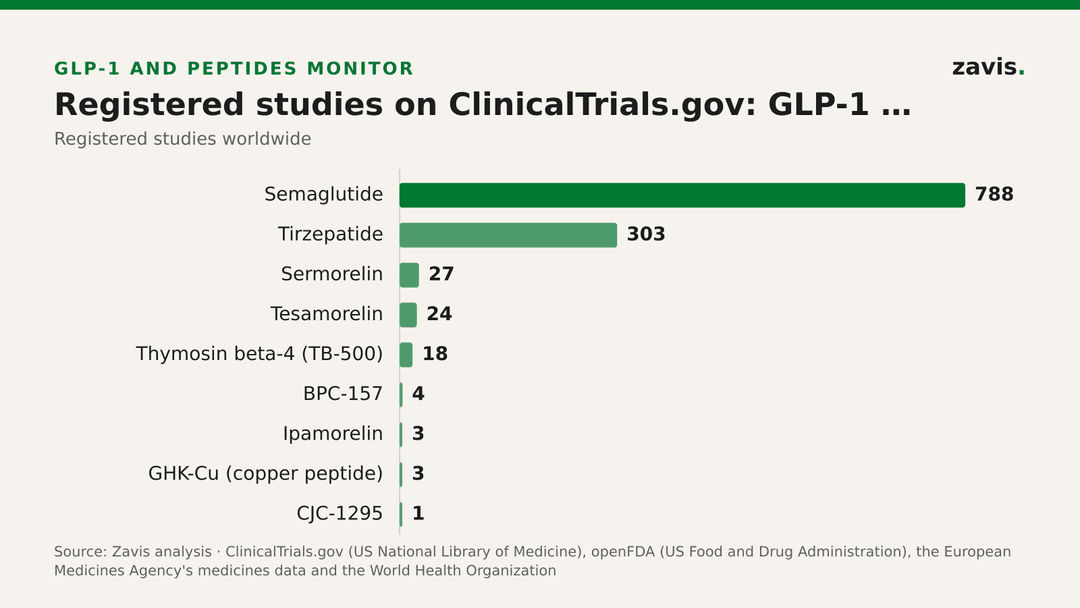
Five peptides with no US approval on record have 29 registered studies worldwide combined. Semaglutide alone has 788.
How Zavis verifies this coverage
Editorial standards, source rules, methodology, and review provenance are public.
Key findings
- UAE: 15 GLP-1 studies on record, 1 recruiting or active now
- GCC: 35 studies on record, 10 recruiting or active
- US FDA approved 8 GLP-1 submissions in 90 days, 0 original generics
- 9 liraglutide presentations listed as current US shortages
- 29 registered studies combined for five peptides with no US approval on record
Only 1 of the 15 registered studies of GLP-1 and related medicines with a site in the UAE is recruiting or active now, according to the Zavis GLP-1 and Peptides Monitor. The monitor read public study registries on 19 October 2026. Across the six GCC countries there are 35 such studies on record. Of these, 10 are recruiting or active and 7 are recruiting.
These numbers matter to hospitals and clinics that want to host research. They also matter to insurers estimating future demand for these medicines and to patients who want to know whether local studies are open. Saudi Arabia has 5 studies recruiting or active and Kuwait has 4. The UAE's single active study is a Phase 3 study of orforglipron sponsored by Eli Lilly and Company. That study also has a site in Saudi Arabia.
The Gulf study pipeline
Zavis analysis of ClinicalTrials.gov, the US National Library of Medicine's public study registry, shows 15 studies of GLP-1 and related medicines with a UAE site and 15 with a site in Saudi Arabia. Kuwait has 8 and Qatar has 2. The registry shows no such studies with a site in Bahrain or Oman.
Semaglutide accounts for the most GCC studies, with 12 on record and 2 recruiting or active. Liraglutide follows with 9 and tirzepatide with 5. Survodutide has 3 GCC studies, 2 of them recruiting or active. Both of those are Phase 3 studies sponsored by Boehringer Ingelheim with sites in Saudi Arabia. In Kuwait, Dasman Diabetes Institute is the lead sponsor of several recruiting studies, including studies of tirzepatide. In Qatar, a liraglutide study sponsored by Weill Cornell Medical College in Qatar is listed as active but not recruiting.
| Registry ID | Medicines | Lead sponsor | Phase | Status | GCC countries |
|---|---|---|---|---|---|
| NCT07613307 | orforglipron | Eli Lilly and Company | Phase 3 | Recruiting | United Arab Emirates, Saudi Arabia |
| NCT07614412 | semaglutide | Ministry of Health, Saudi Arabia | Phase 2 | Not yet recruiting | Saudi Arabia |
| NCT07574723 | tirzepatide | Dasman Diabetes Institute | Not applicable | Recruiting | Kuwait |
| NCT07096908 | tirzepatide | Dasman Diabetes Institute | Phase 4 | Recruiting | Kuwait |
| NCT06885736 | Class named, no medicine | Dasman Diabetes Institute | Not applicable | Recruiting | Kuwait |
| NCT06632444 | survodutide | Boehringer Ingelheim | Phase 3 | Recruiting | Saudi Arabia |
| NCT06632457 | survodutide | Boehringer Ingelheim | Phase 3 | Recruiting | Saudi Arabia |
| NCT06571383 | semaglutide | Novo Nordisk A/S | Phase 4 | Active not recruiting | Saudi Arabia |
| NCT06374875 | Class named, no medicine | The Cleveland Clinic | Phase 4 | Recruiting | Kuwait |
| NCT02879409 | liraglutide | Weill Cornell Medical College in Qatar | Not applicable | Active not recruiting | Qatar |
What the US and EU approved or changed
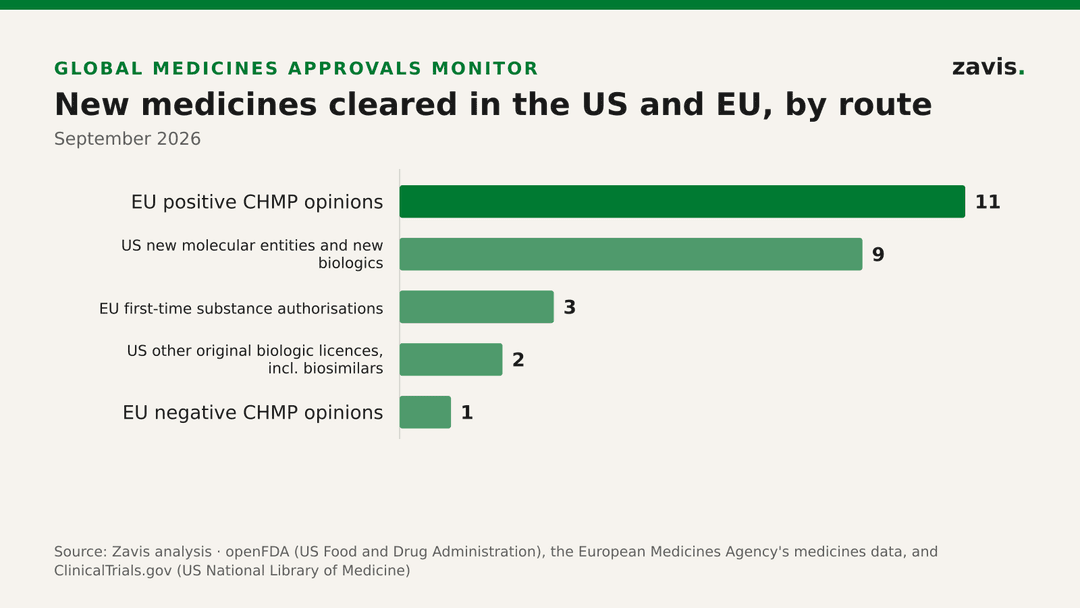
In the 90 days to 19 October, the US Food and Drug Administration approved 8 submissions for GLP-1 medicines, according to Zavis analysis of openFDA records. The count covers both original applications and supplements. Of these, 3 were efficacy supplements, which cover new or changed uses. They went to 2 medicines, Mounjaro and Zepbound, both tirzepatide, and were approved on 27 and 26 August 2026. The other approvals in the period were labelling supplements for synthetic exenatide, Ozempic and Foundayo (orforglipron). The FDA approved no original generic GLP-1 applications in the period.
| Date | Medicine | Application | Approval | Category | Submissions |
|---|---|---|---|---|---|
| 2 October 2026 | Exenatide synthetic (exenatide) | ANDA206697 | Supplement | Labeling | 3 |
| 27 August 2026 | Ozempic (semaglutide) | NDA209637 | Supplement | Labeling | 1 |
| 27 August 2026 | Mounjaro (tirzepatide) | NDA215866 | Supplement | Efficacy | 2 |
| 26 August 2026 | Zepbound (tirzepatide) | NDA217806 | Supplement | Efficacy | 1 |
| 4 August 2026 | Foundayo (orforglipron) | NDA220934 | Supplement | Labeling | 1 |
In the European Union, 13 GLP-1 and related medicines are authorised through the centralised procedure, according to the European Medicines Agency's medicines data. Of these, 4 were first authorised in the last 12 months. They are Kyinsu (insulin icodec and semaglutide) on 24 November 2025, Kayshild (semaglutide) on 26 March 2026, and Ablymico and Liraglutide STADA, both liraglutide, on 15 July 2026. One more medicine, Foundayo, has a committee opinion and is awaiting a marketing authorisation decision. Lyxumia and Bydureon are listed as withdrawn.
The FDA drug shortage list also has GLP-1 entries. It lists 9 GLP-1 presentations as current shortages, and every one is a liraglutide injection, including Victoza and Saxenda presentations. Another 5 presentations are listed as to be discontinued, including Rybelsus tablets. These entries cover the US market. They do not describe supply in the UAE or the wider GCC.
Five peptides, 29 registered studies
ClinicalTrials.gov holds 29 registered studies worldwide for five peptides with no US approval on record: thymosin beta-4 (TB-500), BPC-157, ipamorelin, GHK-Cu and CJC-1295. That count is for all five combined. Semaglutide alone has 788 registered studies, with 109 of them showing posted results. Tirzepatide has 303 registered studies, with 47 showing posted results.
Among the five, thymosin beta-4 (TB-500) has the most registered studies, 18, and 8 of them show posted results. BPC-157 has 4 registered studies, ipamorelin 3, GHK-Cu 3 and CJC-1295 1. None of these four shows any posted results. Two other peptides in the table, tesamorelin and sermorelin, have a US approval on record. They have 24 and 27 registered studies respectively.
| Substance | Registered studies worldwide | With results posted | US approval on record (Drugs@FDA) |
|---|---|---|---|
| Semaglutide | 788 | 109 | Yes |
| Tirzepatide | 303 | 47 | Yes |
| Tesamorelin | 24 | 10 | Yes |
| Sermorelin | 27 | 11 | Yes |
| Thymosin beta-4 (TB-500) | 18 | 8 | No |
| BPC-157 | 4 | 0 | No |
| Ipamorelin | 3 | 0 | No |
| GHK-Cu (copper peptide) | 3 | 0 | No |
| CJC-1295 | 1 | 0 | No |
A registered study shows that research is taking place. It is not evidence that a substance works or is safe. Counts are matched by name, and some studies may include a substance only as a comparator. Peptides can also be sold under names that differ from the registered ones, and the counts cover only the names shown.
Obesity rates for context
World Health Organization estimates for 2024 put adult obesity at 42% in Qatar, the highest of the six GCC countries. Kuwait follows at 40.4% and Saudi Arabia at 40.1%. The UAE ranks fifth of the six at 31.6%, ahead of Oman at 30.5%. The figures are age-standardised.
| Country | Adults with obesity (%) | Year |
|---|---|---|
| Qatar | 42 | 2024 |
| Kuwait | 40.4 | 2024 |
| Saudi Arabia | 40.1 | 2024 |
| Bahrain | 34.9 | 2024 |
| United Arab Emirates | 31.6 | 2024 |
| Oman | 30.5 | 2024 |
What it means
Operators: The UAE has as many GLP-1 studies on record as Saudi Arabia but far fewer open now. Hospitals that want to host research can check the public registry for studies that are recruiting at Gulf sites.
Insurers: New EU authorisations and US efficacy supplements change the formal record of approved products and uses. Benefit reviews may need to follow that record as it changes.
Patients: Before joining a study, check its registry entry for its status and its sites. Decisions about any medicine or peptide belong with a licensed doctor.
Sources
Zavis Data Science Desk
Data & Analytics
The Zavis Data Science Desk publishes the monthly Zavis indices at zavis.ai/intelligence/data. They are bui...