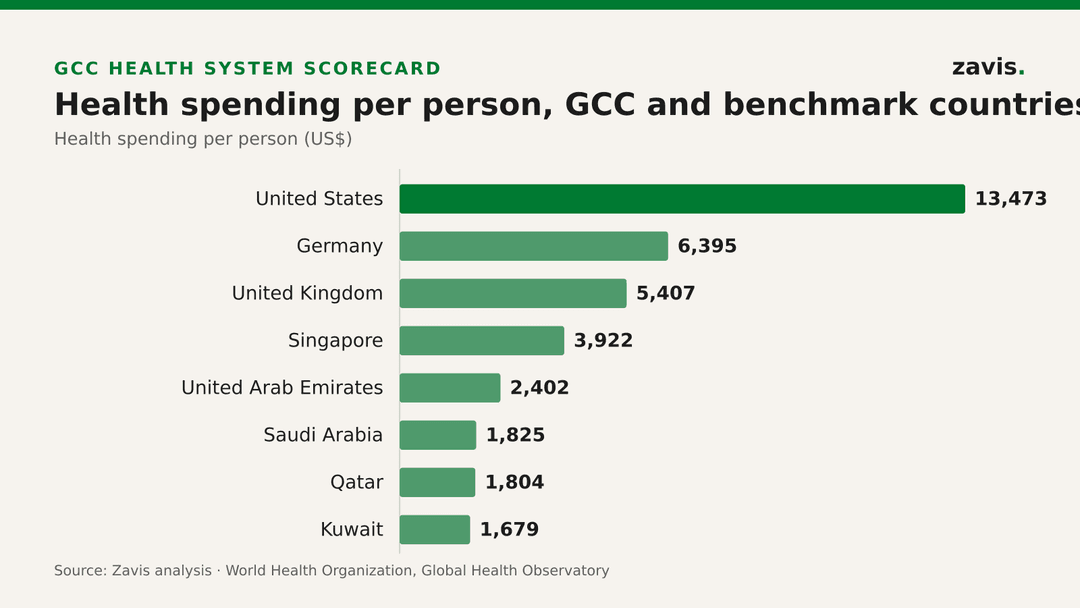
UAE health spending reaches US$2,402 per person, the highest of the six GCC states
The UAE ranks third among the six Gulf states on doctors per 10,000 people and fourth on nurses and midwives, the Zavis GCC Health System Scorecard shows.
How Zavis verifies this coverage
Editorial standards, source rules, methodology, and review provenance are public.
Key findings
- The UAE spent US$2,402 per person on health in 2023, the highest of the six GCC states.
- The UAE ranks third in the GCC on doctors, with 29.9 per 10,000 people in 2023.
- Nurses and midwives number 61.6 per 10,000 people in the UAE, fourth in the GCC.
- UAE life expectancy at birth was 82.7 years in 2023, first among GCC states.
- In 2024, 31.6% of UAE adults had obesity, fifth of six in the GCC where first is the highest rate.
The UAE spent US$2,402 per person on health in 2023, the highest of the six GCC states, according to the Zavis GCC Health System Scorecard, which tracks the latest World Health Organization figures as published on 7 November 2026. The UAE does not hold the same lead on staff. It ranks third in the Gulf on doctors per 10,000 people and fourth on nurses and midwives.
That gap matters to hospital and clinic operators planning to expand, because spending alone does not supply clinicians. It matters to insurers and investors too. The UAE pays more per person than any Gulf neighbour, yet its staffing levels sit in the middle of the group. No UAE figure in the Scorecard has changed since the last edition.
Top Gulf spender, but well below the benchmarks
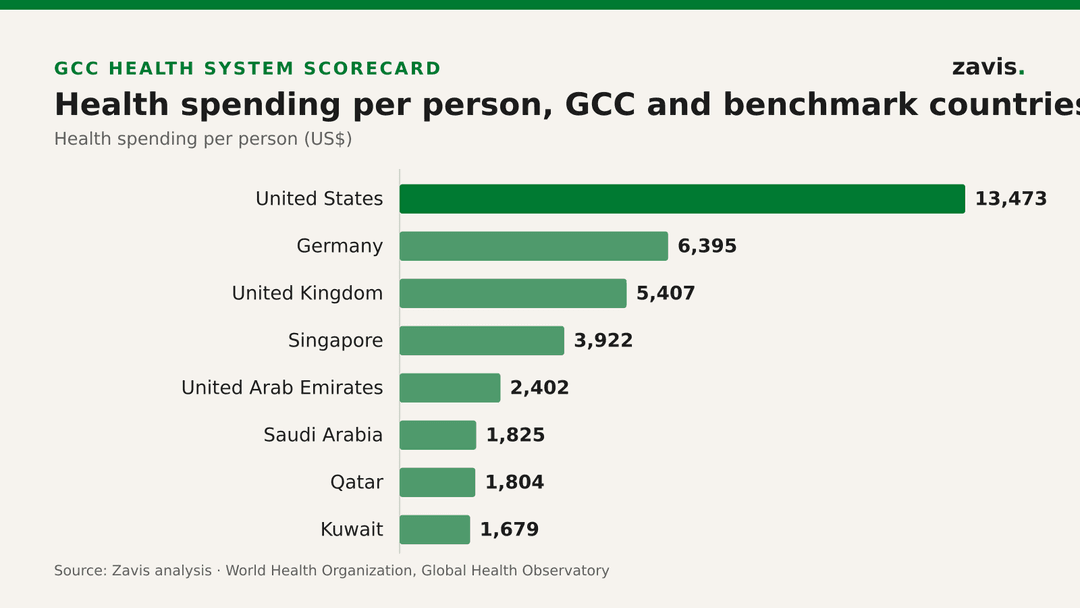
Zavis analysis of WHO data shows that current health spending in the UAE was US$2,402 per person in 2023. Saudi Arabia followed at US$1,825 and Qatar at US$1,804. Kuwait spent US$1,679, Bahrain US$1,176 and Oman US$732.
Measured as a share of the economy, the UAE spent 5% of GDP on health in 2023. That ranks second among the six GCC states, tied with Kuwait. Saudi Arabia ranks first at 5.7%. Qatar spent 2.5% of GDP.
All four benchmark countries in the Scorecard spend more per person than the UAE. The United States spent US$13,473 per person in 2023, Germany US$6,395, the United Kingdom US$5,407 and Singapore US$3,922. Singapore is the closest comparison. It spent 4.5% of GDP on health, below the UAE's 5%.
| Country | Health spending per person (US$) | Year |
|---|---|---|
| United States | 13,473 | 2023 |
| Germany | 6,395 | 2023 |
| United Kingdom | 5,407 | 2023 |
| Singapore | 3,922 | 2023 |
| United Arab Emirates | 2,402 | 2023 |
| Saudi Arabia | 1,825 | 2023 |
| Qatar | 1,804 | 2023 |
| Kuwait | 1,679 | 2023 |
| Bahrain | 1,176 | 2023 |
| Oman | 732 | 2023 |
Out-of-pocket payments made up 9.7% of current health spending in the UAE in 2023. On this measure a higher number is worse. The UAE ranks fourth of six, where first is the highest share. Bahrain has the highest out-of-pocket share in the Gulf at 28.7%, followed by Saudi Arabia at 14.1%. Oman has the lowest at 6.3%. Among the benchmarks, Singapore's share is 25.4% and the United States' is 10.9%.
Workforce and beds sit mid-table
The UAE had 29.9 medical doctors per 10,000 people in 2023, third among the GCC states. Saudi Arabia had 34.1 and Qatar 31.4 (Qatar's figure is from 2024). Kuwait's 29.7 is from 2022. Bahrain's 7.4 is from 2020, so it is the oldest figure in the comparison.
Nursing and midwifery staff numbered 61.6 per 10,000 people in the UAE in 2023, fourth in the Gulf. Qatar reported 86.1, Kuwait 67.1 and Saudi Arabia 65.6. Germany, at 124, and the United States, at 123.9, have the highest nursing density in the Scorecard.
The UAE had 18.7 hospital beds per 10,000 people in 2022, third among the six GCC states. Saudi Arabia had 24.1 and Kuwait 23.3, although Kuwait's figure dates from 2020. Germany has 75.5.
| Country | Doctors per 10,000 | Nurses and midwives per 10,000 | Hospital beds per 10,000 |
|---|---|---|---|
| Germany | 45.9 | 124 | 75.5 |
| Saudi Arabia | 34.1 | 65.6 | 24.1 |
| United Kingdom | 33.5 | 95.6 | 24.2 |
| Qatar | 31.4 | 86.1 | 12.5 |
| United Arab Emirates | 29.9 | 61.6 | 18.7 |
| Kuwait | 29.7 | 67.1 | 23.3 |
| Singapore | 26.7 | 70.9 | 28.1 |
| United States | 26.5 | 123.9 | 26.8 |
| Oman | 21.4 | 45.9 | 9.9 |
| Bahrain | 7.4 | 26.5 | 18.4 |
For operators, this points to a market where demand is funded but nurses and beds are less plentiful than in several peer systems. Recruitment and retention are likely to stay central to any expansion plan.
Best Gulf outcomes, alongside a large obesity burden
Life expectancy at birth in the UAE was 82.7 years in 2023, the highest of the six GCC states. Healthy life expectancy was 70.2 years, also first in the Gulf. Among all ten countries in the Scorecard, only Singapore scores higher on both, at 83.6 and 72.9 years. The UAE ranks above Germany, the United Kingdom and the United States on both measures.
The UAE scores 84 on the UHC service coverage index in 2023. It is tied for first among the GCC states with Qatar and Kuwait. Saudi Arabia scores 83, Bahrain 78 and Oman 73. The UAE remains below all four benchmarks. The United Kingdom, United States and Singapore each score 88, and Germany scores 87.
Obesity is the weak spot. In 2024, 31.6% of UAE adults had obesity on an age-standardised basis. For obesity, a higher number is worse. The UAE ranks fifth of six, where first is the highest rate, and only Oman, at 30.5%, is lower. Qatar has the highest rate at 42%, followed by Kuwait at 40.4% and Saudi Arabia at 40.1%. The UAE's rate is still well above Singapore's 17% and Germany's 20.6%.
| Country | Life expectancy (years) | Healthy life expectancy (years) | Adult obesity (%) |
|---|---|---|---|
| Singapore | 83.6 | 72.9 | 17 |
| United Arab Emirates | 82.7 | 70.2 | 31.6 |
| Kuwait | 82.3 | 69.5 | 40.4 |
| Bahrain | 81.3 | 68.7 | 34.9 |
| Germany | 81 | 69.1 | 20.6 |
| Qatar | 80.8 | 69.3 | 42 |
| United Kingdom | 80.7 | 68.2 | 27.4 |
| Oman | 80.2 | 68.2 | 30.5 |
| Saudi Arabia | 78.9 | 66.5 | 40.1 |
| United States | 78.5 | 64.6 | 41 |
What it means
Operators: The UAE spends more per person than any other Gulf state but has fewer nurses per head than three of its neighbours. Staffing, rather than demand, is the more likely limit on growth. Bed density is also below Saudi Arabia and Kuwait.
Insurers: An out-of-pocket share of 9.7% means most spending flows through payers rather than patients. The 31.6% adult obesity rate points to sustained demand for chronic-condition care.
Investors: The UAE leads the Gulf on spending per person, life expectancy and healthy life expectancy, and shares first place on coverage. Spending still trails every benchmark country, which suggests room to grow. WHO estimates are modelled and revised, and the latest year differs by country and indicator, so check the data years before comparing.
Patients: The UAE's coverage score of 84 leads the Gulf jointly with Qatar and Kuwait. Check what your insurance plan covers before booking care, since out-of-pocket costs still make up part of spending.
| Country | Life expectancy (years) | Healthy life expectancy (years) | Doctors per 10,000 | Nurses and midwives per 10,000 | Hospital beds per 10,000 | Health spending per person (US$) | Health spending (% of GDP) | Out-of-pocket share (%) | UHC coverage index | Adult obesity (%) |
|---|---|---|---|---|---|---|---|---|---|---|
| United Arab Emirates | 2023 | 2023 | 2023 | 2023 | 2022 | 2023 | 2023 | 2023 | 2023 | 2024 |
| Saudi Arabia | 2023 | 2023 | 2023 | 2023 | 2023 | 2023 | 2023 | 2023 | 2023 | 2024 |
| Qatar | 2023 | 2023 | 2024 | 2024 | 2022 | 2023 | 2023 | 2023 | 2023 | 2024 |
| Kuwait | 2023 | 2023 | 2022 | 2022 | 2020 | 2023 | 2023 | 2023 | 2023 | 2024 |
| Bahrain | 2023 | 2023 | 2020 | 2020 | 2022 | 2023 | 2023 | 2023 | 2023 | 2024 |
| Oman | 2023 | 2023 | 2024 | 2024 | 2023 | 2023 | 2023 | 2023 | 2023 | 2024 |
| United Kingdom | 2023 | 2023 | 2023 | 2023 | 2022 | 2023 | 2023 | 2023 | 2023 | 2024 |
| United States | 2023 | 2023 | 2022 | 2024 | 2022 | 2023 | 2023 | 2023 | 2023 | 2024 |
| Singapore | 2023 | 2023 | 2023 | 2023 | 2023 | 2023 | 2023 | 2023 | 2023 | 2024 |
| Germany | 2023 | 2023 | 2023 | 2023 | 2023 | 2023 | 2023 | 2023 | 2023 | 2024 |
Sources
Zavis Data Science Desk
Data & Analytics
The Zavis Data Science Desk publishes the monthly Zavis indices at zavis.ai/intelligence/data. They are bui...