UAE health spending reaches US$2,402 per person, the highest of the six GCC states
UAE life expectancy of 82.7 years also tops the Gulf, but the country ranks third on doctors and fourth on nurses per 10,000 people, Zavis analysis of WHO data shows.
How Zavis verifies this coverage
Editorial standards, source rules, methodology, and review provenance are public.
Key findings
- The UAE spent US$2,402 per person on health in 2023, first among the six GCC states
- UAE life expectancy was 82.7 years in 2023, first in the GCC
- The UAE had 61.6 nurses and midwives per 10,000 people in 2023, fourth in the GCC
- Out-of-pocket payments were 9.7% of UAE health spending in 2023
- 31.6% of UAE adults had obesity in 2024, fifth-highest of the six GCC states
The United Arab Emirates spent US$2,402 per person on health in 2023, the highest of the six Gulf Cooperation Council states, according to the Zavis GCC Health System Scorecard. The scorecard uses the latest figures in the World Health Organization's public Global Health Observatory. The UAE also ranks first in the GCC on life expectancy, at 82.7 years in 2023. Its workforce does not match that position. The UAE ranks third among the six states on doctors per 10,000 people and fourth on nurses and midwives.
That gap matters to clinic and hospital operators planning to grow, because hiring clinicians is the main limit on adding capacity. Insurers and investors should also note where the UAE sits against benchmark countries. Its spending per person is below the United Kingdom, Germany, Singapore and the United States, and so is its spending as a share of GDP, apart from Singapore.
The Gulf's top spender, but below global benchmarks
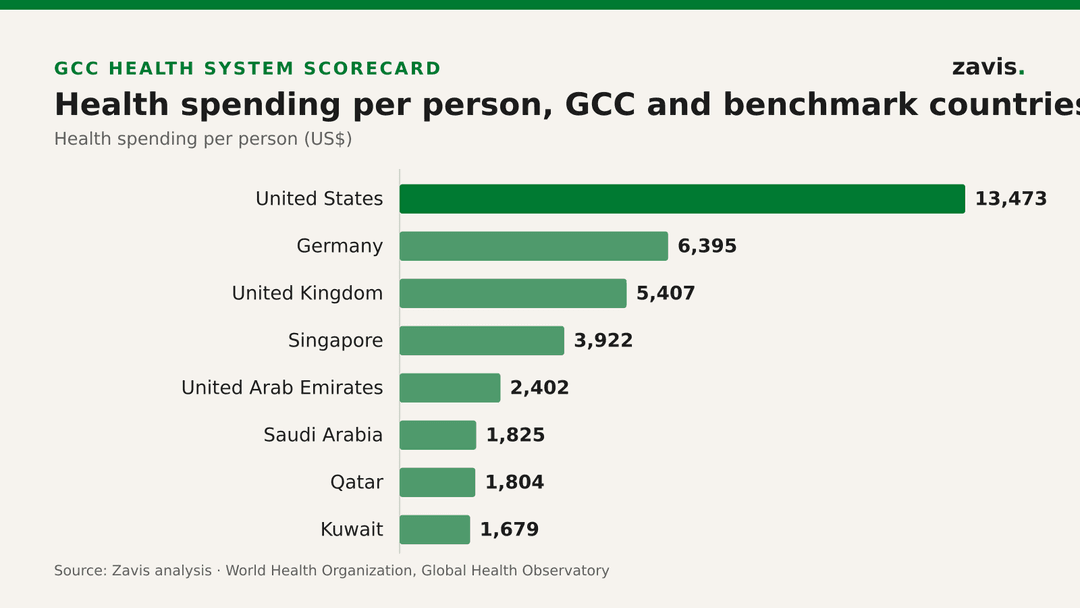
Current health spending in the UAE was US$2,402 per person in 2023, Zavis analysis shows. Saudi Arabia was at US$1,825, Qatar at US$1,804 and Kuwait at US$1,679. Bahrain spent US$1,176 and Oman US$732.
Outside the Gulf the figures are much higher. The United States spent US$13,473 per person in 2023, Germany US$6,395, the United Kingdom US$5,407 and Singapore US$3,922. The UAE is fifth in the table below, behind all four benchmark countries.
| Country | Health spending per person (US$) | Year |
|---|---|---|
| United States | 13,473 | 2023 |
| Germany | 6,395 | 2023 |
| United Kingdom | 5,407 | 2023 |
| Singapore | 3,922 | 2023 |
| United Arab Emirates | 2,402 | 2023 |
| Saudi Arabia | 1,825 | 2023 |
| Qatar | 1,804 | 2023 |
| Kuwait | 1,679 | 2023 |
| Bahrain | 1,176 | 2023 |
| Oman | 732 | 2023 |
As a share of the economy, UAE health spending was 5% of GDP in 2023. That ranks second in the GCC, tied with Kuwait, behind Saudi Arabia at 5.7%. Germany spent 11.7% of GDP, the United Kingdom 11% and the United States 16.7%. Singapore spent 4.5%.
Patients in the UAE paid 9.7% of current health spending out of pocket in 2023. The UAE ranks fourth of the six GCC states on this measure, where first is the highest share. A higher share is worse for patients. Bahrain's out-of-pocket share was 28.7% and Saudi Arabia's 14.1%. Qatar was at 7.4% and Oman at 6.3%. Among the benchmarks, Singapore's share was 25.4% and the United Kingdom's 14.6%.
Workforce sits mid-table
The UAE had 29.9 medical doctors per 10,000 people in 2023, third among the six GCC states, according to the Zavis scorecard. Saudi Arabia had 34.1 and Qatar 31.4. Kuwait had 29.7, from a 2022 figure. Bahrain's figure of 7.4 dates from 2020.
Nursing is where the UAE ranks lower. It had 61.6 nursing and midwifery personnel per 10,000 people in 2023, fourth in the GCC. Qatar had 86.1 and Kuwait 67.1. Germany had 124 and the United States 123.9.
The UAE had 18.7 hospital beds per 10,000 people in 2022, third in the GCC. Saudi Arabia had 24.1 and Kuwait 23.3, the Kuwait figure dating from 2020. Germany had 75.5.
| Country | Doctors per 10,000 | Nurses and midwives per 10,000 | Hospital beds per 10,000 |
|---|---|---|---|
| Germany | 45.9 | 124 | 75.5 |
| Saudi Arabia | 34.1 | 65.6 | 24.1 |
| United Kingdom | 33.5 | 95.6 | 24.2 |
| Qatar | 31.4 | 86.1 | 12.5 |
| United Arab Emirates | 29.9 | 61.6 | 18.7 |
| Kuwait | 29.7 | 67.1 | 23.3 |
| Singapore | 26.7 | 70.9 | 28.1 |
| United States | 26.5 | 123.9 | 26.8 |
| Oman | 21.4 | 45.9 | 9.9 |
| Bahrain | 7.4 | 26.5 | 18.4 |
The years differ by country. WHO publishes each indicator on its own schedule, so some comparisons set a 2023 UAE figure against older data from other states.
Longer lives, and lower obesity than most of the Gulf
Life expectancy at birth in the UAE was 82.7 years in 2023. That is first in the GCC and second only to Singapore, at 83.6 years, among the ten countries in the scorecard. Healthy life expectancy in the UAE was 70.2 years, also first in the GCC. Kuwait followed at 69.5 years. Saudi Arabia had 66.5 years and the United States 64.6.
On coverage, the UAE scored 84 on WHO's UHC service coverage index in 2023. It ranks first in the GCC, tied with Qatar and Kuwait. The United Kingdom, the United States and Singapore each scored 88 and Germany 87. Oman scored 73.
Obesity is the biggest long-term cost pressure in the data. In 2024, 31.6% of UAE adults had obesity on an age-standardised basis. The UAE ranks fifth of the six GCC states, where first is the highest share. Here a higher number is worse. Only Oman, at 30.5%, was lower in the Gulf. Qatar was at 42%, Kuwait at 40.4% and Saudi Arabia at 40.1%. The UAE rate is still well above Singapore at 17%, Germany at 20.6% and the United Kingdom at 27.4%.
| Country | Life expectancy (years) | Healthy life expectancy (years) | Adult obesity (%) |
|---|---|---|---|
| Singapore | 83.6 | 72.9 | 17 |
| United Arab Emirates | 82.7 | 70.2 | 31.6 |
| Kuwait | 82.3 | 69.5 | 40.4 |
| Bahrain | 81.3 | 68.7 | 34.9 |
| Germany | 81 | 69.1 | 20.6 |
| Qatar | 80.8 | 69.3 | 42 |
| United Kingdom | 80.7 | 68.2 | 27.4 |
| Oman | 80.2 | 68.2 | 30.5 |
| Saudi Arabia | 78.9 | 66.5 | 40.1 |
| United States | 78.5 | 64.6 | 41 |
What it means
For operators, the data shows a market that already spends the most per person in the Gulf but ranks third on doctors and fourth on nurses. Hiring and keeping clinical staff, nurses in particular, is likely to decide how fast new capacity can open.
For insurers, an out-of-pocket share of 9.7% means most UAE health spending already goes through pooled funding rather than direct patient payment. An adult obesity rate of 31.6% points to long-term demand for chronic care.
For patients, the UAE scores first in the GCC on life expectancy and on healthy life expectancy. Coverage on WHO's index matches the best in the Gulf, but it is below the benchmark countries.
WHO figures are modelled estimates and are revised over time. They can differ from national statistics.
| Country | Life expectancy (years) | Doctors per 10,000 | Nurses and midwives per 10,000 | Health spending per person (US$) | Health spending (% of GDP) | Out-of-pocket share (%) | UHC coverage index | Adult obesity (%) |
|---|---|---|---|---|---|---|---|---|
| United Arab Emirates | 82.7 | 29.9 | 61.6 | 2,402 | 5 | 9.7 | 84 | 31.6 |
| Saudi Arabia | 78.9 | 34.1 | 65.6 | 1,825 | 5.7 | 14.1 | 83 | 40.1 |
| Qatar | 80.8 | 31.4 | 86.1 | 1,804 | 2.5 | 7.4 | 84 | 42 |
| Kuwait | 82.3 | 29.7 | 67.1 | 1,679 | 5 | 10 | 84 | 40.4 |
| Bahrain | 81.3 | 7.4 | 26.5 | 1,176 | 4 | 28.7 | 78 | 34.9 |
| Oman | 80.2 | 21.4 | 45.9 | 732 | 3.5 | 6.3 | 73 | 30.5 |
Sources
Zavis Data Science Desk
Data & Analytics
The Zavis Data Science Desk publishes the monthly Zavis indices at zavis.ai/intelligence/data. They are bui...