
What should you know about eyelash milia?
Short answer
Eyelash milia are tiny, firm, pearly-white cysts near the lash line that are usually harmless but should not be squeezed or picked.
This answers one question. It is not a diagnosis and does not replace an assessment by a licensed doctor.
At a glance
- Typical look
- Firm white or skin-coloured bump
- Common symptom
- Often no pain or inflammation
- Avoid
- Squeezing or self-piercing
What eyelash milia can mean
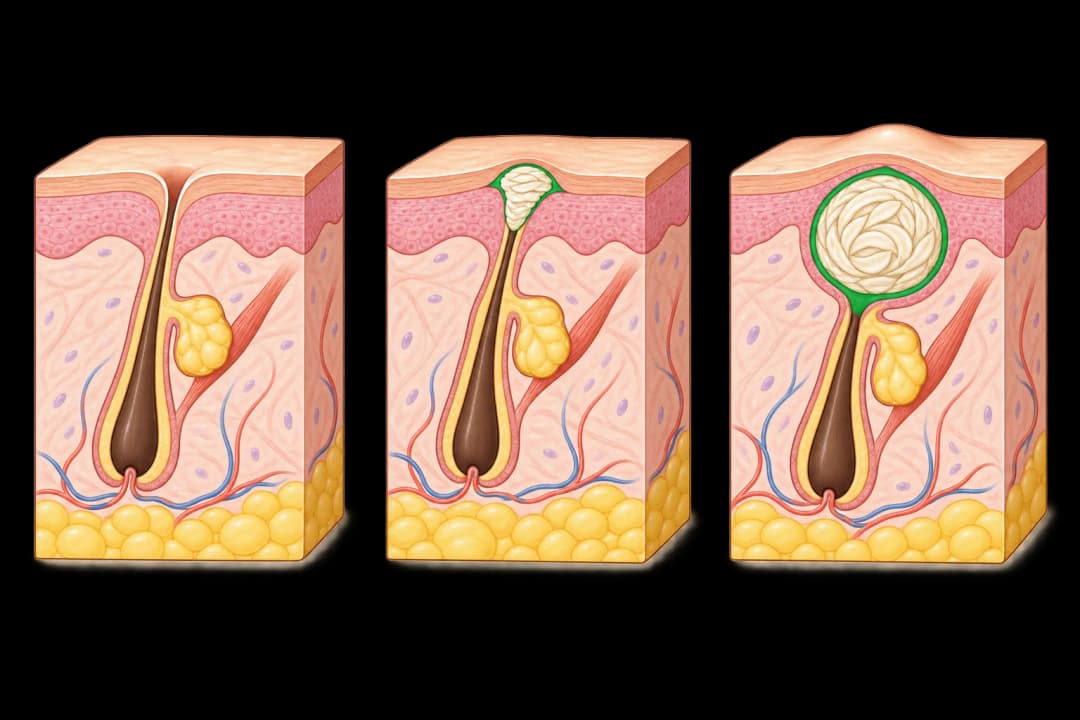
Milia form when keratin, a protein in the outer skin, becomes trapped in a small pocket beneath the surface. Around the eyelash area they may appear as isolated white or skin-coloured bumps and generally do not behave like inflamed spots. They are different from a stye, which is often tender and swollen, and from a whitehead that can have a more open pore.
A clinician can inspect the bump with magnification if its appearance is unusual, if several lesions develop, or if the diagnosis is uncertain. A bump that changes, bleeds, becomes painful, or affects the eye itself deserves assessment rather than home treatment.
What you can do
Keep the eyelid clean with a gentle cleanser and avoid rubbing the lashes. Do not pierce the bump with a needle, use household acids, or pull it out with tweezers; the thin eyelid skin can be injured and the eye can be contaminated. Some milia settle without intervention, while persistent lesions can be opened and removed by a trained clinician.
If treatment is appropriate, options may include carefully selected topical retinoids or a procedure such as curettage and cautery. These choices need extra care close to the eye, so follow the prescriber’s instructions and keep products away from the eye surface.
When to seek care
Arrange a dermatology or eye assessment when the bump is new and uncertain, persists despite gentle care, or repeatedly returns. Seek prompt medical attention for marked eyelid swelling, significant pain, pus, vision changes, light sensitivity, or redness of the eye, because those features may point to a problem other than simple milia.
Questions for your doctor
Ask whether the bump is milia or a stye, whether observation is reasonable, and which removal method is safest beside the lashes. You can also ask how to protect the eye during treatment and what signs should prompt a follow-up visit.
Find care
General Clinics & Polyclinics in Abu Dhabi
That answer is general. If you want it applied to your own case, these are licensed general clinics & polyclinics listed in Abu Dhabi.
27 Ar Ruwwad St - Shakhbout City - MSH4 - Abu Dhabi - United Arab Emirates
Accepts: Daman, Thiqa, Cigna, MetLife +20 more
Al Ruwais, Al Dhafrah
Accepts: Daman, Thiqa, AXA, Cigna +16 more
Al Bahyah - Al Bahyah Old - Abu Dhabi - United Arab Emirates
Accepts: Daman, Thiqa, Cigna, Allianz Care +18 more
Abu Dhabi
Accepts: Daman, Thiqa, AXA, Cigna +27 more
Ordered by verification status and how complete each clinic's public record is, then alphabetically. This is a directory listing, not a ranking — Zavis does not rate or recommend providers.
A factual listing drawn from the DHA, DOH and MOHAP licence registers. It is not a referral, an endorsement, or advice that any of these providers is right for you.
Questions people ask
Can eyelash milia go away on their own?
Some do settle over time, but a persistent lesion can be assessed and removed safely by a clinician.
Can I pop milia near my eyelashes?
No. Popping or piercing can injure delicate eyelid skin and introduce infection near the eye.
Related
Related reading
Keep reading
Medical disclaimer. This page is general health information, not medical advice, and it cannot diagnose you. Always consult a licensed healthcare provider about your own symptoms and treatment. In an emergency in the UAE, call 998 for an ambulance.