

Uganda Ebola all-clear leaves UAE focus on Congo’s 5,600 cases
WHO says Uganda’s Ebola outbreak is over. UAE clinics, insurers and travellers still face Congo-linked screening and response risk.
How Zavis verifies this coverage
Editorial standards, source rules, methodology, and review provenance are public.
World Health Organization (WHO) said Uganda’s Bundibugyo Ebola outbreak is over, while the Democratic Republic of the Congo has reported more than 5,600 cases and 2,700 deaths, according to Dubai Eye 103.8 and Reuters on 26 August 2026.
The highest-stakes readers are COOs, medical directors and insurers. Dubai clinics need travel-history triage at first contact. Abu Dhabi providers need escalation routes under the Department of Health Abu Dhabi (DOH). Northern emirates providers need to follow Ministry of Health and Prevention (MOHAP) and Emirates Health Services pathways for suspected viral haemorrhagic fever.
What changed on 26 August
Uganda’s all-clear follows its 28 July 2026 declaration that the country was free of Ebola after 20 cases and two deaths. WHO kept monitoring Uganda until this week to check that no transmission chain had been missed.
Congo is moving in the opposite direction. WHO’s 14 August 2026 disease outbreak news reported 4,665 confirmed cases and 2,184 deaths in Congo as of 12 August 2026, a crude case fatality ratio of 46.8%. Dubai Eye cited Congolese government figures of more than 5,600 cases and more than 2,700 deaths by 25 August 2026.
“Transmission remains very active.” Dr. Marie Roseline Belizaire, WHO African region director of emergency preparedness, said at a WHO regional meeting.
The strain matters for clinical planning. WHO says the outbreak is caused by Bundibugyo virus, a species of Ebola for which there is no approved vaccine or specific treatment. WHO also says the incubation period ranges from two to 21 days, and patients are infectious only after symptoms begin.
Why UAE operators should care
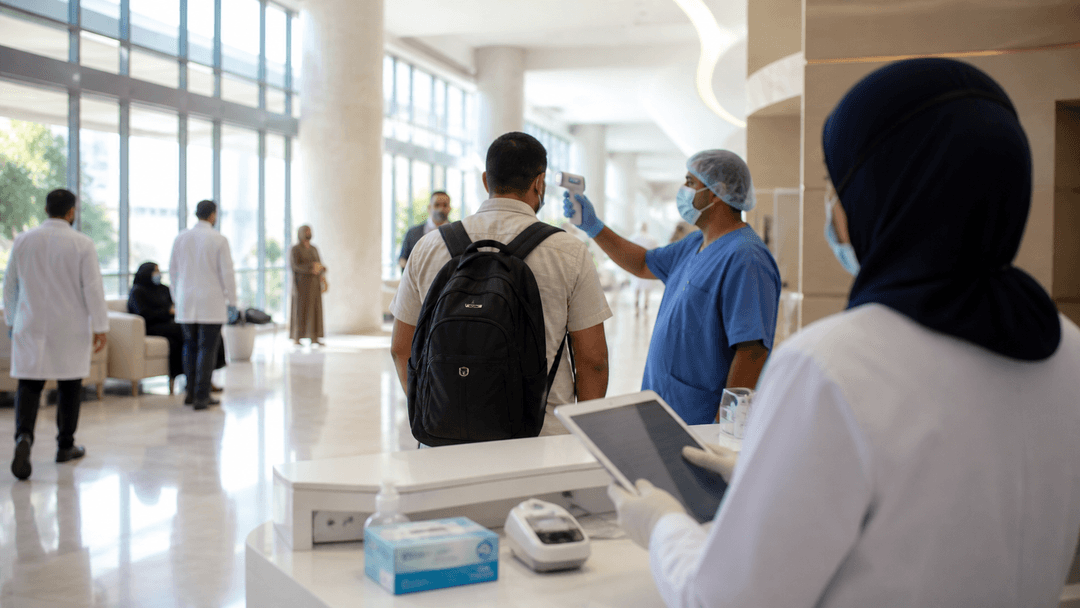
Dubai’s risk is operational rather than epidemiological. The UAE has direct global air connectivity and a large expatriate workforce, so missed travel history is the weak point. Dubai Health Authority (DHA)-licensed clinics should make Congo, Uganda and South Sudan travel questions visible in call-centre scripts, reception triage and emergency department intake forms.
UAE authorities introduced extra entry measures for travellers who had recently been in the Democratic Republic of the Congo, Uganda or South Sudan from 6 June 2026 at 1:00pm UAE time, according to an immigration update citing NCEMA and the Federal Authority for Identity, Citizenship, Customs and Port Security. Travellers who had remained outside those countries for more than 21 consecutive days before UAE arrival were exempt from those measures, subject to other entry rules.
- Clinics: flag fever, fatigue, muscle pain, headache, sore throat, vomiting or diarrhoea after relevant travel within 21 days.
- Insurers: check member support scripts for Daman, Thiqa and Sukoon networks before travellers are directed to routine outpatient clinics.
- Employers: verify travel history before booking staff return to the UAE from Congo, Uganda or South Sudan.
- Patients: call ahead before attending a clinic if symptoms follow travel to an affected area.
For payers, the P&L exposure is a low-frequency, high-cost workflow problem. Public guidance does not publish a standard AED tariff for Ebola assessment in UAE private facilities. Finance teams should use their insurer’s emergency benefit schedule, network contract and pre-authorisation rules rather than a clinic price list. Suspected Ebola should be treated as an emergency pathway issue, not a shopping decision.
What to implement now
Medical directors should review suspected viral haemorrhagic fever protocols against WHO guidance and local regulator instructions. DHA applies in Dubai. DOH applies in Abu Dhabi and Al Ain. MOHAP applies in the northern emirates, with Emirates Health Services operating federal public facilities.
The practical test is simple. A febrile patient with relevant travel in the previous 21 days should not sit in a general waiting area while staff search for a policy. Front-desk teams need a script, nurses need isolation steps, physicians need a regulator escalation route and insurers need a same-day authorisation contact for emergency care.
Uganda’s status reduces one near-term source of imported cases. Congo’s case curve keeps the UAE alert relevant. Operators should monitor DHA, DOH, MOHAP, WHO and UAE travel notices before changing triage rules.
Patients and care teams can use the UAE Open Healthcare Directory to find licensed emergency care providers regulated by DHA, DOH or MOHAP.
Zavis Intelligence
Healthcare Industry Desk
Contributing to UAE healthcare industry coverage
Related coverage


FAQ
What is happening in UAE healthcare industry?
WHO says Uganda’s Ebola outbreak is over. UAE clinics, insurers and travellers still face Congo-linked screening and response risk.