
Congo Ebola deaths pass 2,600; UAE emergency desks need 21-day travel screen
Congo's Ebola outbreak is moving faster across six provinces. UAE clinics, insurers and patients need tighter travel screening and escalation rules.
How Zavis verifies this coverage
Editorial standards, source rules, methodology, and review provenance are public.
Congo's Ebola outbreak has passed 5,514 confirmed cases and 2,642 deaths, a signal for UAE emergency departments, insurers and patients to tighten 21-day travel-history screening rather than treat the event as distant news.
The highest-stakes readers are COOs running emergency and urgent-care intake, medical directors responsible for infection control, and finance heads at insurers handling coverage and authorisation risk. In Dubai, the relevant regulator is the Dubai Health Authority (DHA). In Abu Dhabi and Al Ain, it is the Department of Health Abu Dhabi (DOH). In Sharjah, Ajman, Ras Al Khaimah, Fujairah and Umm Al Quwain, it is the Ministry of Health and Prevention (MOHAP).
What changed in Congo
Gulf Today reported on 24 August 2026 that about 2,500 people had died since the outbreak began in May, citing a faster and wider spread in the Democratic Republic of the Congo. Associated Press later cited Congolese Ministry of Health data showing 317 deaths in the previous seven days and 5,514 cases as of 22 August 2026.
The World Health Organization said on 14 August 2026 that the Bundibugyo virus disease outbreak had reached 54 health zones across six provinces: Ituri, North Kivu, South Kivu, Haut-Uele, Tshopo and Bas-Uele. WHO reported 4,665 confirmed DRC cases and 2,184 deaths as of 12 August 2026, a crude fatality ratio of 46.8%.
“Spreading faster and wider.”
Julien Harneis, UN Senior Ebola Coordinator, cited by Al Jazeera on 21 August 2026
For UAE operators, the clinical fact that matters is the incubation window. WHO says Bundibugyo virus disease has an incubation period of two to 21 days, and patients are infectious after symptoms begin. Early symptoms can look like fever, fatigue, muscle pain, headache and sore throat, which means triage desks need travel history before routine febrile-patient routing.
Dubai clinics should treat this as an intake problem
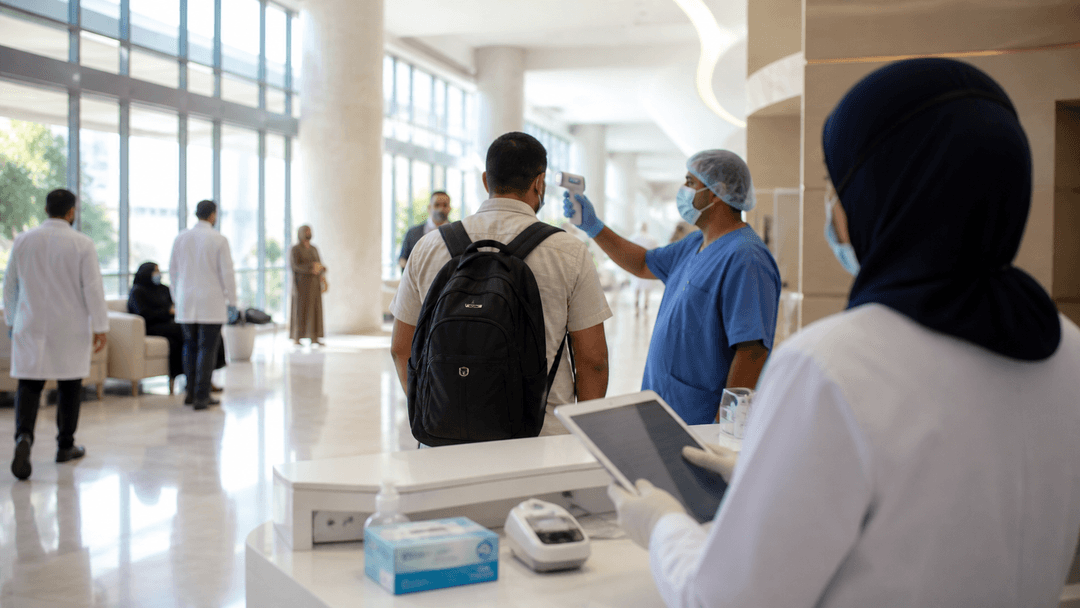
A Dubai clinic or emergency department does not need a Congo case to change workflow. It needs a clear first-contact question: travel to or transit through an affected area in the past 21 days, plus fever or compatible symptoms. DHA has issued Ebola-related circular material and maintains communicable-disease notification rules for Dubai providers. Operators should check the latest DHA circulars and internal infection-control policy before changing patient pathways.
The same logic applies in Abu Dhabi and Al Ain under DOH, and in the northern emirates under MOHAP. The federal UAE portal says private medical facilities in Dubai notify DHA about infectious diseases, while Abu Dhabi facilities notify DOH and northern-emirate facilities follow MOHAP channels. A front-desk script has little value unless it names the notification owner, the isolation room and the escalation contact for out-of-hours cases.
- COO action: audit triage forms this week for a 21-day Ebola travel-history field.
- Medical director action: verify PPE, isolation and ambulance transfer steps against DHA, DOH or MOHAP guidance.
- CFO action: confirm how emergency isolation, laboratory referral and ambulance transfer are billed under network tariffs.
- CIO action: add an EHR alert for fever plus recent travel to DRC, Uganda or another listed risk area.
Insurers such as Daman, Thiqa and Sukoon should avoid generic Ebola cost assumptions. The practical number is plan-specific. Claims teams should check the member handbook, network tariff schedule and pre-authorisation rules for emergency presentation, ambulance transfer, isolation-bed billing and overseas travel cover. Patients should call the insurer before non-urgent care, but should use emergency care immediately for fever after relevant travel.
What patients and insurers should watch next
MOHAP said on 10 July 2026 that there were no Ebola cases in the UAE and advised people who feel unwell after travel to seek medical advice promptly and disclose recent travel history. That guidance is operationally useful for reception teams: the patient may arrive at a clinic, a hotel doctor, an urgent-care centre or an emergency department before calling an ambulance.
WHO says the global risk is low, while the DRC risk is very high and Uganda risk is high because of cross-border movement. That distinction matters for UAE finance teams. A low global risk does not remove the cost of preparedness, staff training, triage scripting and possible isolation events. It argues for targeted screening rather than blanket disruption.
The next check is the WHO update cycle and UAE regulator circulars. Dubai providers should monitor DHA circulars first. Abu Dhabi and Al Ain providers should monitor DOH. Northern-emirate providers should monitor MOHAP and Emirates Health Services pathways. Patients and insurers looking for licensed emergency care providers can use the UAE Open Healthcare Directory, which lists licensed providers across all seven emirates.
Zavis Intelligence
Healthcare Industry Desk
Contributing to UAE healthcare industry coverage
Related coverage



FAQ
What is happening in UAE healthcare industry?
Congo's Ebola outbreak is moving faster across six provinces. UAE clinics, insurers and patients need tighter travel screening and escalation rules.