

Congo Ebola deaths reach 317 in 7 days, raising UAE emergency screening risk
Congo reported 317 Ebola deaths in one week. UAE providers should review triage, isolation, reporting and payer workflows.
How Zavis verifies this coverage
Editorial standards, source rules, methodology, and review provenance are public.
Democratic Republic of the Congo reported 317 Ebola deaths in the seven days to 22 August 2026, a rise that should push UAE emergency departments, urgent-care operators and insurers to recheck travel screening and high-risk infection workflows.
The immediate operating risk for Dubai providers is small but specific. The World Health Organization (WHO) assessed global risk as low on 14 August 2026, while UAE Ministry of Health and Prevention (MOHAP) guidance published on 10 July 2026 said the UAE had no confirmed Ebola cases. The affected reader is the COO first, then the medical director and the insurer claims head.
What happened in Congo
Associated Press, citing Congo Ministry of Health data, reported that the outbreak had reached 5,514 cases and 2,642 deaths as of 22 August 2026. The reported case fatality rate was 47.9%, with North Kivu recording 68.6% in hard-to-reach areas. The article is available through AP News.
WHO said in its 14 August disease outbreak notice that Bundibugyo virus disease had caused 4,686 confirmed cases and 2,186 deaths across Congo, Uganda and one imported case in France by 12 August 2026. Congo accounted for 4,665 cases. WHO said the outbreak had already passed the 3,317 cases recorded in Congo's 2018-2020 outbreak.
The strain matters for clinical governance. WHO says approved Ebola vaccines and treatments apply to disease caused by Zaire ebolavirus, while no approved vaccine or specific treatment exists for Bundibugyo virus disease. Congo received more than 16,000 Ervebo doses for frontline workers and trials, according to AP, but WHO has said protection against Bundibugyo is still being tested.
What UAE providers should check now
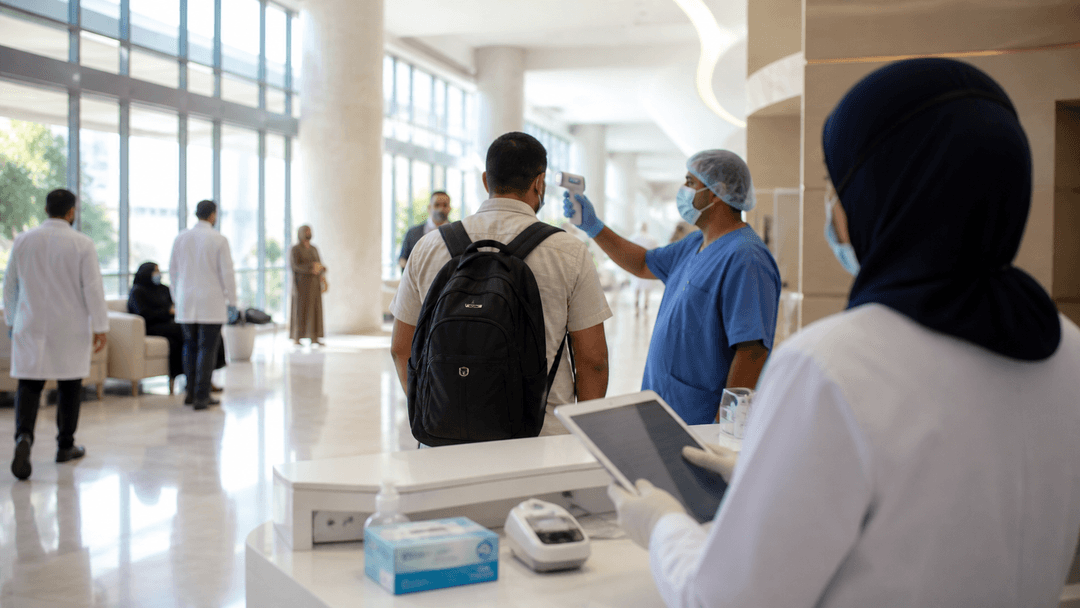
Dubai operators should treat this as a front-door readiness issue under Dubai Health Authority (DHA) licensing and infection-control expectations. A patient with fever, vomiting, diarrhoea, unexplained bleeding or severe weakness after travel to an affected area within 21 days should trigger immediate masking if tolerated, separation from waiting-room traffic, senior clinical review and notification through the facility's communicable-disease pathway.
- Dubai: confirm the named DHA reporting contact, after-hours escalation number and nearest suitable isolation room.
- Abu Dhabi and Al Ain: report suspected ebolavirus disease to Department of Health Abu Dhabi (DOH) and the Abu Dhabi Public Health Centre through the Public Health Platform, as set out in DOH Ebola circular material issued in May 2026.
- Northern Emirates: align suspected-case reporting with MOHAP and Emirates Health Services pathways.
- All emirates: refresh PPE donning and doffing drills for emergency, laboratory, housekeeping and ambulance handover staff within 30 days.
MOHAP and the National Emergency, Crisis and Disaster Management Authority (NCEMA) said on 19 May 2026 that UAE surveillance and response systems were under continuous review. That statement, carried by Emirates News Agency, is useful for boards because it names the national coordination channel.
The payer and patient implications
For insurers, the practical question is whether suspected high-consequence infectious disease care is routed as emergency care, public-health response, inpatient admission or transfer. Daman and Thiqa are central to Abu Dhabi coverage, while Sukoon is a major private insurer in the UAE. Each network should publish a claims handling note for suspected Ebola evaluation before the first UAE case appears.
Providers should avoid quoting a routine urgent-care price for a suspected Ebola presentation. The cost depends on isolation level, laboratory pathway, ambulance transfer, payer network status and whether public-health authorities direct the case to a specific facility. Finance teams should verify current emergency tariffs in the relevant claims systems, including DHA eClaimLink in Dubai and DOH Shafafiya in Abu Dhabi, then brief call-centre and billing staff using the same written script.
Patients need one instruction: call before arrival if symptoms follow recent travel to an affected area. Walk-in arrival still happens, so reception teams need a two-question screen on travel in the past 21 days and direct contact with a person with suspected or confirmed Ebola.
The next UAE signal to watch is any updated travel, surveillance or facility circular from DHA, DOH or MOHAP. Operators reviewing emergency coverage can use the UAE Open Healthcare Directory to find licensed emergency and urgent-care providers by emirate, regulator and insurance network.
Zavis Intelligence
Healthcare Industry Desk
Contributing to UAE healthcare industry coverage
Related coverage



FAQ
What is happening in UAE healthcare industry?
Congo reported 317 Ebola deaths in one week. UAE providers should review triage, isolation, reporting and payer workflows.