

Congo gets 70,000 Ebola vaccine doses as UAE clinics revisit 21-day triage checks
Congo’s Ebola surge changes risk checks for UAE emergency teams, insurers and travellers. Here is what operators should review now.
How Zavis verifies this coverage
Editorial standards, source rules, methodology, and review provenance are public.
Congo will receive 70,000 doses of Merck’s Ervebo Ebola vaccine as authorities respond to a Bundibugyo outbreak that the Emirates 24|7 report said is fast-spreading, a signal for UAE emergency departments to refresh travel triage for patients with fever after recent Africa travel.
The highest-stakes readers are COOs, medical directors and insurer operations teams. For Dubai providers, the operational question sits with the Dubai Health Authority (DHA): can front-desk, emergency and urgent-care staff identify a possible viral haemorrhagic fever case within minutes, isolate the patient, and notify the regulator through the required communicable disease route. In Abu Dhabi and Al Ain, the same pressure falls under the Department of Health Abu Dhabi (DOH). In Sharjah, Ajman, Ras Al Khaimah, Fujairah and Umm Al Quwain, it sits with the Ministry of Health and Prevention (MOHAP) and Emirates Health Services facilities.
What changed in Congo
The World Health Organization (WHO) said on 14 August 2026 that the Bundibugyo virus disease outbreak in the Democratic Republic of the Congo had reached 4,665 confirmed cases and 2,184 deaths, a crude case fatality ratio of 46.8%. WHO said cases had reached 54 health zones across six provinces, with Ituri accounting for 85% of confirmed cases.
The new vaccine shipment matters because Bundibugyo has no approved vaccine or specific treatment. WHO’s technical advisers have prioritised Ervebo, a vaccine licensed for Zaire ebolavirus, for a randomised clinical trial in the current outbreak. The Associated Press reported that 20,000 doses are expected for a phase 3 trial and 50,000 doses for health and frontline workers. That allocation does not create a routine vaccine pathway for UAE residents or travellers.
“The Bundibugyo virus disease outbreak in the Democratic Republic of the Congo is in a phase of intense transmission.” — World Health Organization, Disease Outbreak News, 14 August 2026
WHO says the incubation period for Bundibugyo virus disease is two to 21 days. Early symptoms can look like malaria, influenza or gastroenteritis: fever, fatigue, muscle pain, headache and sore throat. For UAE clinicians, the actionable point is the travel history, exposure history and rapid escalation route.
What UAE operators should review
MOHAP said on 10 July 2026 that the UAE public health situation remained stable and that there were no confirmed Ebola cases in the country, according to its public awareness notice. The UAE Ministry of Foreign Affairs advised UAE nationals and residents on 30 May 2026 against travel to the Democratic Republic of the Congo, Uganda and South Sudan.
Emergency and urgent-care providers should treat the Congo vaccine shipment as a preparedness trigger, rather than a patient-demand event. Dubai clinics should check the latest DHA communicable disease notification policy. Abu Dhabi providers should use DOH’s May 2026 circular on Bundibugyo ebolavirus disease, which required healthcare facilities to report suspected or confirmed cases immediately and assess epidemiological risk factors. Northern emirates providers should check MOHAP and Emirates Health Services channels for federal instructions.
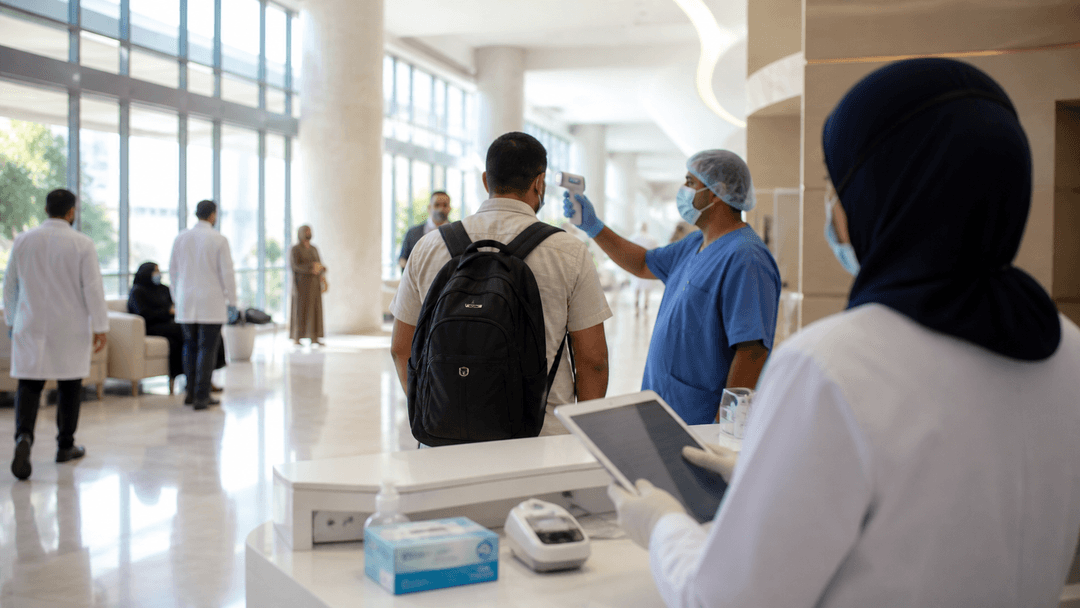
- Front desk: ask fever patients about travel to the Democratic Republic of the Congo, Uganda or South Sudan within the past 21 days.
- Emergency teams: confirm isolation room access, PPE stock, donning and doffing supervision, and waste-handling contacts before a suspected case arrives.
- Medical directors: brief clinicians that Ervebo availability in Congo does not mean proven protection against Bundibugyo in humans.
- Insurers: Daman, Thiqa and Sukoon teams should review emergency authorisation scripts for suspected high-consequence infectious disease transfers.
Cost and patient implications
There is no public UAE tariff for an Ebola assessment, and operators should not create one from general consultation prices. CFOs should pull four figures from their own contracts: emergency department triage charge, isolation-room charge, PPE cost per suspected case, and any reference-laboratory send-out cost. If a patient has insurance, the payable amount depends on the policy, network status and emergency authorisation rules.
For patients, the practical advice is narrow. Anyone with fever after recent travel to an affected area should call ahead before attending a clinic or emergency department. Walk-in presentation can expose registration staff, nurses and other patients before isolation starts. Travel clinics should direct patients to official MOHAP and MoFA notices, then document advice in the medical record.
The next marker for UAE operators is whether WHO reports sustained exportation beyond Africa or changes its travel advice. WHO currently advises against general travel or trade restrictions, while UAE MoFA has issued country-specific advice for UAE nationals and residents. Patients who need urgent care should use the UAE Open Healthcare Directory to find licensed emergency care providers by emirate and regulator.
Zavis Intelligence
Healthcare Industry Desk
Contributing to UAE healthcare industry coverage
Related coverage



FAQ
What is happening in UAE healthcare industry?
Congo’s Ebola surge changes risk checks for UAE emergency teams, insurers and travellers. Here is what operators should review now.