
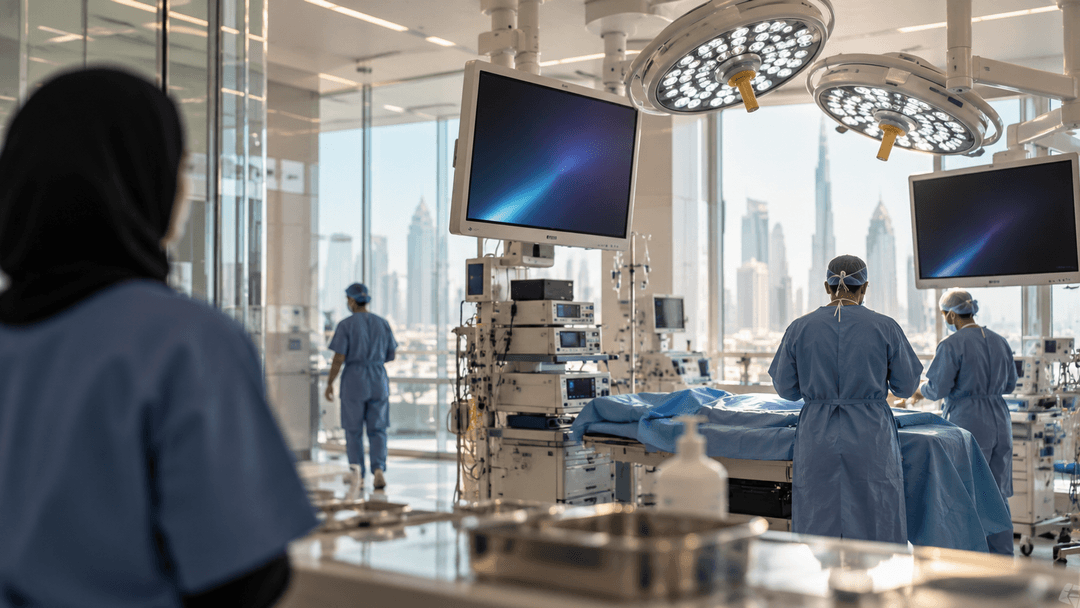
IndexBox sees surgical display demand rising to 2035 as UAE clinics weigh 4K OR upgrades
IndexBox forecasts 5.8% annual surgical display growth to 2035. UAE clinics must weigh 4K OR upgrades, payer pressure and regulator expectations.
How Zavis verifies this coverage
Editorial standards, source rules, methodology, and review provenance are public.
IndexBox expects the global surgical display market to grow at a 5.8% compound annual rate from 2026 to 2035, a signal that UAE day surgery centres and specialty clinics face a new capital cycle for minimally invasive procedures.
The practical question is narrow. Dubai clinics licensed by the Dubai Health Authority (DHA), Abu Dhabi and Al Ain operators regulated by the Department of Health Abu Dhabi (DOH Abu Dhabi), and Northern Emirates facilities licensed by the Ministry of Health and Prevention (MOHAP) must decide when consumer screens, ageing HD monitors or isolated endoscopy displays become a compliance, clinical and reimbursement risk.
What IndexBox is saying
The IndexBox report, published on 8 October 2026, says the surgical display market is being driven by minimally invasive surgery, robotic procedures, hybrid operating rooms and the move from Full HD to 4K and emerging 8K screens. Its baseline forecast puts the market index at 176 by 2035, using 2025 as 100.
IndexBox identifies hospitals as nearly half of global demand and ambulatory surgical centres as a faster-growing procedural setting. It names Barco, EIZO Corporation, Sony Corporation, LG Electronics, Stryker, Karl Storz and Olympus Corporation among market participants. The Middle East and Africa account for an estimated 7% share, with GCC demand tied to private hospital chains and technology upgrades.
For UAE clinics, the near-term buyer is likely the ophthalmology, gastroenterology, orthopaedic, dermatology, dental surgery or cosmetic surgery operator adding minimally invasive work. A typical international public price range for medical-grade surgical monitors is about $4,000 to $9,000 for many 26-inch to 55-inch models, before UAE distributor margin, installation, warranty and integration. At AED 3.67 per $1, that is roughly AED 14,700 to AED 33,000 per display, excluding mounts, signal routing, cabling and OR downtime.
The UAE compliance angle
DHA has already set a baseline for display quality. In circular CIR-2019-00000257, dated 20 May 2019, DHA told licensed health facilities that medical images must be read on high-quality medical display screens, with medically qualified LCD or OLED flat panels, at least 2 megapixels, no Twisted Nematic LCD devices for medical image viewing, and closed-loop control circuitry.
That circular was aimed at medical image reading, rather than every live surgical feed. It still matters for clinics because surgical displays increasingly connect to PACS, endoscopy towers, navigation tools and pre-operative imaging. A clinic buying an operating-room screen should ask whether it will ever be used for image review or documentation. If yes, DHA’s medical display position becomes part of the procurement file.
In Abu Dhabi, DOH Abu Dhabi’s Standard for Day Surgery/Procedure Service requires licensed facilities to satisfy day surgery licensure requirements, integrate medical record data with Malaffi, meet AAMEN information-security requirements, and routinely maintain equipment in line with manufacturer recommendations. Those clauses make the display a biomedical engineering and IT asset, rather than a simple monitor purchase.
For Northern Emirates operators, MOHAP licensing processes cover facility approval and site assessment for categories including day surgery centres and gastroenterology or endoscopy centres. Operators adding a procedure room should treat display specifications, maintenance records and user training as part of the licensing file, because MOHAP facility review is tied to the approved service scope.
What operators should budget and check
The CFO issue is reimbursement. A new 4K tower may support more minimally invasive volume, but payers will still test medical necessity, network status and pre-authorisation. Clinics dealing with Sukoon in Dubai, Daman or Thiqa in Abu Dhabi should check whether the procedure, implant, anaesthesia class and day-case setting are covered before marketing new surgical slots.
- COO: map each procedure to the facility licence, privileging file, sedation policy and transfer agreement before buying the screen.
- CFO: request quotes that separate display, mounting, OR integration, warranty years, preventive maintenance and staff training.
- CIO: confirm PACS, EHR, video-routing and cybersecurity requirements before selecting 4K, 8K or managed service models.
- Medical director: document when image quality changes clinical practice, consent, recording or liability exposure.
Patients may see the effect as shorter stays and more day-case options, but only when the facility licence, surgeon privileges, anaesthesia pathway and insurer approval line up.
For clinic operators comparing competitors or patients checking licensed providers, start with the UAE Open Healthcare Directory, which lists 12,394+ licensed healthcare providers across Dubai, Abu Dhabi, Sharjah, Ajman, Al Ain, Ras Al Khaimah, Fujairah and Umm Al Quwain.
Zavis Intelligence
Healthcare Industry Desk
Contributing to UAE healthcare industry coverage
Related coverage

FAQ
What is happening in UAE healthcare industry?
IndexBox forecasts 5.8% annual surgical display growth to 2035. UAE clinics must weigh 4K OR upgrades, payer pressure and regulator expectations.