
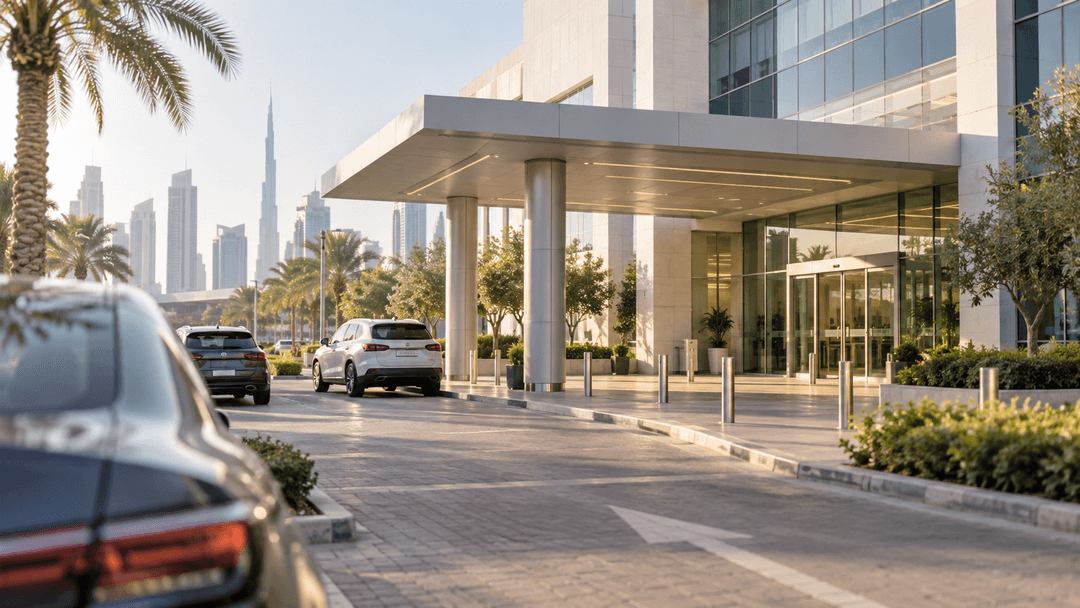
Dubai Police AED 400 accident report rule clinics should add to parking SOPs
For Dubai clinics, the rule changes the paperwork, not clinical licensing. A police report now sits before insurance repair approval.
How Zavis verifies this coverage
Editorial standards, source rules, methodology, and review provenance are public.
The practical change is simple: a parked-car hit-and-run in Dubai should be treated as a Dubai Police accident-report workflow before a clinic, patient, staff member or fleet operator starts an insurance repair claim.
For healthcare operators, the rule matters because parking disputes reach reception desks before they reach insurers. A damaged patient vehicle can become a service complaint. A damaged staff car can become an HR issue. A damaged clinic-owned vehicle can become a finance issue if the repair starts before the police report is issued. The Dubai Health Authority (DHA) regulates Dubai healthcare facilities; this reporting step sits with Dubai Police and motor insurers, so clinic licensing obligations do not change.
What changes in plain terms
The person whose vehicle was damaged needs an official accident report when the responsible driver is unknown. Dubai’s official government portal says road accidents can be reported by calling police on 999 or through the Dubai Police app, and lists an Unknown Accident Report as a related online service. Gulf News reported on 21 July 2026 that the Ministry of Interior’s digital channels allow motorists to file an official report for damage caused by an unidentified driver and use that report with insurers.
The cost to budget for is the report fee, plus any policy excess. The National’s updated UAE accident guide lists Dh400 for an accident report against an unknown person through the Ministry of Interior service, and Dh335 for Sharjah unknown-party damage reporting through Rafid. Dubai app fees should be checked inside the service before payment because service charges can vary by channel.
- Immediate step: photograph the vehicle, location, plate number and visible damage before the car is moved.
- Dubai channel: use the Dubai Police app, DubaiNow where available, or call 999 if there is injury, obstruction or dispute.
- Insurance step: send the police report, registration card and damage photos to the motor insurer before repair authorisation.
- Clinic step: log the incident internally if it occurred in clinic-controlled parking or during valet handling.
Why clinics should care
The rule does not create a new DHA compliance filing. It creates a front-desk and facilities-management control. A Dubai clinic with valet parking, basement bays or shared tower parking should have a written incident script for reception, security and operations staff. The script should say who takes photos, who checks CCTV availability, who gives the patient the Dubai Police reporting route, and who avoids admitting liability before the insurer reviews the claim.
The financial exposure is usually small, but it is frequent enough to need a process. For a clinic-owned vehicle, finance teams should expect three cost lines: the police or accident-report fee, the insurance excess stated in the motor policy, and any non-covered repair item. For a patient vehicle, the clinic should avoid promising reimbursement unless management has reviewed CCTV, valet records and the parking contract.
Medical directors and COOs should separate this from patient-safety incident reporting. A scratched parked car is a facilities incident. A collision that injures a patient, staff member or visitor becomes a safety and emergency-response matter first. In that case, the clinic should call 999, preserve CCTV, record witness names and follow its internal incident policy.
Dubai first, then the other emirates
Dubai operators should build their SOP around Dubai Police and DubaiNow. In Abu Dhabi and Al Ain, the relevant healthcare regulator is the Department of Health Abu Dhabi (DOH), while accident reporting commonly runs through Abu Dhabi Police or related traffic services. In Sharjah, Rafid is a named accident-reporting route, with the unknown-party damage fee reported at Dh335. In the northern emirates, healthcare licensing sits with the Ministry of Health and Prevention (MOHAP), while motorists can use Ministry of Interior digital channels for eligible traffic reports.
The implementation point for clinic operators is a one-page parking incident SOP. It should cover clinic-owned cars, staff cars, patient cars and valet situations. It should also state that insurance repair approval requires the official traffic report, rather than a reception note or security email.
Patients looking for licensed care after a road or parking-related injury should use the UAE Open Healthcare Directory to find DHA-, DOH- and MOHAP-licensed clinics and providers across the seven emirates.
Zavis Intelligence
Healthcare Industry Desk
Contributing to UAE healthcare industry coverage
Related coverage


FAQ
What is happening in UAE healthcare industry?
For Dubai clinics, the rule changes the paperwork, not clinical licensing. A police report now sits before insurance repair approval.