
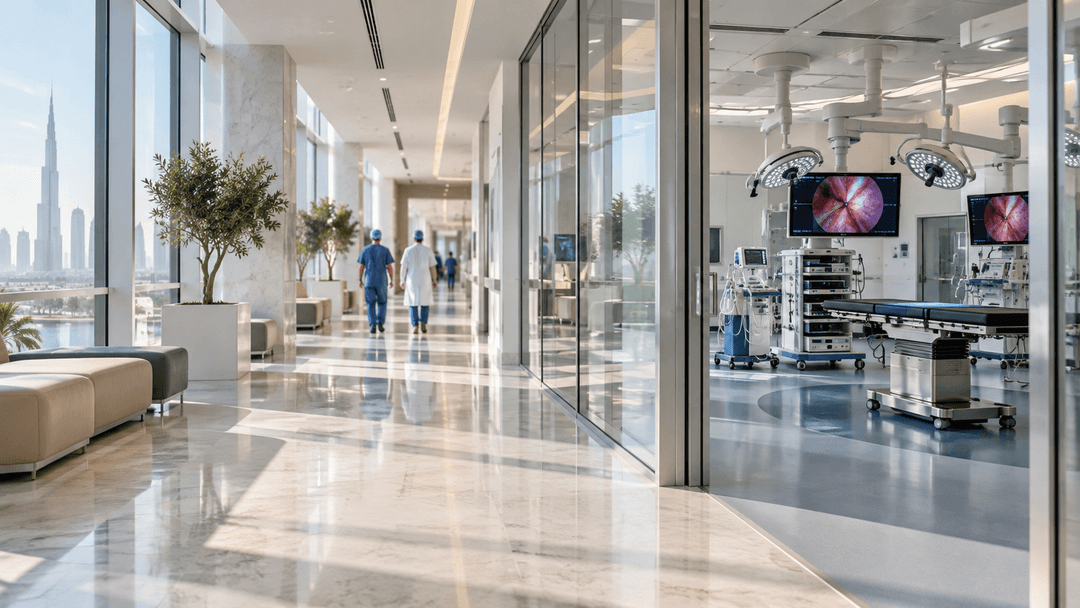
IndexBox sees surgical displays up 76% by 2035 as UAE clinics weigh 4K OR upgrades
IndexBox forecasts 5.8% annual growth in surgical displays to 2035. UAE clinics face a capital, integration and payer test.
How Zavis verifies this coverage
Editorial standards, source rules, methodology, and review provenance are public.
IndexBox expects the global surgical display market to grow at a 5.8% compound annual rate from 2026 to 2035, taking its market index to 176 by 2035 against 2025, as minimally invasive surgery pushes clinics toward medical-grade 4K and 8K operating-room displays.
For UAE operators, the highest-stakes readers are COOs, CFOs and CIOs. Dubai day surgery centres and specialty clinics regulated by the Dubai Health Authority (DHA) face the near-term procurement question first. Abu Dhabi facilities regulated by the Department of Health Abu Dhabi (DOH), and northern emirates providers under the Ministry of Health and Prevention (MOHAP), face the same decision when they add endoscopy, laparoscopy, arthroscopy, ophthalmology or image-guided procedures.
Why the IndexBox forecast matters
The IndexBox report, published on 8 October 2026, defines surgical displays as high-performance medical-grade monitors used for real-time visualisation in surgical and interventional settings. It says demand is being driven less by new hospital construction and more by replacement of installed systems as providers move from Full HD to 4K and, in premium rooms, 8K.
That point matters in Dubai because many outpatient surgical upgrades are incremental. A clinic may add a new laparoscopic tower or endoscopy platform before it expands its physical footprint. DHA’s outpatient care standard requires facilities to maintain medical equipment according to manufacturer recommendations, while DHA’s standalone day surgery centre standards govern permitted procedures and facility classification. The display is part of that compliance file, not a consumer monitor purchase.
- Ambulatory surgical centres account for an estimated 20% of the wider surgical display market in the IndexBox segmentation.
- Clinics and physician offices account for an estimated 15%, including specialty clinics, dental offices and cosmetic surgery centres.
- Academic and research institutions account for an estimated 12%, with early demand for 8K, 3D and high dynamic range systems.
- Representative suppliers named by IndexBox include Stryker, Conmed, EIZO, Sony, Barco, Brainlab and NDS Surgical Imaging.
The cost test for UAE clinics
Public US price anchors give UAE buyers a practical starting point, although landed UAE pricing will depend on distributor margin, warranty, installation, calibration, customs handling and service response. IndexBox price evidence places UHD surgical display corridors at roughly $1,500 to $25,000 per unit, or about AED 5,500 to AED 91,800 before local commercial adjustments. A public US medical-surgical catalogue lists examples from $4,100 for a 26-inch EIZO surgical monitor to $13,282.50 for a 65-inch 4K surgical monitor, equal to about AED 15,100 to AED 48,800 before UAE costs.
For CFOs, the issue is utilisation. A single 4K display can be justified if it supports a high-volume room used for endoscopy, arthroscopy or laparoscopy across multiple sessions each week. A premium 55-inch or 65-inch display is harder to justify in a clinic that performs low-volume minor procedures. The procurement file should compare procedure volume, payer approval rates, maintenance cost, warranty term and expected replacement year.
Insurers such as Daman, Thiqa and Sukoon generally do not reimburse a display as a standalone item. They reimburse approved procedures under network contracts and policy terms. Clinics should therefore test whether better visualisation supports more day-case eligibility, fewer cancellations, shorter room time or a broader permitted procedure mix. Those numbers belong in the business case before purchase orders are signed.
What operators should check before buying
CIOs should treat surgical displays as OR infrastructure. A 4K monitor may require compatible cameras, routers, recording systems, PACS connectivity, video-over-IP planning, cybersecurity review and biomedical engineering support. In Abu Dhabi, DOH’s healthcare information and cybersecurity standard applies to regulated healthcare entities and to systems that handle patient health, diagnostic or personal information. A display integrated with imaging, storage or telemedicine workflows enters that governance perimeter.
Device market access is another checkpoint. The Emirates Drug Establishment describes medical device marketing authorisation as the service used to register medical equipment for importing and trading in the UAE. MOHAP’s services guide lists a AED 100 application fee and AED 5,000 medical device registration fee. Buyers should ask distributors for UAE registration evidence, manufacturer manuals, warranty scope, calibration schedule and local service-level terms.
Patients will not see the procurement spreadsheet, but they will feel the result through access. If Dubai clinics can add safe minimally invasive capacity, insurers may gain lower-cost day-case pathways and patients may avoid inpatient admissions. If clinics buy displays without the procedure volume, trained staff and payer approvals to support them, the equipment becomes a margin drag.
The next marker is the 2027 capital budget cycle. UAE clinics planning new procedure rooms should map licensed services, permitted day-surgery classifications and payer contracts before selecting a display vendor. Patients and operators can use the UAE Open Healthcare Directory to check licensed clinics and providers across Dubai, Abu Dhabi and the northern emirates.
Zavis Intelligence
Healthcare Industry Desk
Contributing to UAE healthcare industry coverage
Related coverage
FAQ
What is happening in UAE healthcare industry?
IndexBox forecasts 5.8% annual growth in surgical displays to 2035. UAE clinics face a capital, integration and payer test.