
What are the different MRI scan machine types?
Short answer
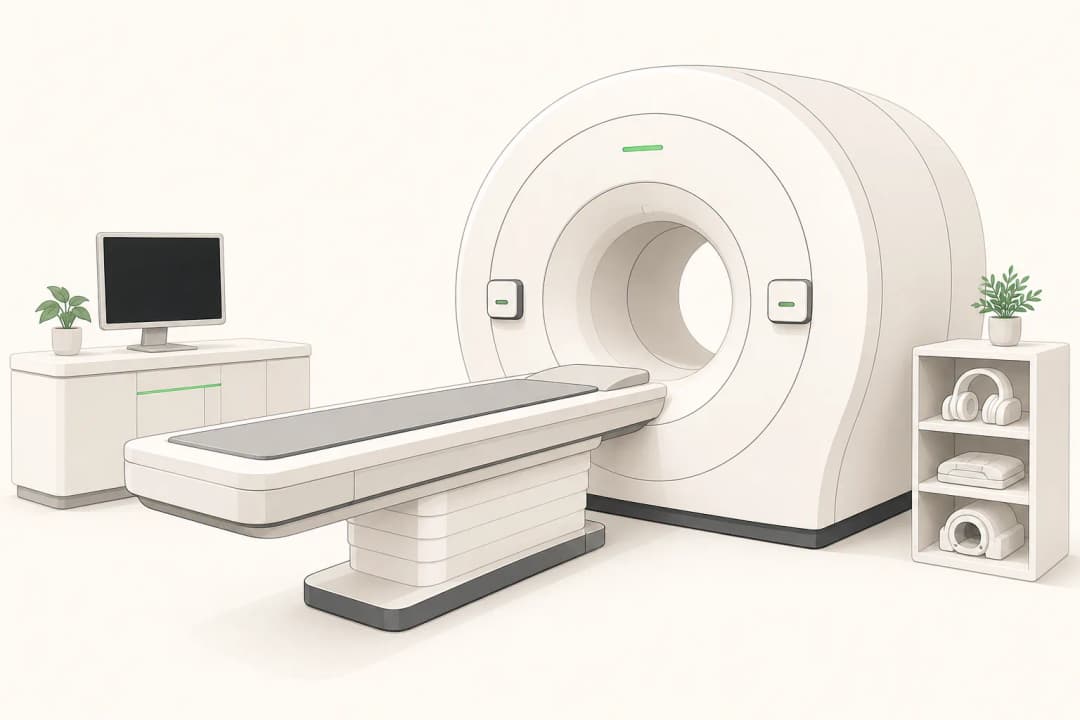
MRI scan machines vary by magnet strength, opening design, and body area, so the imaging team selects equipment for your clinical question and safety.
This answers one question. It is not a diagnosis and does not replace an assessment by a licensed doctor.
At a glance
- Designs
- Tunnel, wider-bore, open, and dedicated systems
- Selection factors
- Body area, clinical question, movement, and safety
- Your role
- Share complete implant and health information
How MRI machines differ
Most scanners use a tunnel-shaped magnet and a table that moves through it. Some have a wider opening, which may feel more comfortable for people who are anxious in enclosed spaces or have a larger body size. Open-style designs have more space around the patient, but the available equipment and image quality depend on the examination. A dedicated scanner may be designed for a particular body area, such as the breast, joints, or heart.
Magnet strength can affect image detail, scan speed, and which examinations are suitable. A stronger system is not automatically the right choice. The radiographer and radiologist consider the body part, the question being investigated, movement, implants, and local equipment availability. A brain tumour assessment and a joint assessment may use different coils or positioning even on a similar scanner.
What to do before choosing
You usually do not need to choose the machine yourself. Give the imaging team complete information about implants, metal fragments, pregnancy, kidney disease, previous reactions to contrast, and difficulty staying still. Ask whether a wide-bore or open design is available if enclosed spaces are a concern. Follow instructions about clothing, food, drink, and medicines, and arrive with enough time for safety checks.
When to seek care
During imaging, report pain, heating, pulling, or panic immediately so staff can pause and assess you. Seek urgent help for breathing difficulty, facial swelling, or faintness after contrast. New seizures, sudden weakness, loss of speech, or a severe abrupt headache require urgent assessment and should not wait for a scan appointment.
Questions for your doctor
Ask which scanner design is planned, whether contrast or a special coil is needed, and whether your implant has been cleared. Ask how the chosen scan will answer the clinical question and when the report will be reviewed.
Questions people ask
Is an open MRI suitable for every scan?
Not always. The imaging team chooses equipment that can produce appropriate pictures for the body area and clinical question.
Does a stronger magnet mean a better scan?
Not necessarily. Suitability depends on the examination, your safety information, and the scanner’s capabilities.
Related
Related reading
Keep reading
Cancer care in the UAE
Hospitals & Medical Centers in Abu Dhabi
Most UAE cancer care is delivered inside hospital services rather than by standalone oncology clinics, so these are licensed hospitals & medical centers listed in Abu Dhabi. Confirm the specific cancer service exists before you travel, and know that asking for a second opinion is routine.
Ahalia Hospital Musaffah Building - Musaffah - Musaffah Industrial - Abu Dhabi - United Arab Emirates
Accepts: Daman, Thiqa, AXA, Cigna +26 more
Al Ruwais Industrial City - Abu Dhabi - United Arab Emirates
Accepts: Daman, Thiqa, AXA, Cigna +30 more
Abu Dhabi, Abu Dhabi
Accepts: Daman, Thiqa, AXA, Cigna +30 more
Second opinions are routine in cancer care and asking for one does not affect your treatment. How to arrange a second opinion in the UAE.
Ordered by verification status and how complete each clinic's public record is, then alphabetically. This is a directory listing, not a ranking — Zavis does not rate or recommend providers.
A factual listing drawn from the DHA, DOH and MOHAP licence registers. It is not a referral, an endorsement, or advice that any of these providers is right for you.
Medical disclaimer. This page is general health information, not medical advice, and it cannot diagnose you. Always consult a licensed healthcare provider about your own symptoms and treatment. In an emergency in the UAE, call 998 for an ambulance.