
Desmoplastic melanoma: what to know
Short answer
Desmoplastic melanoma is a melanoma pattern with fibrous tissue that can look subtle, making specialist diagnosis and staging important.
This answers one question. It is not a diagnosis and does not replace an assessment by a licensed doctor.
At a glance
- Key test
- Biopsy reviewed by pathology
- Treatment planning
- Depends on pathology and stage
- Follow-up
- Regular skin and clinical checks
Understanding the diagnosis
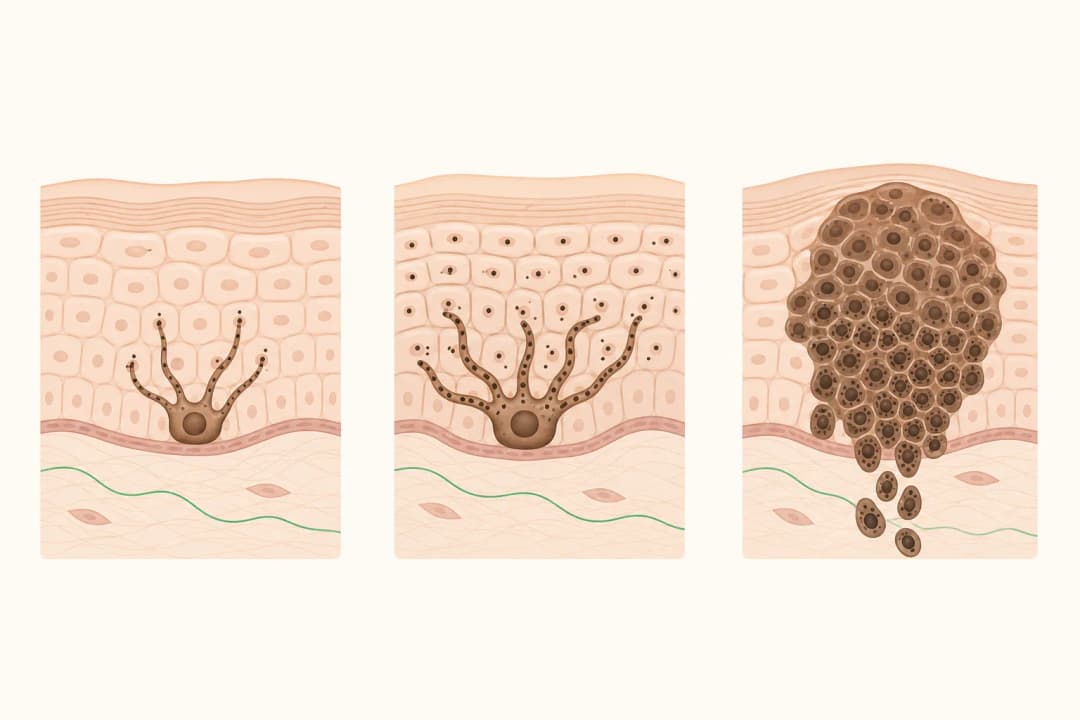
Desmoplastic melanoma develops from pigment-producing skin cells and contains prominent scar-like fibrous tissue. It may appear as a firm, pale, scar-like, or skin-coloured patch or lump rather than a classic dark mole. Appearance alone cannot confirm it. A biopsy allows a pathologist to examine the tissue and distinguish it from other skin growths.
The report and examination help the team assess depth, edges, ulceration, and other features that guide staging. Read more about [Melanoma](/conditions/melanoma/) and ask how the findings apply to your individual diagnosis.
What usually happens next
After diagnosis, a specialist team may discuss [Surgical Excision](/treatments/surgical-dermatology/excisional-surgery/) or other [Skin Cancer Surgery](/treatments/surgical-dermatology/skin-cancer-surgery/) to remove the tumour with an appropriate margin. Depending on the tumour’s features and stage, a [Sentinel Lymph Node Biopsy](/treatments/diagnostics-and-staging/sentinel-lymph-node-biopsy/) may be considered. Additional imaging or treatment is based on examination and pathology rather than the name alone.
Take a copy of the pathology report to appointments and ask which findings determine the next decision. Treatment can include surgery, close observation, or medicines such as [Immunotherapy](/treatments/systemic-therapy/immunotherapy/) when clinically appropriate.
When to seek care
Contact your care team promptly for a new or enlarging lump near the scar, persistent bleeding, wound separation, increasing pain, or a new lump in a nearby lymph-node area. Seek urgent care for uncontrolled bleeding, rapidly spreading redness with fever, severe swelling, or new neurological symptoms such as weakness, confusion, or a seizure. These symptoms need assessment; they do not by themselves establish spread.
Questions for your doctor
What does the pathology show about depth and margins? Is lymph-node assessment recommended? Which scans or treatments are relevant, and how will follow-up be organised?
Find care
General Clinics & Polyclinics in Abu Dhabi
That answer is general. If you want it applied to your own case, these are licensed general clinics & polyclinics listed in Abu Dhabi.
27 Ar Ruwwad St - Shakhbout City - MSH4 - Abu Dhabi - United Arab Emirates
Accepts: Daman, Thiqa, Cigna, MetLife +20 more
Al Ruwais, Al Dhafrah
Accepts: Daman, Thiqa, AXA, Cigna +16 more
Al Bahyah - Al Bahyah Old - Abu Dhabi - United Arab Emirates
Accepts: Daman, Thiqa, Cigna, Allianz Care +18 more
Abu Dhabi
Accepts: Daman, Thiqa, AXA, Cigna +27 more
Ordered by verification status and how complete each clinic's public record is, then alphabetically. This is a directory listing, not a ranking — Zavis does not rate or recommend providers.
A factual listing drawn from the DHA, DOH and MOHAP licence registers. It is not a referral, an endorsement, or advice that any of these providers is right for you.
Questions people ask
Is desmoplastic melanoma always dark?
No. It can be pale, skin-coloured, firm, or scar-like, so a subtle appearance does not exclude melanoma.
Does the diagnosis automatically mean it has spread?
No. Spread is assessed with examination, pathology, and selected staging tests.
Related
Related reading
Keep reading
Medical disclaimer. This page is general health information, not medical advice, and it cannot diagnose you. Always consult a licensed healthcare provider about your own symptoms and treatment. In an emergency in the UAE, call 998 for an ambulance.