

3 routes to prescription medicine in Dubai and the UAE, and when each one works
A Dubai-first guide to licensed pharmacies, delivery, insurance networks and controlled medicines in the UAE.
How Zavis verifies this coverage
Editorial standards, source rules, methodology, and review provenance are public.
The fastest route to prescription medicine in Dubai is a Dubai Health Authority (DHA)-licensed community or hospital pharmacy that can read a valid UAE prescription, check insurance eligibility and dispense the medicine on the same visit.
This matters most for COOs, CFOs and medical directors. COOs need reliable refill pathways for discharged patients. CFOs need patients directed to insurer network pharmacies before claims are rejected. Medical directors need prescribing teams to know when a medicine is routine, semi-controlled or controlled under UAE rules.
Start with the licence and the prescription
In Dubai, use pharmacies licensed by DHA or by the relevant health free zone where applicable. In Abu Dhabi and Al Ain, the regulator is the Department of Health - Abu Dhabi (DOH). In Sharjah, Ajman, Umm Al Quwain, Ras Al Khaimah and Fujairah, the relevant federal regulator is the Ministry of Health and Prevention (MOHAP), with medicines now searchable through the Emirates Drug Establishment registered medical product directory.
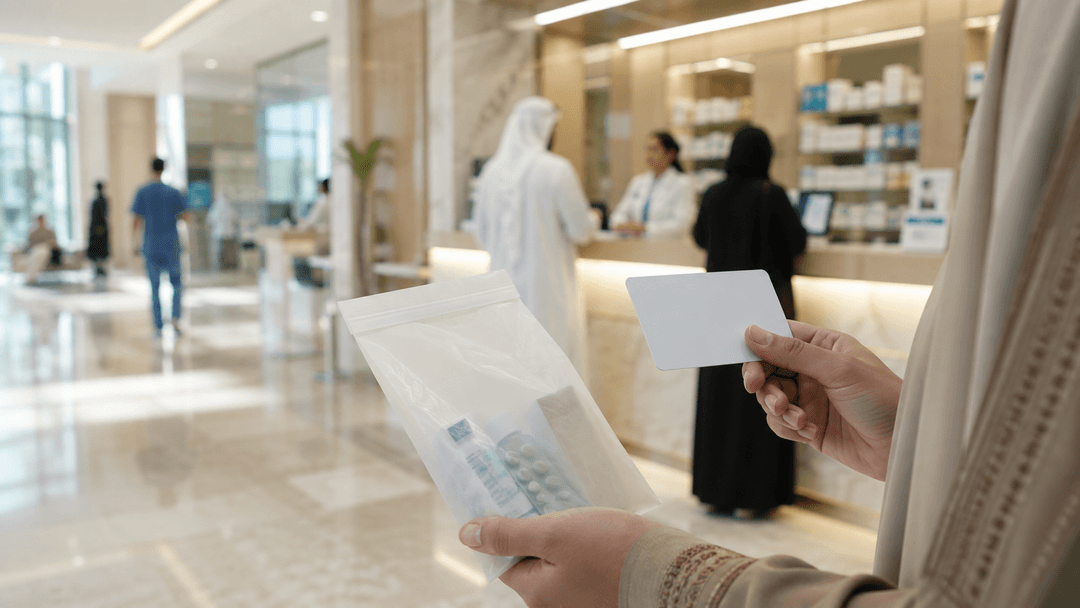
The practical test is simple. A patient should be able to show a prescription, Emirates ID or passport, and insurance card. The pharmacy should be able to confirm stock, substitution options and claim status before payment. For regulated medicines, pharmacists may require the original prescription and extra identity checks.
- Same-day dispensing: common for routine medicines already in stock at community pharmacies.
- Home delivery: available through many licensed pharmacy groups and hospital pharmacies; prescription medicines still require a valid prescription.
- Hospital pharmacy: useful after discharge, oncology, transplant, fertility or specialty clinic visits where medicine supply is tied to clinical records.
- Government refill channels: relevant for patients treated by public-sector facilities, including Dubai Health and SEHA-linked services.
Insurance determines the cheapest counter
The lowest cash price is rarely the only issue. For insured patients, the most important question is whether the pharmacy is inside the plan network. Daman and Thiqa are central in Abu Dhabi. Sukoon and other private insurers use plan-specific networks in Dubai and across the UAE. A patient should check the insurer app, member card hotline or provider search before choosing a pharmacy for recurring medicines.
Cash prices are regulated at product level. MOHAP published a public medicines price list effective 1 January 2014, and the current practical lookup is the registered product directory or the official price-list request route. Patients should search by brand name and active ingredient because generic alternatives can change the out-of-pocket amount. Do not rely on a social media price or a delivery-app listing for a chronic medicine without confirming the registered product and package size.
For operators, the P&L point is leakage. If discharged patients leave with a prescription that their insurer will only reimburse at another pharmacy, the provider has created a claims problem and a patient-experience problem. Discharge teams should give patients two pieces of information before they leave: the medicine name and whether the intended pharmacy is in network.
Controlled medicines need a different route
The UAE treats narcotic, psychotropic and other controlled medicines differently from routine prescriptions. The UAE government says travellers carrying controlled medicines must seek prior approval and carry medical documentation through the relevant official service. Dubai’s public guidance says failure to comply can lead to legal penalties.
For residents, the same caution applies inside the country. A prescription that is valid for an antibiotic or antihypertensive does not mean the same dispensing workflow applies to controlled medicine. Patients should use the prescribing hospital pharmacy first, or a pharmacy confirmed by the prescriber as able to dispense that medicine. Travellers should apply before arrival if their medicine is controlled, rather than trying to resolve the issue at the airport or at a Dubai pharmacy counter.
Delivery is useful but limited. Dubai Health’s pharmacy delivery guidance states that a valid medicine prescription is mandatory and refill requests should be made only within one week of the due refill time. Private pharmacy delivery services may offer same-day or next-day delivery in many areas, but controlled medicines can require stricter handling and may be excluded from standard delivery flows.
What operators should do now
Clinics in Dubai should keep an updated list of nearby DHA-licensed pharmacies by insurer network, opening hours and delivery capability. Abu Dhabi providers should cross-check DOH pharmacy options; DOH says Abu Dhabi has more than 950 pharmacies operating in the emirate. Providers in the northern emirates should check MOHAP and Emirates Drug Establishment records for licensed supply and registered products.
The patient-facing instruction should be short: take the prescription, Emirates ID or passport, insurance card and the exact medicine name. For controlled medicines, check the official UAE controlled-medicine approval route before travel or dispensing. For licensed pharmacy providers, start with the UAE Open Healthcare Directory and filter for pharmacies in the relevant emirate.
Zavis Intelligence
Healthcare Industry Desk
Contributing to UAE healthcare industry coverage
Related coverage



FAQ
What is happening in UAE healthcare industry?
A Dubai-first guide to licensed pharmacies, delivery, insurance networks and controlled medicines in the UAE.