

Glide’s New York AI push: 5 checks UAE patients should book before the tools arrive
Abu Dhabi’s AI work does not change treatment today. Dubai patients should use it as a prompt to check screening eligibility, coverage and licensed providers.
How Zavis verifies this coverage
Editorial standards, source rules, methodology, and review provenance are public.
For patients in Dubai, Abu Dhabi’s disease-prevention and AI push in New York means one practical thing today: book the preventive checks already covered or recommended in the UAE before waiting for new AI tools to reach clinics.
The news concerns Abu Dhabi’s Global Institute for Disease Elimination (Glide), which used the UN General Assembly high-level week in New York to announce AI training programmes for public-health leaders, according to The National. That matters for UAE patients because the country is moving care earlier in the disease cycle, through screening, risk scoring and data-led follow-up. The immediate value is not a new consumer app. It is a reason to use existing pathways under the Dubai Health Authority (DHA), Department of Health Abu Dhabi (DOH) and Ministry of Health and Prevention (MOHAP).
What Dubai patients can do this month
DHA’s Dubai Periodic Health Screening Guideline was issued on 11 March 2024 and became effective on 11 May 2024. It gives Dubai residents a clear checklist to discuss with a family physician, internist or gynaecologist.
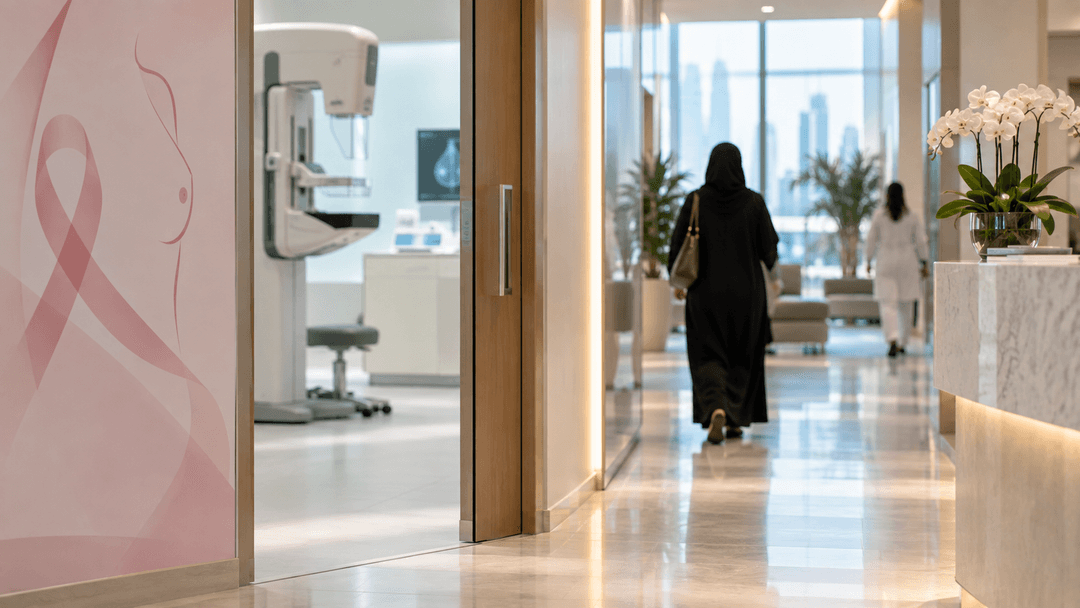
- Breast cancer: women aged 40 years and over are advised to have a mammogram every 2 years, with earlier screening if risk factors apply.
- Cervical cancer: eligible women aged 25 to 65 are screened every 3 years at ages 25 to 49, then every 5 years at ages 50 to 65.
- Colorectal cancer: men and women aged 40 to 75 are advised to have a FIT test every 2 years or colonoscopy every 10 years.
- Chronic disease risk: blood pressure, diabetes and lipid checks should be tied to a documented follow-up plan, especially for patients with obesity, smoking history or family risk.
Price transparency is uneven. Published Dubai clinic pages in September 2026 show basic preventive packages starting around AED 399, broader men’s and women’s packages around AED 850, and more comprehensive packages around AED 1,750 to AED 3,200. Some providers list a mammogram add-on at AED 375. Patients should treat those figures as market reference points, then ask their insurer whether the exact CPT-coded service is covered, whether pre-approval is required, and whether the facility is in-network.
What AI changes, and what it does not
AI in prevention should change how risk is sorted, not who makes the diagnosis. Glide’s chief executive, Dr Farida Al Hosani, told The National that AI can help countries use constrained health budgets and improve disease surveillance. For UAE patients, that points to more risk prompts inside clinical workflows, especially where screening results, lab history and family risk can be analysed together.
“The use of AI should always be with caution,” Dr Farida Al Hosani, chief executive of Glide, told The National.
That caution matters in Dubai clinics. A patient should ask whether an AI tool is used for triage, image review, risk scoring or patient education. The next question is whether a DHA-licensed physician reviews the result before it affects referral, treatment or reassurance. A screening report that flags a risk without a named responsible clinician is not enough.
Abu Dhabi is further ahead on population-level prevention. The Abu Dhabi Public Health Centre says IFHAS is available to Thiqa holders aged 18 to 75, with screening typically every 3 years or more often if a doctor decides. DOH and Malaffi have also described patient risk profiling for chronic conditions such as diabetes, chronic kidney disease and hypertension. That is the direction Dubai and the northern emirates will be measured against.
How to use this as a patient in the UAE
The most useful action is to turn a broad AI headline into a short appointment agenda. Dubai residents should take their Emirates ID, insurance card, medication list, family history and any old lab reports to a licensed primary-care clinic. Ask for a screening plan by age and risk, a written follow-up date, and a referral route if the result is abnormal.
Insurance rules decide the bill. In Dubai, check the DHA network shown by your insurer, including Sukoon or other private insurers where applicable. In Abu Dhabi, confirm whether Thiqa or Daman terms apply before booking IFHAS or specialist follow-up. In Sharjah, Ajman, Umm Al Quwain, Ras Al Khaimah and Fujairah, patients should check MOHAP or Emirates Health Services routes and then confirm private insurance approval in writing.
Patients should be wary of packages that sell large test panels without age criteria, symptoms or follow-up. More testing can create repeat scans, specialist visits and exclusions that were avoidable with guideline-led screening. A good clinic can explain why each test is being ordered, when results return, and who is accountable for next steps.
Before booking, verify that the clinic and clinician are licensed. For Dubai, start with the DHA Dubai Medical Registry. For a broader UAE search, use the UAE Open Healthcare Directory to find licensed clinics and providers by emirate, specialty and location.
Zavis Intelligence
Healthcare Industry Desk
Contributing to UAE healthcare industry coverage
Related coverage


FAQ
What is happening in UAE healthcare industry?
Abu Dhabi’s AI work does not change treatment today. Dubai patients should use it as a prompt to check screening eligibility, coverage and licensed providers.