
Breast Ultrasound vs Mammogram
At a glance
- Ultrasound
- Sound-wave imaging
- Mammogram
- Low-dose X-ray imaging
- Possible outcome
- Further imaging or biopsy may be advised
Find care
Radiology & Imaging in Dubai
Licensed radiology & imaging listed in Dubai. Appearing here means a provider holds a UAE licence in this category — not that it offers breast ultrasound vs mammogram, which is worth confirming with the clinic before you book.
First Gulf Real Estate Building, Amman Street, AL NAHDA FIRST, Dubai
Accepts: Daman, Thiqa, AXA, Cigna +28 more
LEADER, 3 Street 99, DUBAI INVESTMENT PARK FIRST, Dubai
Accepts: Daman, Thiqa, AXA, Cigna +29 more
villa, Al Wasl Road, JUMEIRAH FIRST, Dubai
Accepts: Daman, Thiqa, AXA, Cigna +16 more
Aletihad Diagnostic Center, Alwasl Road, AL SAFFA SECOND, Dubai
Accepts: AXA, Cigna, MetLife, Allianz Care +17 more
Moza Suwaidan Saeed Building, 45b Street 27, AL MURQABAT, Dubai
Accepts: Thiqa, AXA, Cigna, MetLife +25 more
Rdk1, 70 Street, DUBAI INVESTMENT PARK FIRST, Dubai
Accepts: Daman, AXA, Cigna, MetLife +20 more
Ordered by verification status and how complete each clinic's public record is, then alphabetically. This is a directory listing, not a ranking — Zavis does not rate or recommend providers.
A factual listing drawn from the DHA, DOH and MOHAP licence registers. It is not a referral, an endorsement, or advice that any of these providers is right for you.
What each test shows
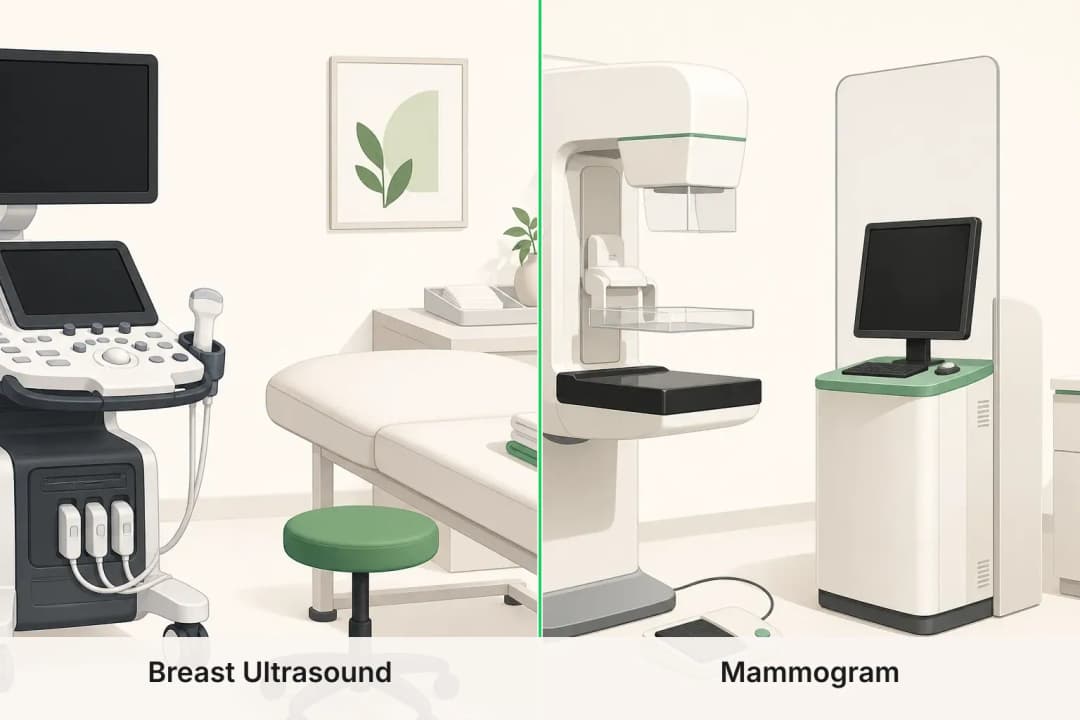
Breast ultrasound uses sound waves to examine breast tissue, while a mammogram uses low-dose X-rays to create breast images.
Ultrasound and mammography are complementary rather than interchangeable. Ultrasound can help distinguish a fluid-filled cyst from a solid area and can guide a needle procedure. Mammography can show masses and tiny calcium deposits, including patterns that may not be felt. The clinician chooses the test or combination that best answers the question.
When ultrasound may be selected
Ultrasound may be selected to assess a specific lump, pain in one area, or an abnormality already seen on another test. It is often useful for younger people and for guiding drainage or biopsy. Ultrasound does not show every type of breast change, so a normal result may not end the assessment when a lump or other concerning sign remains.
When a mammogram may be selected
Mammography may be selected for routine breast screening when appropriate or for a diagnostic assessment of a new breast concern. It can reveal calcium deposits and tissue patterns that ultrasound may miss. Tell the imaging team about pregnancy, breastfeeding, implants, or difficulty standing, because these details can affect positioning and the imaging plan.
Discomfort and limitations
Ultrasound has no ionising radiation, but pressure from the probe can be tender and the result depends on the area examined and the operator’s technique. Mammography uses radiation and compression can feel uncomfortable briefly. Both tests can produce findings that need extra views, follow-up imaging, or biopsy; that does not by itself establish a diagnosis.
When another step is needed
Neither test should be used to dismiss a persistent or changing concern without clinical review. Depending on the finding, the next step may be targeted imaging, breast MRI, tissue sampling, or review by a breast specialist. Seek prompt assessment for a new lump, bloody nipple discharge, skin dimpling, nipple inversion, or a rapidly changing breast shape.
How the imaging choice is made
Clinicians consider the symptom, examination, age, pregnancy status, breast density, implants, personal history, and whether the purpose is screening or diagnosis. They also compare the new images with earlier studies when available. Ask what the test is intended to answer, whether another test will be needed, and when you should expect the report.
Questions people ask
Is ultrasound safer than a mammogram?
Ultrasound does not use ionising radiation, while mammography uses a low dose of X-rays. Safety and usefulness depend on the clinical situation, so one cannot routinely replace the other.
Can ultrasound find breast cancer?
Ultrasound can identify and characterise some breast abnormalities, but imaging alone cannot confirm cancer. A biopsy may be needed for a definite diagnosis.
Related
Related reading
Keep reading
Medical disclaimer. This page is general health information, not medical advice, and it cannot diagnose you. Always consult a licensed healthcare provider about your own symptoms and treatment. In an emergency in the UAE, call 998 for an ambulance.