
When is splinting recommended for trigger finger?
Updated
Short answer
Splinting may be recommended for trigger finger when catching, painful bending, or morning stiffness is aggravated by repeated finger motion and the finger needs a period of relative rest.
This answers one question. It is not a diagnosis and does not replace an assessment by a licensed doctor.
At a glance
- Typical pattern
- Clicking or catching with soreness at the base of a finger
- Support goal
- Limit the provoking position and allow smoother tendon movement
Why support can help
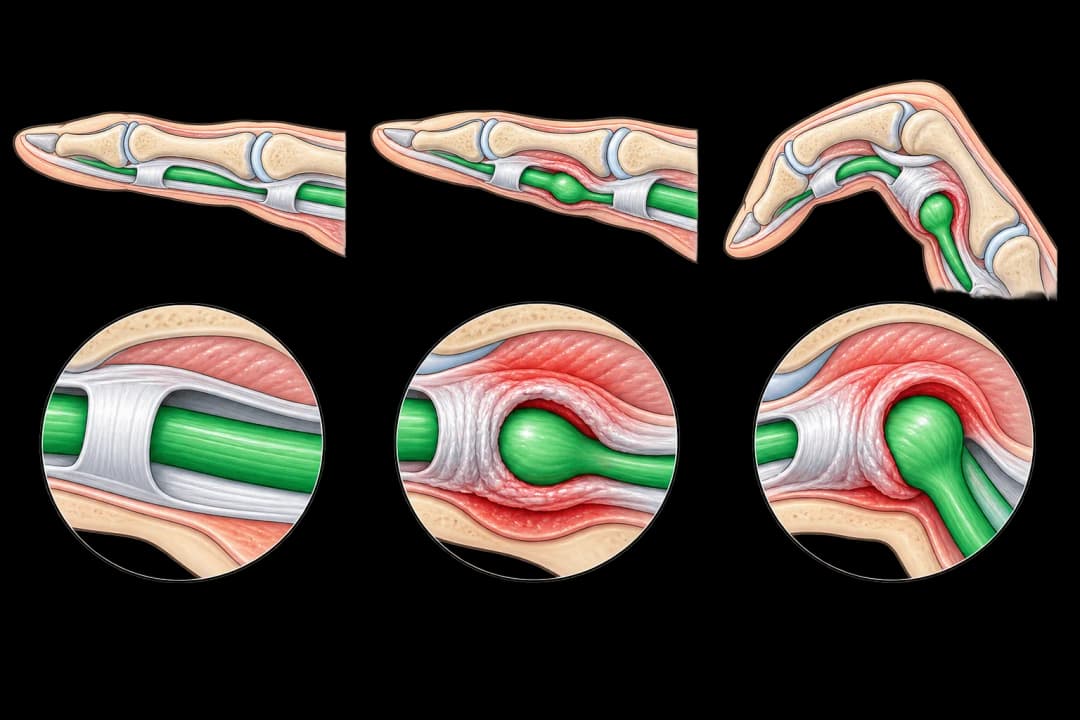
Trigger finger occurs when a finger tendon does not glide smoothly through its surrounding pulley. The finger may click, catch, or lock, often with soreness near the palm at the base of the affected finger. A splint can limit the position that provokes catching and reduce repeated irritation while symptoms are assessed.
The support may be worn at night, during specific tasks, or for a clinician-selected period. Its design depends on which joint is catching and whether the finger can still move comfortably.
Practical steps
Use the splint as directed and avoid repeated forceful gripping, vibrating tools, or activities that make the finger catch. Keep nearby joints moving gently if comfortable, and do not force a locked finger open. A hand therapist can check the fit and suggest ways to modify work or household tasks.
Watch the skin under the support for pressure or rubbing. Numbness, tingling, swelling, or a change in finger colour should prompt a fit review. If the finger becomes stuck, support it without force and seek clinical advice.
When to seek care promptly
Seek prompt care if the finger is locked, severely swollen, numb, pale or blue, or cannot move after an injury. Arrange an assessment when catching persists, pain interferes with sleep or daily tasks, or the splint causes skin injury. A clinician can discuss other options when support does not restore comfortable movement.
Questions for your doctor
Ask which joint the splint should hold, when to wear it, which movements to limit, how to keep the hand mobile, and what should happen if the finger continues to lock.
Find care
General Clinics & Polyclinics in Dubai
That answer is general. If you want it applied to your own case, these are licensed general clinics & polyclinics listed in Dubai.
The Court Residence, 39B Street, Jumeirah 1, Dubai
Accepts: Tabby, Tamara
Elite Business Bay Residence - Shop 03 & 04, 34 Marasi Dr - Business Bay - Dubai - United Arab Emirates
Accepts: Tabby
Airport View Building, Al Garhoud, Dubai
Accepts: Daman, Thiqa, AXA, Cigna +25 more
IBIS Building, 5th Floor, Unit 5003, Deira, Dubai
Accepts: AXA, Cigna, MetLife, Allianz Care +18 more
Ordered by verification status and how complete each clinic's public record is, then alphabetically. This is a directory listing, not a ranking — Zavis does not rate or recommend providers.
A factual listing drawn from the UAE health regulators' public licence registers. It is not a referral, an endorsement, or advice that any of these providers is right for you.
Questions people ask
Is a trigger-finger splint worn only at night?
Night use is common for some people, but the schedule depends on the catching pattern and the support selected.
Should I force the finger straight when it catches?
No. Forcing it can increase pain; use gentle support and seek advice if the finger remains locked.
Related
Related reading
Keep reading
Medical disclaimer. This page is general health information, not medical advice, and it cannot diagnose you. Always consult a licensed healthcare provider about your own symptoms and treatment. In an emergency in the UAE, call 998 for an ambulance.