
What does salpingectomy treat?
Short answer
Salpingectomy treats problems affecting a fallopian tube, including ectopic pregnancy, hydrosalpinx, and some blocked or damaged tubes.
This answers one question. It is not a diagnosis and does not replace an assessment by a licensed doctor.
At a glance
- Procedure
- Removal of one or both fallopian tubes
- Can treat
- Ectopic pregnancy and hydrosalpinx
- Fertility impact
- Depends on the remaining tube and ovaries
Why a tube may be removed
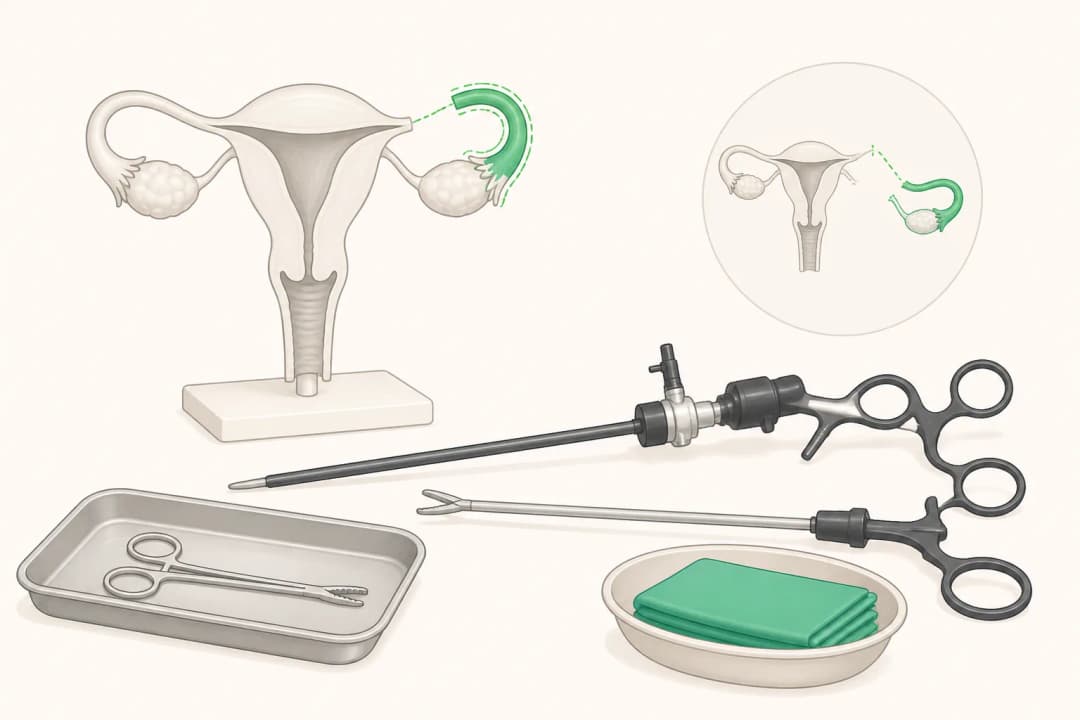
A salpingectomy is removal of one fallopian tube or both tubes. It may be urgent when an ectopic pregnancy has implanted in a tube and the tube is bleeding or badly damaged. It may be planned when a tube is blocked, scarred, or filled with fluid, as in hydrosalpinx.
Removing a diseased tube can protect health and may form part of fertility treatment planning. Removing one tube does not remove the ovaries or the uterus. The effect on fertility depends on the condition of the remaining tube, ovarian function, and the reason for surgery.
What to discuss before surgery
Ask whether one tube or both need removal and whether the operation is open or keyhole surgery. Your clinician may review pregnancy testing, scans, blood tests, previous pelvic surgery, and fertility goals. A laparoscopic surgery system may be used for small incisions when that approach is appropriate.
Arrange practical support for the first part of recovery and follow the discharge instructions about activity, driving, wound care, and pain relief. If fertility matters to you, ask about the next steps before the operation rather than waiting until recovery is complete.
When to seek care
After surgery, seek prompt clinical advice for increasing pain, fever, repeated vomiting, heavy vaginal bleeding, worsening redness or drainage from an incision, or trouble passing urine. Emergency assessment is needed for fainting, severe weakness, chest pain, or sudden breathlessness.
Questions for your doctor
What is affecting the tube, and why is removal recommended? Could the tube be treated another way? How might this change fertility plans? What will happen if the other tube is not healthy? Which symptoms after surgery should trigger an urgent call?
Find care
General Clinics & Polyclinics in Abu Dhabi
That answer is general. If you want it applied to your own case, these are licensed general clinics & polyclinics listed in Abu Dhabi.
27 Ar Ruwwad St - Shakhbout City - MSH4 - Abu Dhabi - United Arab Emirates
Accepts: Daman, Thiqa, Cigna, MetLife +20 more
Al Ruwais, Al Dhafrah
Accepts: Daman, Thiqa, AXA, Cigna +16 more
Al Bahyah - Al Bahyah Old - Abu Dhabi - United Arab Emirates
Accepts: Daman, Thiqa, Cigna, Allianz Care +18 more
Abu Dhabi
Accepts: Daman, Thiqa, AXA, Cigna +27 more
Ordered by verification status and how complete each clinic's public record is, then alphabetically. This is a directory listing, not a ranking — Zavis does not rate or recommend providers.
A factual listing drawn from the DHA, DOH and MOHAP licence registers. It is not a referral, an endorsement, or advice that any of these providers is right for you.
Questions people ask
Does salpingectomy remove the ovaries?
No. Salpingectomy removes fallopian tubes; the ovaries are separate organs and are not removed unless another operation is planned.
Can salpingectomy treat a blocked fallopian tube?
It can treat a severely blocked or damaged tube, especially when the tube cannot function normally or contains fluid.
Related
Related reading
Keep reading
Medical disclaimer. This page is general health information, not medical advice, and it cannot diagnose you. Always consult a licensed healthcare provider about your own symptoms and treatment. In an emergency in the UAE, call 998 for an ambulance.