
What should you know about sickle cell disease hemoglobin?
Short answer
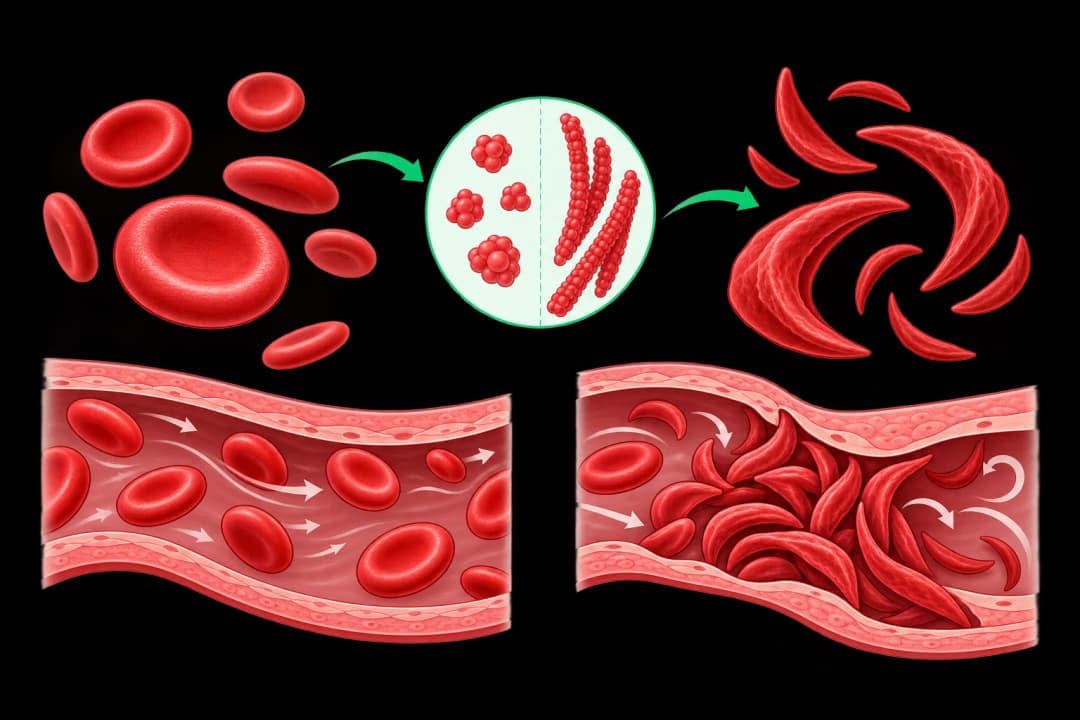
Sickle haemoglobin is an altered form of haemoglobin that can make red blood cells rigid, contributing to anaemia and pain episodes.
This answers one question. It is not a diagnosis and does not replace an assessment by a licensed doctor.
At a glance
- Main role
- Haemoglobin carries oxygen in red blood cells
- Sickle change
- Cells may become rigid and break down early
- Interpretation
- The complete pattern matters more than one label
What haemoglobin does
Haemoglobin is the red blood cell protein that carries oxygen. In sickle cell disease, an inherited haemoglobin change can cause red blood cells to become less flexible, especially under physical stress. These cells can break down earlier than usual or interfere with small blood vessels, which helps explain fatigue, pale skin, and episodes of joint pain.
A laboratory report may list several haemoglobin types and their proportions. The pattern must be interpreted alongside age, symptoms, family history, and any recent transfusion. A result that mentions sickle haemoglobin does not, on its own, describe the full severity of a person's condition.
How results are checked
Discuss the report with a clinician who can explain whether it indicates sickle cell disease, sickle cell trait, or another haemoglobin condition. A blood test may be followed by additional testing when the pattern is unclear. Keep a copy of results and mention transfusions, pregnancy, or treatment because these can affect interpretation.
When to seek prompt help
Get urgent care for severe or sudden pain, breathing difficulty, fainting, confusion, or a high temperature if sickle cell disease is known or suspected. Fatigue or pale skin can have several causes, so arrange medical assessment rather than treating a haemoglobin result as a diagnosis by itself.
Questions to ask
Ask which haemoglobin types were found, whether the result confirms disease or trait, whether another test is needed, and how the finding changes monitoring, treatment, or family planning.
Find care
General Clinics & Polyclinics in Abu Dhabi
That answer is general. If you want it applied to your own case, these are licensed general clinics & polyclinics listed in Abu Dhabi.
27 Ar Ruwwad St - Shakhbout City - MSH4 - Abu Dhabi - United Arab Emirates
Accepts: Daman, Thiqa, Cigna, MetLife +20 more
Al Ruwais, Al Dhafrah
Accepts: Daman, Thiqa, AXA, Cigna +16 more
Al Bahyah - Al Bahyah Old - Abu Dhabi - United Arab Emirates
Accepts: Daman, Thiqa, Cigna, Allianz Care +18 more
Abu Dhabi
Accepts: Daman, Thiqa, AXA, Cigna +27 more
Ordered by verification status and how complete each clinic's public record is, then alphabetically. This is a directory listing, not a ranking — Zavis does not rate or recommend providers.
A factual listing drawn from the DHA, DOH and MOHAP licence registers. It is not a referral, an endorsement, or advice that any of these providers is right for you.
Questions people ask
Is sickle haemoglobin the same as sickle cell disease?
Not necessarily. Sickle haemoglobin can appear in different inherited patterns, including sickle cell trait, so the full blood test result is needed.
Why might a haemoglobin result need repeating?
Additional testing may be useful when the pattern is uncertain or when factors such as a recent transfusion could affect the result.
Related
Related reading
Keep reading
Medical disclaimer. This page is general health information, not medical advice, and it cannot diagnose you. Always consult a licensed healthcare provider about your own symptoms and treatment. In an emergency in the UAE, call 998 for an ambulance.