
Right Salpingectomy: What to Know
Short answer
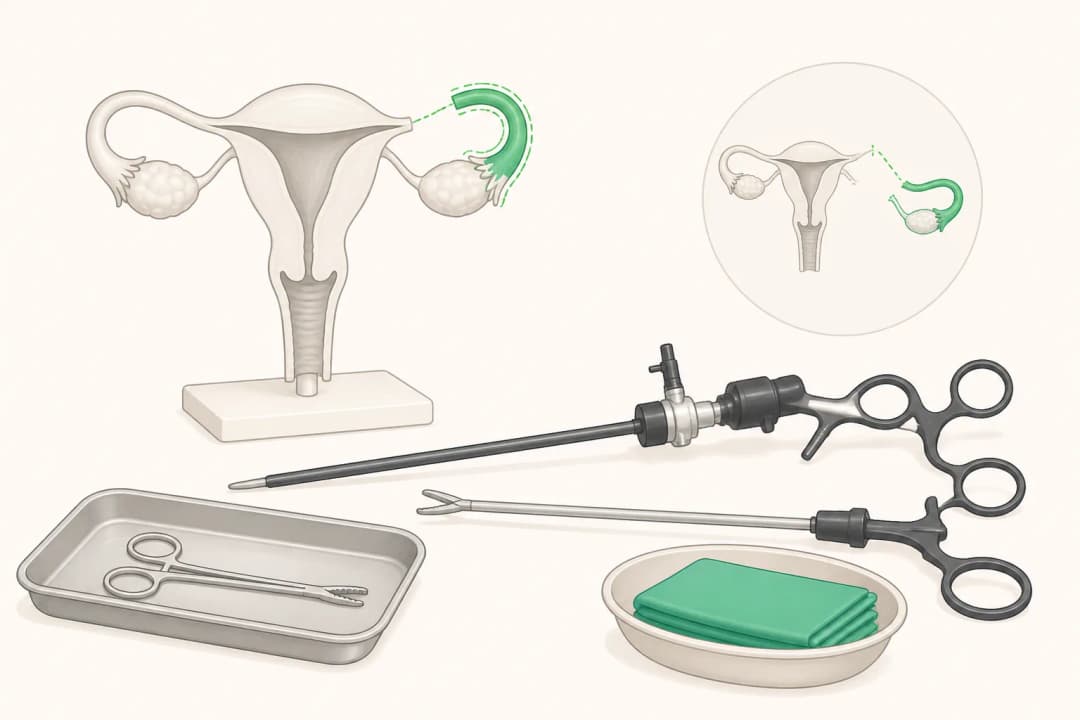
A right salpingectomy is surgery to remove the right fallopian tube, while usually leaving the right ovary in place, and it may be advised for several gynaecological conditions.
This answers one question. It is not a diagnosis and does not replace an assessment by a licensed doctor.
At a glance
- Removed structure
- The right fallopian tube
- Often preserved
- The right ovary, unless another reason requires treatment
- Surgical approach
- Laparoscopic or open surgery, depending on the situation
What the operation involves
The surgeon separates and removes the right tube through small abdominal incisions when laparoscopic surgery is suitable, or through a larger incision when open surgery is safer or necessary. The ovary and uterus are separate structures, so removing one tube does not automatically remove either of them.
Reasons can include an ectopic pregnancy, a damaged or fluid-filled tube, repeated infection, or risk reduction discussed with your specialist. Your fertility outlook depends on the left tube, ovulation, the uterus, and other reproductive factors.
Preparing and recovering
Before surgery, review medicines, allergies, fasting instructions, transport, and whether a pregnancy test is required. Ask whether the procedure may need to change during surgery if unexpected findings appear. Afterward, short-term tiredness, shoulder discomfort from laparoscopic gas, and soreness around the incisions can occur.
Walk gently as advised, keep dressings and wounds cared for as instructed, and avoid lifting or strenuous activity until your team clears you. Arrange follow-up to discuss the pathology result, healing, contraception or fertility plans, and return to work or exercise.
When to get medical help
Contact your surgical team for increasing wound redness, swelling, discharge, fever, worsening pain, persistent vomiting, or difficulty passing urine. Seek emergency care for fainting, chest pain, breathlessness, heavy vaginal bleeding, or sudden severe abdominal pain.
Questions for your doctor
Ask why the right tube should be removed, whether the operation will be laparoscopic, what will happen to the ovary, and how the procedure affects pregnancy planning. Ask about alternatives, expected recovery milestones, pathology, and symptoms that need urgent attention.
Find care
General Clinics & Polyclinics in Abu Dhabi
That answer is general. If you want it applied to your own case, these are licensed general clinics & polyclinics listed in Abu Dhabi.
27 Ar Ruwwad St - Shakhbout City - MSH4 - Abu Dhabi - United Arab Emirates
Accepts: Daman, Thiqa, Cigna, MetLife +20 more
Al Ruwais, Al Dhafrah
Accepts: Daman, Thiqa, AXA, Cigna +16 more
Al Bahyah - Al Bahyah Old - Abu Dhabi - United Arab Emirates
Accepts: Daman, Thiqa, Cigna, Allianz Care +18 more
Abu Dhabi
Accepts: Daman, Thiqa, AXA, Cigna +27 more
Ordered by verification status and how complete each clinic's public record is, then alphabetically. This is a directory listing, not a ranking — Zavis does not rate or recommend providers.
A factual listing drawn from the DHA, DOH and MOHAP licence registers. It is not a referral, an endorsement, or advice that any of these providers is right for you.
Questions people ask
Can pregnancy occur after a right salpingectomy?
Pregnancy may remain possible if the uterus, ovulation, and left tube support conception; your clinician can assess your individual circumstances.
Is a salpingectomy the same as removing an ovary?
No. A salpingectomy removes a fallopian tube, whereas an oophorectomy removes an ovary.
Related
Related reading
Keep reading
Medical disclaimer. This page is general health information, not medical advice, and it cannot diagnose you. Always consult a licensed healthcare provider about your own symptoms and treatment. In an emergency in the UAE, call 998 for an ambulance.