
What should you know about a pulled groin ligament?
Short answer
A pulled groin ligament usually describes pain near the groin, but an adductor muscle strain or another structure may be involved.
This answers one question. It is not a diagnosis and does not replace an assessment by a licensed doctor.
At a glance
- The term
- Pulled groin ligament may refer to several nearby tissues
- Possible source
- Adductor muscle, tendon, hip, abdominal wall or connective tissue
- Early approach
- Reduce sharp-pain movements and keep gentle activity
What may be injured
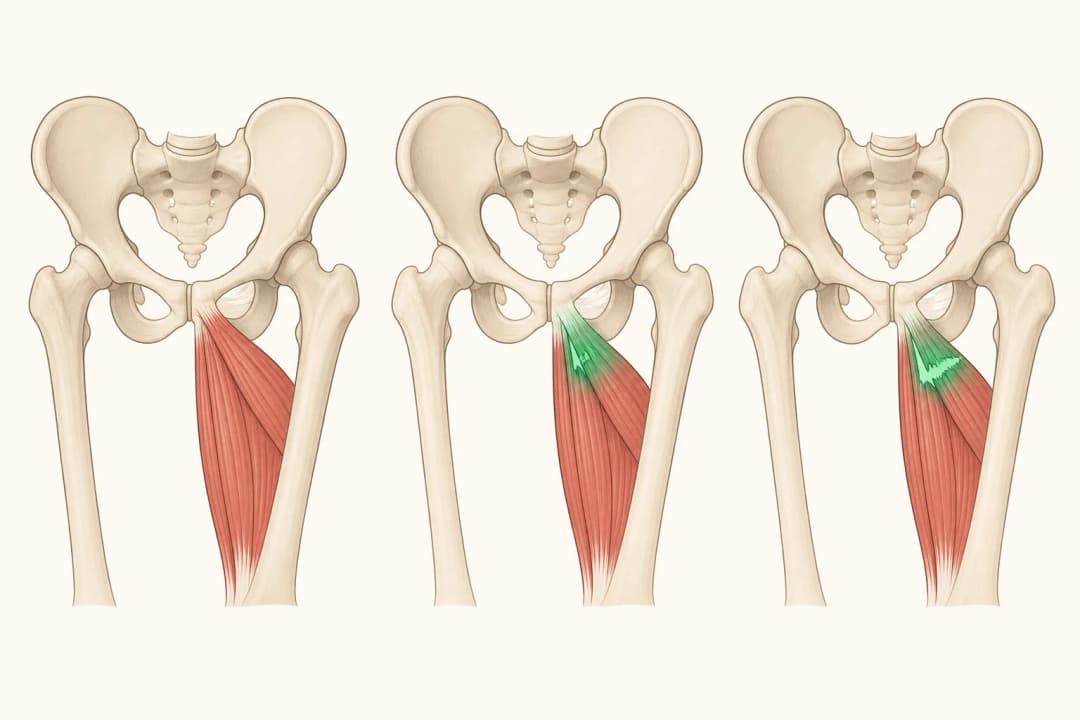
The groin contains the adductor muscles, tendons, hip joint, abdominal wall and supporting connective tissues. A sudden turn, kick, split-like movement, fall or heavy lift can irritate one or more of them. Pain may appear at the inner thigh, crease of the hip or pubic area and may worsen with bringing the leg inward, walking quickly, coughing or changing direction. The label ligament does not identify the injured tissue by itself.
An examination can map tenderness, test hip movement and compare strength. [Groin Pain](/symptoms/groin-pain/) includes other patterns that may need different care, especially when symptoms did not begin with a clear movement or injury.
How to manage it
Protect the area from the motion that provokes sharp pain while maintaining easy movement. For a recent injury, a cloth-wrapped cold pack may be soothing. Avoid forceful stretching, repeated self-testing and high-speed sport until basic movement is comfortable. Rehabilitation commonly progresses from gentle motion to controlled strengthening, followed by running, cutting or kicking drills when appropriate. [Exercise Therapy](/treatments/physiotherapy-and-rehabilitation/exercise-therapy/) can help tailor that progression.
Sports participants may benefit from [Sports Physiotherapy](/treatments/physiotherapy-and-rehabilitation/sports-physiotherapy/) to review technique and training load. Pain relief choices should be checked with a pharmacist or clinician when other health conditions or medicines are involved.
When to get checked
Arrange an assessment for ongoing pain, a pop, bruising, weakness, a limp or difficulty climbing stairs. Seek urgent care for inability to bear weight, severe swelling, a painful groin bulge, fever, major trauma, or testicular pain or swelling. Prompt review is also sensible when pain is severe without a clear injury.
Questions for a clinician
Ask which tissue seems affected, whether imaging is needed, which movements are safe, and how return to running or sport will be tested. Describe the injury mechanism, exact pain location, swelling, bruising and any abdominal, hip or testicular symptoms.
Find care
General Clinics & Polyclinics in Abu Dhabi
That answer is general. If you want it applied to your own case, these are licensed general clinics & polyclinics listed in Abu Dhabi.
27 Ar Ruwwad St - Shakhbout City - MSH4 - Abu Dhabi - United Arab Emirates
Accepts: Daman, Thiqa, Cigna, MetLife +20 more
Al Ruwais, Al Dhafrah
Accepts: Daman, Thiqa, AXA, Cigna +16 more
Al Bahyah - Al Bahyah Old - Abu Dhabi - United Arab Emirates
Accepts: Daman, Thiqa, Cigna, Allianz Care +18 more
Abu Dhabi
Accepts: Daman, Thiqa, AXA, Cigna +27 more
Ordered by verification status and how complete each clinic's public record is, then alphabetically. This is a directory listing, not a ranking — Zavis does not rate or recommend providers.
A factual listing drawn from the DHA, DOH and MOHAP licence registers. It is not a referral, an endorsement, or advice that any of these providers is right for you.
Questions people ask
Is a pulled groin ligament the same as a groin strain?
Not necessarily. Groin strain often refers to an adductor muscle injury, while the word ligament points to a different tissue; an examination can clarify the source.
When can you resume sport?
Resume in stages after daily movement, strength and sport-specific drills are comfortable, using a [Return-to-Sport Programme](/treatments/physiotherapy-and-rehabilitation/return-to-sport-programme/) when needed.
Related
Related reading
Keep reading
Medical disclaimer. This page is general health information, not medical advice, and it cannot diagnose you. Always consult a licensed healthcare provider about your own symptoms and treatment. In an emergency in the UAE, call 998 for an ambulance.