
How does a breast cancer gene expression test work?
Short answer
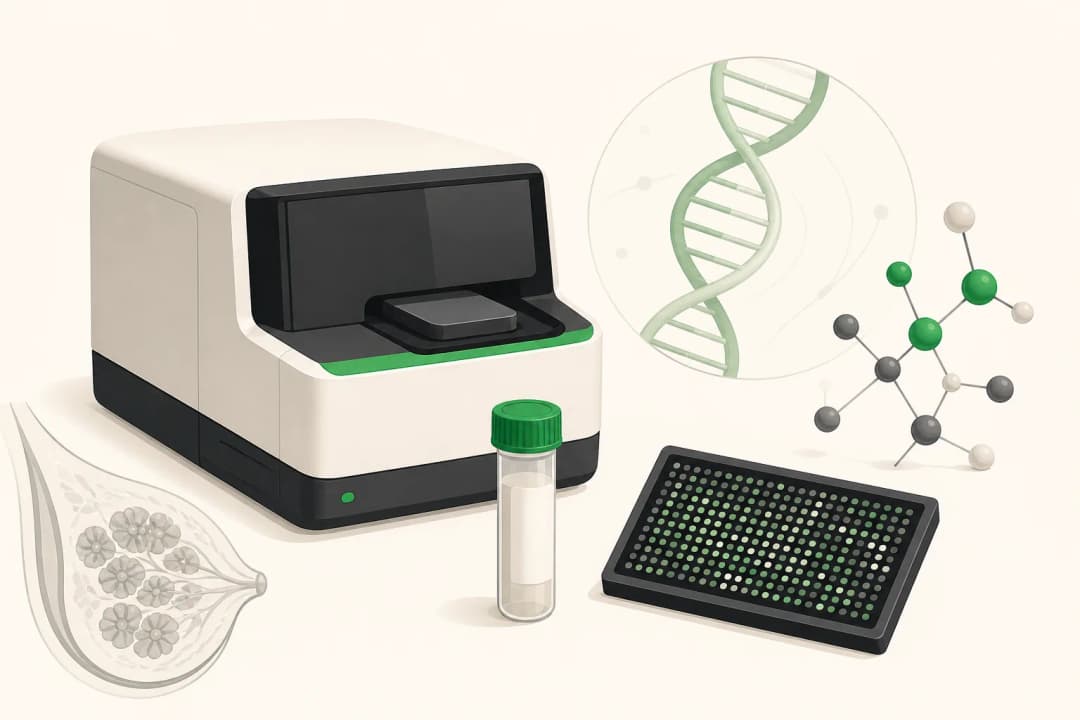
A breast cancer gene expression test analyses activity patterns in tumour tissue to help the care team judge recurrence risk and whether chemotherapy may be useful alongside other treatment information.
This answers one question. It is not a diagnosis and does not replace an assessment by a licensed doctor.
At a glance
- Sample
- Tumour tissue
- Purpose
- Support treatment planning
- Context
- Used with pathology findings
What is being measured
The laboratory examines which genes in the tumour are more or less active. This pattern is combined into a report that supports decisions after surgery or biopsy in selected breast cancers. The result is one part of the picture: tumour size, grade, lymph-node findings, hormone receptors, HER2 status, health and personal preferences also matter.
The test describes the tumour’s biology; it is not an inherited test for cancer risk in relatives. It also does not replace the pathology report or show whether a breast lump is cancer.
What to expect
Usually, the laboratory uses tissue already collected during a biopsy or operation, so another procedure may not be needed. The result is discussed with your oncology team, who can explain its category in the context of your diagnosis. Ask how the report would change the balance between endocrine treatment, chemotherapy, radiotherapy or observation, and whether the sample is suitable for testing.
When to contact your team
Contact your breast-care team if you are waiting for a result and do not know when it will be reviewed, or if a treatment recommendation is unclear. Seek prompt assessment for a new breast change rather than waiting for gene expression testing, because the test is performed on cancer tissue and cannot diagnose a symptom by itself.
Useful questions
Ask whether this test applies to your tumour type, what the report can and cannot predict, how it interacts with your pathology findings, and what treatment choices would change for each possible result.
Questions people ask
Is this the same as inherited genetic testing?
No. Gene expression testing studies activity in tumour tissue, while inherited testing examines DNA passed through families.
Does the report make the treatment decision alone?
No. Your oncology team combines it with pathology, examination, imaging, health and preferences.
Related
Related reading
Keep reading
Cancer care in the UAE
Hospitals & Medical Centers in Abu Dhabi
Most UAE cancer care is delivered inside hospital services rather than by standalone oncology clinics, so these are licensed hospitals & medical centers listed in Abu Dhabi. Confirm the specific cancer service exists before you travel, and know that asking for a second opinion is routine.
Ahalia Hospital Musaffah Building - Musaffah - Musaffah Industrial - Abu Dhabi - United Arab Emirates
Accepts: Daman, Thiqa, AXA, Cigna +26 more
Al Ruwais Industrial City - Abu Dhabi - United Arab Emirates
Accepts: Daman, Thiqa, AXA, Cigna +30 more
Abu Dhabi, Abu Dhabi
Accepts: Daman, Thiqa, AXA, Cigna +30 more
Second opinions are routine in cancer care and asking for one does not affect your treatment. How to arrange a second opinion in the UAE.
Ordered by verification status and how complete each clinic's public record is, then alphabetically. This is a directory listing, not a ranking — Zavis does not rate or recommend providers.
A factual listing drawn from the DHA, DOH and MOHAP licence registers. It is not a referral, an endorsement, or advice that any of these providers is right for you.
Medical disclaimer. This page is general health information, not medical advice, and it cannot diagnose you. Always consult a licensed healthcare provider about your own symptoms and treatment. In an emergency in the UAE, call 998 for an ambulance.