
What should you know about head and neck melanoma?
Short answer
Head and neck melanoma is a skin cancer that needs prompt assessment when a mole or mark changes in colour, shape, size, or sensation.
This answers one question. It is not a diagnosis and does not replace an assessment by a licensed doctor.
At a glance
- Check
- Scalp, ears, hairline, face, and neck during regular skin checks
- Do not do
- Do not self-remove, burn, or repeatedly traumatise a changing lesion
What melanoma can look like
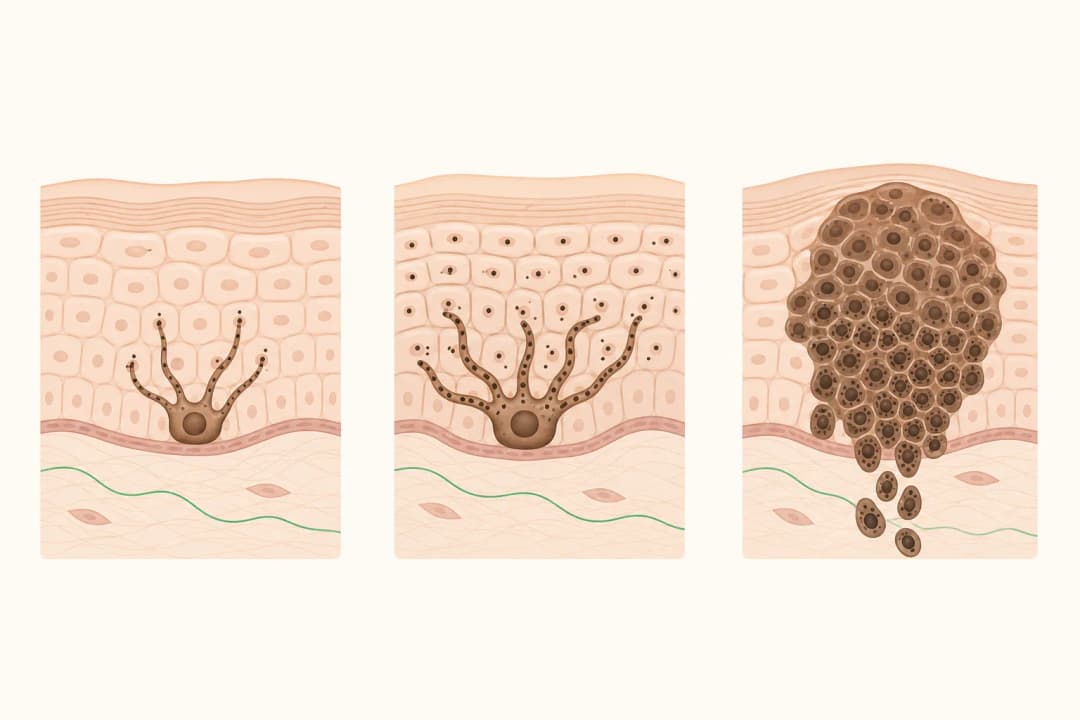
Melanoma may develop in an existing mole or appear as a new spot. Warning features include uneven halves, an irregular edge, more than one colour, noticeable growth, bleeding, crusting, or a persistent change in itch or tenderness. The scalp, ears, hairline, face, and back of the neck can be difficult to inspect, so a close relative or clinician may notice changes first. A changing mark is not automatically melanoma, but it deserves examination because appearance alone cannot confirm or exclude skin cancer.
What to do next
Book a dermatology assessment promptly and avoid picking, cutting, or attempting to remove the lesion yourself. Photographing the area beside a ruler can help document change, but it does not replace examination. A clinician may use dermoscopy and recommend a biopsy or Surgical Excision to establish the diagnosis. If melanoma is confirmed, the team may discuss Skin Cancer Surgery, margins, lymph-node assessment such as Sentinel Lymph Node Biopsy, and further treatment according to the findings.
When to seek care
Arrange prompt review for a new or changing pigmented lesion, especially if it bleeds, forms a persistent crust, becomes painful, or grows quickly. Seek urgent medical help for severe bleeding that does not stop with firm pressure, sudden neurological symptoms, or a rapidly worsening wound. After treatment, keep scheduled Follow-Up After Cancer Treatment appointments so new or recurrent changes can be assessed.
Questions for your doctor
Ask whether the mark needs a biopsy, how its location affects removal and repair, whether lymph-node assessment is appropriate, and what symptoms should prompt an earlier review. If treatment is needed, ask when Immunotherapy or other oncology care might be considered.
Find care
General Clinics & Polyclinics in Abu Dhabi
That answer is general. If you want it applied to your own case, these are licensed general clinics & polyclinics listed in Abu Dhabi.
27 Ar Ruwwad St - Shakhbout City - MSH4 - Abu Dhabi - United Arab Emirates
Accepts: Daman, Thiqa, Cigna, MetLife +20 more
Al Ruwais, Al Dhafrah
Accepts: Daman, Thiqa, AXA, Cigna +16 more
Al Bahyah - Al Bahyah Old - Abu Dhabi - United Arab Emirates
Accepts: Daman, Thiqa, Cigna, Allianz Care +18 more
Abu Dhabi
Accepts: Daman, Thiqa, AXA, Cigna +27 more
Ordered by verification status and how complete each clinic's public record is, then alphabetically. This is a directory listing, not a ranking — Zavis does not rate or recommend providers.
A factual listing drawn from the DHA, DOH and MOHAP licence registers. It is not a referral, an endorsement, or advice that any of these providers is right for you.
Questions people ask
Does every changing mole mean melanoma?
No. Many changing marks have other explanations, but a change should be assessed because visual inspection cannot provide a diagnosis.
Why can head and neck melanoma be easy to miss?
The scalp and back of the neck are hard to see, and hair or sun-exposed facial areas can hide subtle changes.
Related
Related reading
Keep reading
Medical disclaimer. This page is general health information, not medical advice, and it cannot diagnose you. Always consult a licensed healthcare provider about your own symptoms and treatment. In an emergency in the UAE, call 998 for an ambulance.