
What should you know about first stage melanoma?
Short answer
First-stage melanoma is localised skin cancer that usually needs careful surgical removal and an organised follow-up plan.
This answers one question. It is not a diagnosis and does not replace an assessment by a licensed doctor.
At a glance
- Meaning
- Melanoma confined to the skin at diagnosis
- Assessment
- Examination plus biopsy findings
- Typical focus
- Local removal and follow-up
Understanding the stage
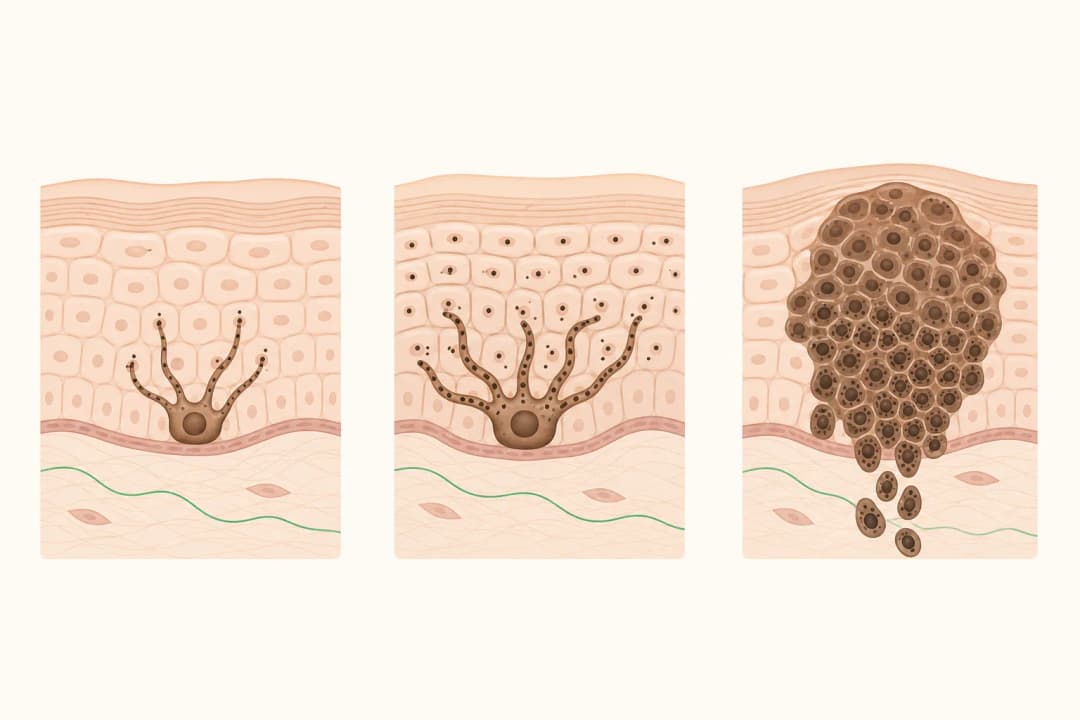
Stage one means the melanoma is confined to the skin at diagnosis. Doctors refine the stage using the biopsy report, including how deeply the tumour has grown and whether the surface is ulcerated. A visible mole or patch cannot show its stage by itself. Melanoma may appear as a changing dark spot, an irregular border, several colours, or a lesion that stands out from others. These features are reasons for assessment, not proof of cancer. See the broader guide to [Melanoma](/conditions/melanoma/).
Your clinician may examine the rest of your skin and nearby lymph nodes. Further testing is selected according to the pathology result and examination rather than automatically performed for every person.
Practical next steps
Keep the appointment arranged for examination or biopsy, and bring a list of medicines and any earlier photographs of the lesion. Do not pick, cut, or repeatedly irritate the area. If melanoma is confirmed, [Surgical Excision](/treatments/surgical-dermatology/excisional-surgery/) removes the lesion and a planned margin. Depending on its thickness, your team may discuss [Sentinel Lymph Node Biopsy](/treatments/diagnostics-and-staging/sentinel-lymph-node-biopsy/). Follow-up may include regular skin checks and [Follow-Up After Cancer Treatment](/treatments/survivorship-and-rehabilitation/post-treatment-surveillance/).
When to seek care
Arrange prompt review for a mole that changes in size, shape, colour, or sensation, or for a new pigmented spot that looks different from the rest. Seek urgent help for persistent bleeding, a rapidly enlarging lesion, severe pain, or spreading redness with fever. These symptoms need medical attention but do not by themselves identify melanoma or determine its stage.
Questions for your doctor
Ask what the biopsy shows, which features establish stage one, whether further surgery is needed, and how the wound will be cared for. Ask how often your skin and lymph nodes should be checked, which changes to report, and whether relatives need general skin-awareness advice.
Find care
General Clinics & Polyclinics in Abu Dhabi
That answer is general. If you want it applied to your own case, these are licensed general clinics & polyclinics listed in Abu Dhabi.
27 Ar Ruwwad St - Shakhbout City - MSH4 - Abu Dhabi - United Arab Emirates
Accepts: Daman, Thiqa, Cigna, MetLife +20 more
Al Ruwais, Al Dhafrah
Accepts: Daman, Thiqa, AXA, Cigna +16 more
Al Bahyah - Al Bahyah Old - Abu Dhabi - United Arab Emirates
Accepts: Daman, Thiqa, Cigna, Allianz Care +18 more
Abu Dhabi
Accepts: Daman, Thiqa, AXA, Cigna +27 more
Ordered by verification status and how complete each clinic's public record is, then alphabetically. This is a directory listing, not a ranking — Zavis does not rate or recommend providers.
A factual listing drawn from the DHA, DOH and MOHAP licence registers. It is not a referral, an endorsement, or advice that any of these providers is right for you.
Questions people ask
Is stage one melanoma curable?
Many localised melanomas are managed successfully with appropriate treatment, but your outlook depends on the pathology and individual clinical details.
Do I need scans for stage one melanoma?
Not everyone needs scans; your team decides based on examination, biopsy features, symptoms, and the confirmed stage.
Related
Related reading
Keep reading
Medical disclaimer. This page is general health information, not medical advice, and it cannot diagnose you. Always consult a licensed healthcare provider about your own symptoms and treatment. In an emergency in the UAE, call 998 for an ambulance.