
Does PRP injection treat patellar tendinitis?
Short answer
PRP injection may help selected cases of patellar tendinitis, but it does not replace a structured tendon-loading programme.
This answers one question. It is not a diagnosis and does not replace an assessment by a licensed doctor.
At a glance
- Core treatment
- Progressive tendon loading and activity adjustment.
- PRP role
- An optional consideration for selected persistent cases.
- Urgent sign
- Inability to straighten the knee after a sudden injury.
How PRP may fit
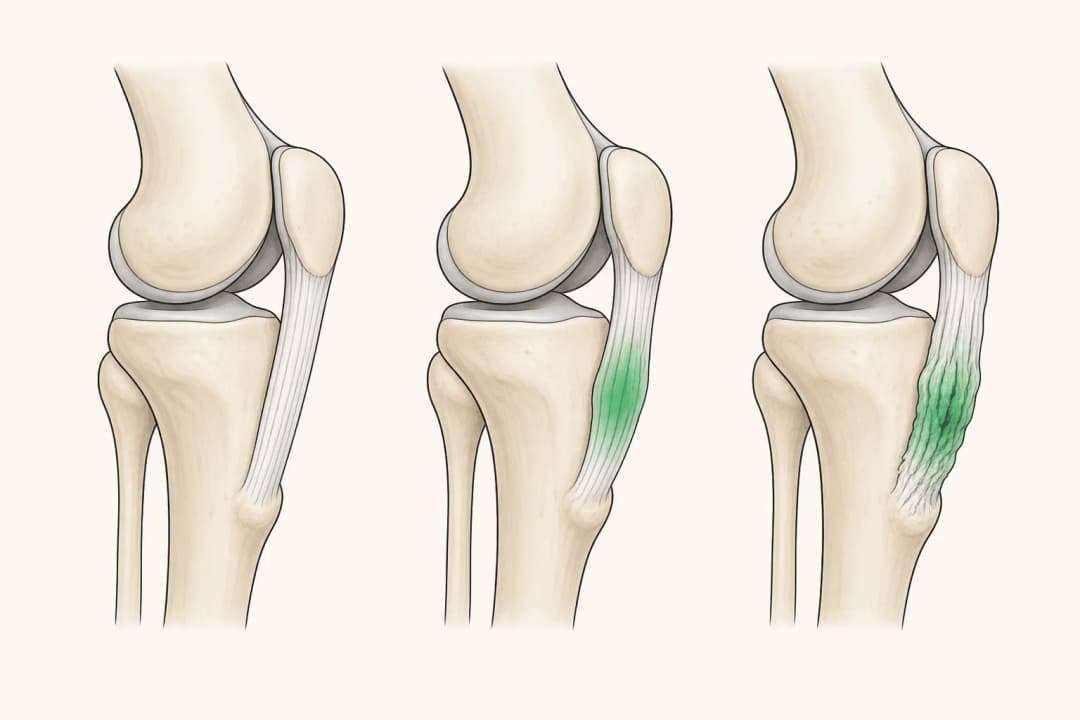
Patellar tendinitis, also called patellar tendinopathy, affects the tendon between the kneecap and shinbone. Pain often appears with jumping, stairs, squats, or repeated knee loading. PRP uses a preparation from your blood and is placed near the painful tendon to concentrate platelets and related signals.
The diagnosis should be checked because pain at the front of the knee can also come from the kneecap joint, fat pad, or other tissues. PRP is not a guaranteed solution and does not remove the need to correct training load, strength, and movement factors.
Practical next steps
Arrange an assessment when tendon pain persists, limits stairs or sport, or returns whenever activity increases. A clinician can examine the tendon, quadriceps and hip strength, landing mechanics, and training pattern. Treatment commonly includes temporarily reducing provoking loads and progressing isometric, slow strengthening, and sport-specific work.
If PRP is offered, ask why it is suitable, what rehabilitation follows it, how jumping and running will be reintroduced, and what other options are available. Do not increase activity simply because the injection has been given.
When to seek care promptly
Seek prompt care after a sudden pop if you cannot straighten the knee, raise the leg, or bear weight, because these signs can indicate a significant tendon injury. After injection, seek advice for fever, spreading redness, drainage, or rapidly worsening pain.
Questions for your doctor
Is the patellar tendon the source of my pain? What loading exercises should I start with? What might PRP add to rehabilitation? When can I return to jumping or running?
Find care
General Clinics & Polyclinics in Abu Dhabi
That answer is general. If you want it applied to your own case, these are licensed general clinics & polyclinics listed in Abu Dhabi.
27 Ar Ruwwad St - Shakhbout City - MSH4 - Abu Dhabi - United Arab Emirates
Accepts: Daman, Thiqa, Cigna, MetLife +20 more
Al Ruwais, Al Dhafrah
Accepts: Daman, Thiqa, AXA, Cigna +16 more
Al Bahyah - Al Bahyah Old - Abu Dhabi - United Arab Emirates
Accepts: Daman, Thiqa, Cigna, Allianz Care +18 more
Abu Dhabi
Accepts: Daman, Thiqa, AXA, Cigna +27 more
Ordered by verification status and how complete each clinic's public record is, then alphabetically. This is a directory listing, not a ranking — Zavis does not rate or recommend providers.
A factual listing drawn from the DHA, DOH and MOHAP licence registers. It is not a referral, an endorsement, or advice that any of these providers is right for you.
Questions people ask
Can PRP replace tendon exercises?
No. Tendon-loading exercises are central to restoring capacity, and PRP does not remove that requirement.
Is front-of-knee pain always patellar tendinitis?
No. Several knee structures can cause front-of-knee pain, so an examination helps identify the source.
Related
Related reading
Keep reading
Medical disclaimer. This page is general health information, not medical advice, and it cannot diagnose you. Always consult a licensed healthcare provider about your own symptoms and treatment. In an emergency in the UAE, call 998 for an ambulance.