
What should you know about cystoscopy catheter?
Short answer
A urinary catheter is not required after every cystoscopy, but it may be placed to support drainage, healing, irrigation, or monitoring.
This answers one question. It is not a diagnosis and does not replace an assessment by a licensed doctor.
At a glance
- Purpose
- A catheter keeps urine draining when the bladder or urinary passage needs support.
- Position
- The drainage bag stays below bladder level to help continuous flow.
- Removal
- Timing depends on why the catheter was placed and how recovery progresses.
The short answer
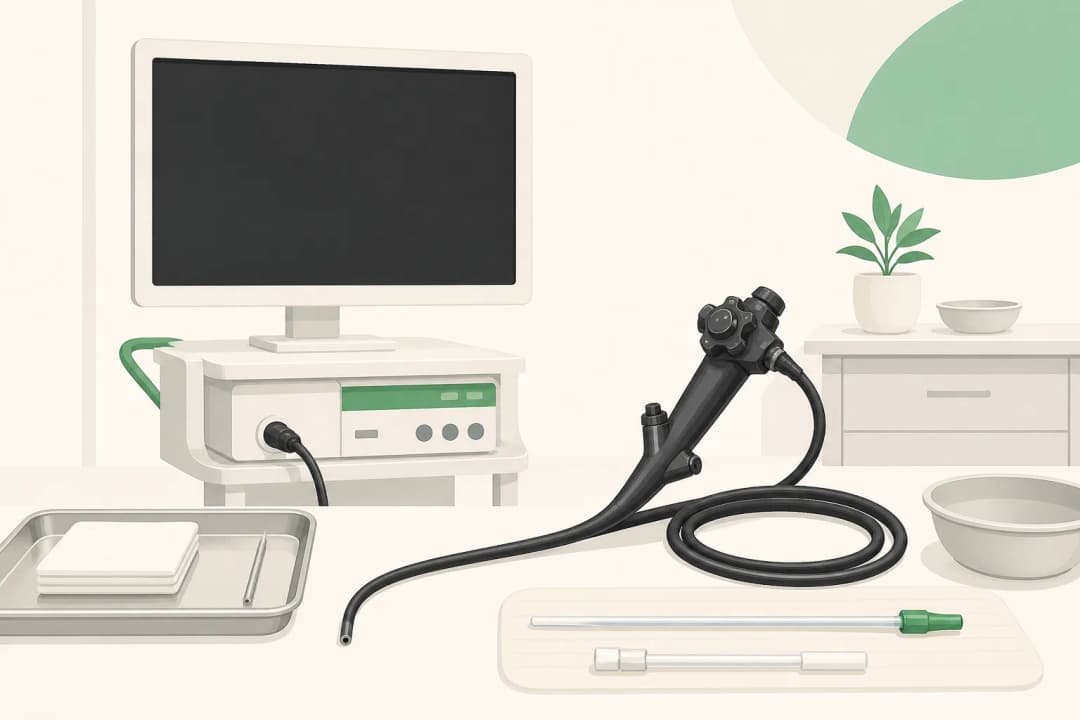
The catheter is a soft tube that passes through the urethra into the bladder. It may be removed before discharge or remain temporarily, depending on swelling, bleeding, difficulty urinating, and any biopsy or treatment performed through the scope.
Why catheter use varies
A straightforward viewing cystoscopy may finish without a catheter. One becomes more useful when the bladder must stay empty, urine output needs observation, or irrigation is needed to reduce blockage from blood and clots. It can also bypass temporary difficulty passing urine after anaesthesia or urinary tract treatment.
A small balloon inside the bladder holds an indwelling catheter in place. Urine travels through tubing into a drainage bag. Pressure, urgency, or bladder spasms can occur even while it drains, because the bladder may react to the tube and balloon.
Looking after the catheter
Wash your hands before and after handling the system. Keep the tubing free of kinks, secure it so it does not pull, and position the drainage bag below bladder level without letting it rest on the floor. Empty the bag using the method shown by the clinical team and avoid disconnecting the closed system unnecessarily.
Follow personalised advice on bathing, fluids, activity, medicines, and the removal appointment. Do not tug on the catheter or attempt removal unless you have explicit instructions. Check that urine continues to enter the bag; if flow slows, first look for compressed tubing or a bag that is too high.
Problems that need assessment
Contact the urology service for worsening bladder spasms, increasing leakage around the tube, cloudy or foul-smelling urine, new bleeding, or pain at the urinary opening. Fever and chills require prompt advice, especially when accompanied by back, side, or lower abdominal pain.
Get urgent help if the catheter stops draining and your bladder feels full or painful, heavy bleeding or clots obstruct the tubing, the catheter falls out, or you become faint, confused, or severely unwell. Never force the tube back into place or improvise irrigation at home.
What to confirm before discharge
Find out why the catheter is needed, how long it should remain, who will remove it, and what urine colour and discomfort are expected. Ask for a demonstration of bag care, written contact details, and a clear plan if drainage stops during the night.
Questions people ask
Will I have a catheter after a diagnostic cystoscopy?
Many viewing procedures do not need one, but the decision changes if there is swelling, bleeding, urinary retention, or added treatment.
Why can I feel urgency when the catheter is draining?
The tube and retaining balloon can irritate the bladder and trigger pressure or spasms even when urine is flowing.
What should I do if there is no urine in the bag?
Check for a kink or raised bag, then contact the care team promptly if flow does not resume or the bladder feels painful and full.
Related
Related reading
Keep reading
Cancer care in the UAE
Hospitals & Medical Centers in Abu Dhabi
Most UAE cancer care is delivered inside hospital services rather than by standalone oncology clinics, so these are licensed hospitals & medical centers listed in Abu Dhabi. Confirm the specific cancer service exists before you travel, and know that asking for a second opinion is routine.
Ahalia Hospital Musaffah Building - Musaffah - Musaffah Industrial - Abu Dhabi - United Arab Emirates
Accepts: Daman, Thiqa, AXA, Cigna +26 more
Al Ruwais Industrial City - Abu Dhabi - United Arab Emirates
Accepts: Daman, Thiqa, AXA, Cigna +30 more
Abu Dhabi, Abu Dhabi
Accepts: Daman, Thiqa, AXA, Cigna +30 more
Second opinions are routine in cancer care and asking for one does not affect your treatment. How to arrange a second opinion in the UAE.
Ordered by verification status and how complete each clinic's public record is, then alphabetically. This is a directory listing, not a ranking — Zavis does not rate or recommend providers.
A factual listing drawn from the DHA, DOH and MOHAP licence registers. It is not a referral, an endorsement, or advice that any of these providers is right for you.
Medical disclaimer. This page is general health information, not medical advice, and it cannot diagnose you. Always consult a licensed healthcare provider about your own symptoms and treatment. In an emergency in the UAE, call 998 for an ambulance.