
What should you know about choroidal melanoma causes?
Short answer
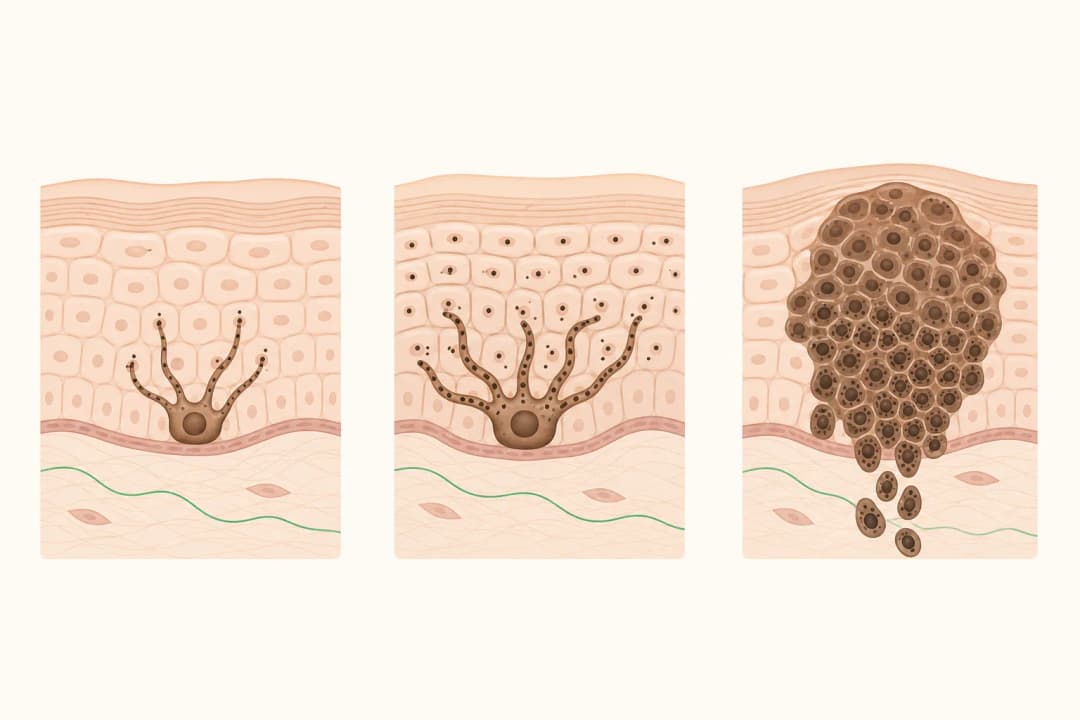
Choroidal melanoma develops when pigment-producing cells in the eye acquire changes that allow abnormal growth; one single cause is usually not identifiable.
This answers one question. It is not a diagnosis and does not replace an assessment by a licensed doctor.
At a glance
- Cell involved
- A melanocyte in the choroid
- Cause
- Acquired changes in cell growth control
- Prevention
- No dependable prevention strategy is known
How it can arise
The choroid contains melanocytes, cells that make pigment. Choroidal melanoma begins when one of these cells develops internal genetic changes affecting growth and survival. Those changes are usually acquired during life rather than inherited from a parent, and they are not caused by something a person did wrong.
Doctors may describe features such as a pigmented spot, a pre-existing eye lesion or the tumour's imaging pattern, but an apparent risk factor does not prove causation. A family history of certain rare eye or skin conditions may be relevant, so mention it during assessment. This disease is distinct from the more familiar skin form of Melanoma.
What you can do now
You cannot reliably prevent every case by changing a daily habit. Protecting the eyes from intense sunlight with well-fitting sunglasses and a brimmed hat is sensible for general eye health, but it should not be presented as a guarantee against this tumour.
If an eye specialist has found a suspicious lesion, attend imaging and review visits so growth can be compared over time. Ask whether observation, a biopsy or treatment is appropriate. A biopsy may provide tumour information, while surgery or focused treatment may control a confirmed lesion. Do not stop prescribed medicines or delay review because no clear cause has been found.
When symptoms need prompt review
Seek prompt eye care for new blurred or distorted vision, flashes, floaters, a blind spot or a dark area that persists. Sudden severe vision loss, intense eye pain, or a curtain-like shadow requires urgent assessment. These signs can reflect several eye emergencies, so urgency comes from the symptom itself, not from assuming it is melanoma.
Useful questions
Ask what the scans show, whether the lesion could be a benign choroidal naevus, whether any family pattern changes the assessment, and whether genetic analysis of tumour tissue would help guide follow-up. Ask which body symptoms should lead to earlier contact and how monitoring will be arranged.
Find care
General Clinics & Polyclinics in Abu Dhabi
That answer is general. If you want it applied to your own case, these are licensed general clinics & polyclinics listed in Abu Dhabi.
27 Ar Ruwwad St - Shakhbout City - MSH4 - Abu Dhabi - United Arab Emirates
Accepts: Daman, Thiqa, Cigna, MetLife +20 more
Al Ruwais, Al Dhafrah
Accepts: Daman, Thiqa, AXA, Cigna +16 more
Al Bahyah - Al Bahyah Old - Abu Dhabi - United Arab Emirates
Accepts: Daman, Thiqa, Cigna, Allianz Care +18 more
Abu Dhabi
Accepts: Daman, Thiqa, AXA, Cigna +27 more
Ordered by verification status and how complete each clinic's public record is, then alphabetically. This is a directory listing, not a ranking — Zavis does not rate or recommend providers.
A factual listing drawn from the DHA, DOH and MOHAP licence registers. It is not a referral, an endorsement, or advice that any of these providers is right for you.
Questions people ask
Did sunlight definitely cause my choroidal melanoma?
No. Sun exposure may be discussed during an eye-health review, but a definite cause is usually not identifiable for an individual.
Can choroidal melanoma run in families?
Most cases are not inherited, though a rare family history can matter and should be shared with the specialist.
Related
Related reading
Keep reading
Medical disclaimer. This page is general health information, not medical advice, and it cannot diagnose you. Always consult a licensed healthcare provider about your own symptoms and treatment. In an emergency in the UAE, call 998 for an ambulance.