
What should you know about canine cutaneous melanoma?
Short answer
Canine cutaneous melanoma is a pigment-cell tumour in the skin that requires veterinary examination, tissue diagnosis and planning based on its location and spread.
This answers one question. It is not a diagnosis and does not replace an assessment by a licensed doctor.
At a glance
- What it is
- A tumour of pigment-producing cells
- How it is confirmed
- Tissue examination
- Useful observation
- New or changing growths
What it can mean
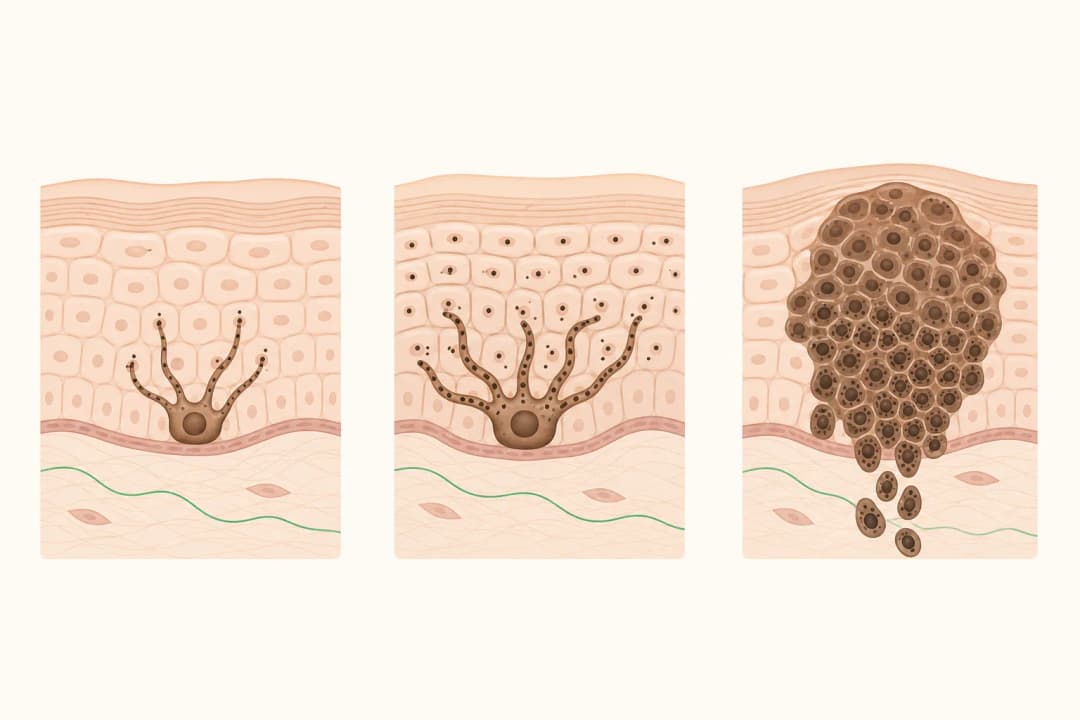
A skin lump, dark patch or changing mole can have several explanations, so colour and shape cannot diagnose melanoma. The veterinarian may inspect the growth, feel nearby lymph nodes and recommend sampling or removal for laboratory examination. The report can describe the tumour's cell features and whether the edges appear clear. Location matters: some sites behave more aggressively than others. Melanoma is the broader condition; a skin lesion is not automatically melanoma. Spread can involve lymph nodes or distant organs, and a specialist may discuss staging, including assessment for Brain Metastases when clinically relevant.
What to do after finding a growth
Book an appointment for any new, enlarging, bleeding, ulcerated or repeatedly irritated skin growth. Photograph it beside a familiar object and record its location, texture and changes, without picking at it. Do not try to remove or burn the lesion at home. Depending on the examination, options may include Surgical Excision, Skin Cancer Surgery or Tumour Removal Surgery. Ask how much tissue may be removed, whether lymph-node assessment such as Sentinel Lymph Node Biopsy is appropriate, and how the wound will be managed.
When to seek urgent care
Request prompt veterinary attention if the growth bleeds repeatedly, opens into a sore, becomes rapidly larger, causes marked pain or interferes with eating, walking, breathing or vision. Sudden weakness, collapse, persistent vomiting or new neurological changes also need urgent assessment. These signs indicate a need for timely care, not a diagnosis by themselves. If melanoma is confirmed, follow-up may include Follow-Up After Cancer Treatment and, for selected cases, Immunotherapy.
Questions for your veterinarian
Ask whether the lesion should be sampled or removed, what the pathology report will clarify, whether nearby nodes or chest imaging need evaluation, and what monitoring schedule fits the diagnosis.
Find care
General Clinics & Polyclinics in Abu Dhabi
That answer is general. If you want it applied to your own case, these are licensed general clinics & polyclinics listed in Abu Dhabi.
27 Ar Ruwwad St - Shakhbout City - MSH4 - Abu Dhabi - United Arab Emirates
Accepts: Daman, Thiqa, Cigna, MetLife +20 more
Al Ruwais, Al Dhafrah
Accepts: Daman, Thiqa, AXA, Cigna +16 more
Al Bahyah - Al Bahyah Old - Abu Dhabi - United Arab Emirates
Accepts: Daman, Thiqa, Cigna, Allianz Care +18 more
Abu Dhabi
Accepts: Daman, Thiqa, AXA, Cigna +27 more
Ordered by verification status and how complete each clinic's public record is, then alphabetically. This is a directory listing, not a ranking — Zavis does not rate or recommend providers.
A factual listing drawn from the DHA, DOH and MOHAP licence registers. It is not a referral, an endorsement, or advice that any of these providers is right for you.
Questions people ask
Does every dark skin lump mean melanoma?
No. Pigmented growths can have different causes, and only veterinary examination with tissue diagnosis can identify melanoma.
Can canine cutaneous melanoma spread?
Some melanomas can spread beyond the original skin site, which is why the veterinarian may discuss lymph nodes and staging.
Related
Related reading
Keep reading
Medical disclaimer. This page is general health information, not medical advice, and it cannot diagnose you. Always consult a licensed healthcare provider about your own symptoms and treatment. In an emergency in the UAE, call 998 for an ambulance.