
Anatomical liver resection explained
Short answer
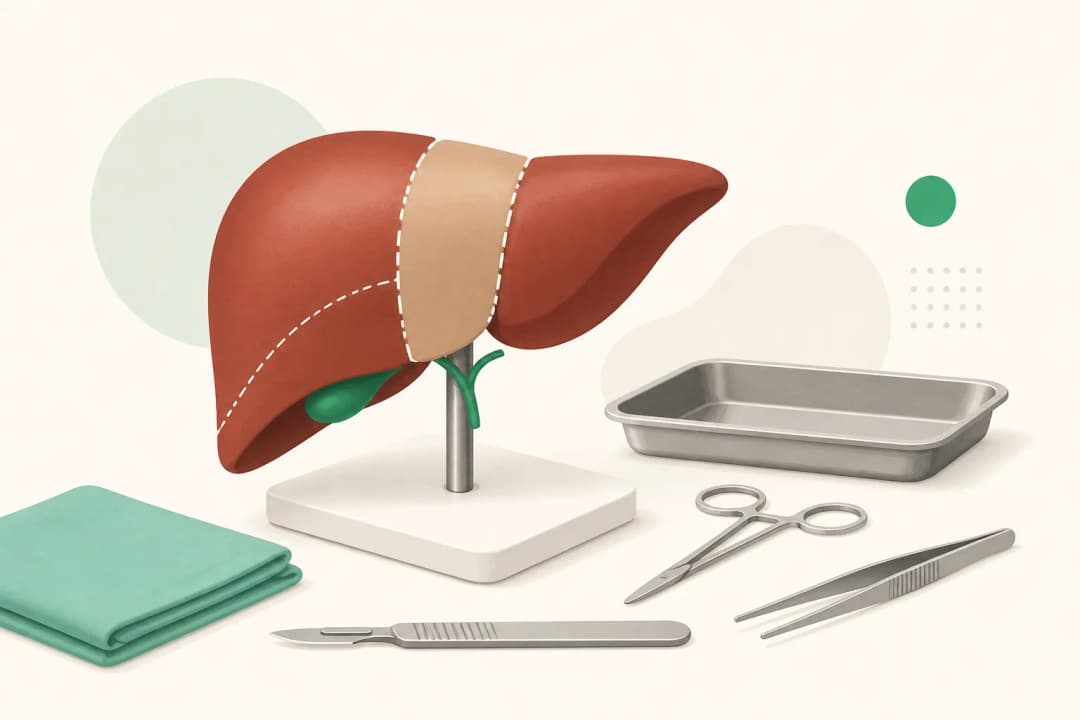
An anatomical liver resection removes a tumour-bearing liver segment together with the blood vessels and bile ducts serving it.
This answers one question. It is not a diagnosis and does not replace an assessment by a licensed doctor.
At a glance
- Surgical principle
- Follows natural liver segments
- Tissue removed
- Tumour-bearing segment and its internal branches
- Planning focus
- Tumour anatomy and healthy liver remaining
The short answer
The operation follows the liver’s internal segment boundaries. This differs from a non-anatomical or wedge resection, which removes the tumour with a surrounding margin without taking an entire defined segment.
Why surgeons may choose this approach
Liver segments have their own branches of the portal vein, hepatic artery and bile ducts. Removing tissue along these boundaries can allow a surgeon to control those structures deliberately and remove disease distributed within a particular segment.
Anatomical resection may be considered for primary liver cancer or selected tumours that have spread to the liver, including some from bowel cancer. The decision depends on tumour position, its relationship to major vessels, liver function, the amount and location of healthy liver that would remain, and the person’s general fitness. Tumour ablation or another resection pattern may suit a different anatomy.
Preparing for surgery and recovery
Before surgery, the team reviews detailed scans and blood tests and may assess how well the future liver remnant is expected to function. Give the surgical team a complete list of medicines and supplements, and follow their instructions about fasting and medicines that affect bleeding.
After the operation, pain control, breathing exercises and gradual movement support recovery. Staff monitor liver function, bleeding, infection and bile leakage. At home, follow wound-care and activity advice, eat as tolerated, and avoid driving or lifting until the surgical team says these are appropriate.
Warning signs after liver surgery
Seek urgent help for severe breathing difficulty, chest pain, fainting or heavy bleeding. Contact the surgical team promptly for fever, worsening abdominal pain or swelling, repeated vomiting, increasing wound redness or discharge, yellowing of the skin or eyes, confusion, very dark urine, or pale stools. Use the discharge contact route even if you are unsure whether a change is expected.
Questions before giving consent
Ask which segments are planned for removal, whether the operation will be open or minimally invasive, and how much healthy liver is expected to remain. Other useful topics include possible changes to the plan during surgery, the role of ablation, the expected hospital course, pathology results and whether further cancer treatment may follow.
Questions people ask
Is anatomical liver resection the same as a wedge resection?
No. Anatomical resection follows a defined liver segment and its vascular territory. A wedge resection removes the lesion and a margin without following the full segment boundary.
Can the liver work after part of it is removed?
The remaining liver can adapt and increase its functional capacity. Surgeons assess the anticipated remnant carefully because recovery also depends on its underlying health and the extent of surgery.
Does every liver tumour need anatomical resection?
No. Tumour location, number and type, liver health and other treatment options all influence the choice. Some people may have a wedge resection, ablation, systemic treatment or a combined approach.
Related
Related reading
Keep reading
Cancer care in the UAE
Hospitals & Medical Centers in Abu Dhabi
Most UAE cancer care is delivered inside hospital services rather than by standalone oncology clinics, so these are licensed hospitals & medical centers listed in Abu Dhabi. Confirm the specific cancer service exists before you travel, and know that asking for a second opinion is routine.
Ahalia Hospital Musaffah Building - Musaffah - Musaffah Industrial - Abu Dhabi - United Arab Emirates
Accepts: Daman, Thiqa, AXA, Cigna +26 more
Al Ruwais Industrial City - Abu Dhabi - United Arab Emirates
Accepts: Daman, Thiqa, AXA, Cigna +30 more
Abu Dhabi, Abu Dhabi
Accepts: Daman, Thiqa, AXA, Cigna +30 more
Second opinions are routine in cancer care and asking for one does not affect your treatment. How to arrange a second opinion in the UAE.
Ordered by verification status and how complete each clinic's public record is, then alphabetically. This is a directory listing, not a ranking — Zavis does not rate or recommend providers.
A factual listing drawn from the DHA, DOH and MOHAP licence registers. It is not a referral, an endorsement, or advice that any of these providers is right for you.
Medical disclaimer. This page is general health information, not medical advice, and it cannot diagnose you. Always consult a licensed healthcare provider about your own symptoms and treatment. In an emergency in the UAE, call 998 for an ambulance.