
Bioabsorbable Screws: Uses, Properties and What Patients Should Know
At a glance
- Main purpose
- Temporary fixation of healing bone, tendon, or ligament tissue
- Material behaviour
- Designed to gradually break down in the body
- Common setting
- Selected sports and orthopaedic reconstruction procedures
- Recovery reminder
- Rehabilitation and protection instructions remain essential
What is a bioabsorbable screw?
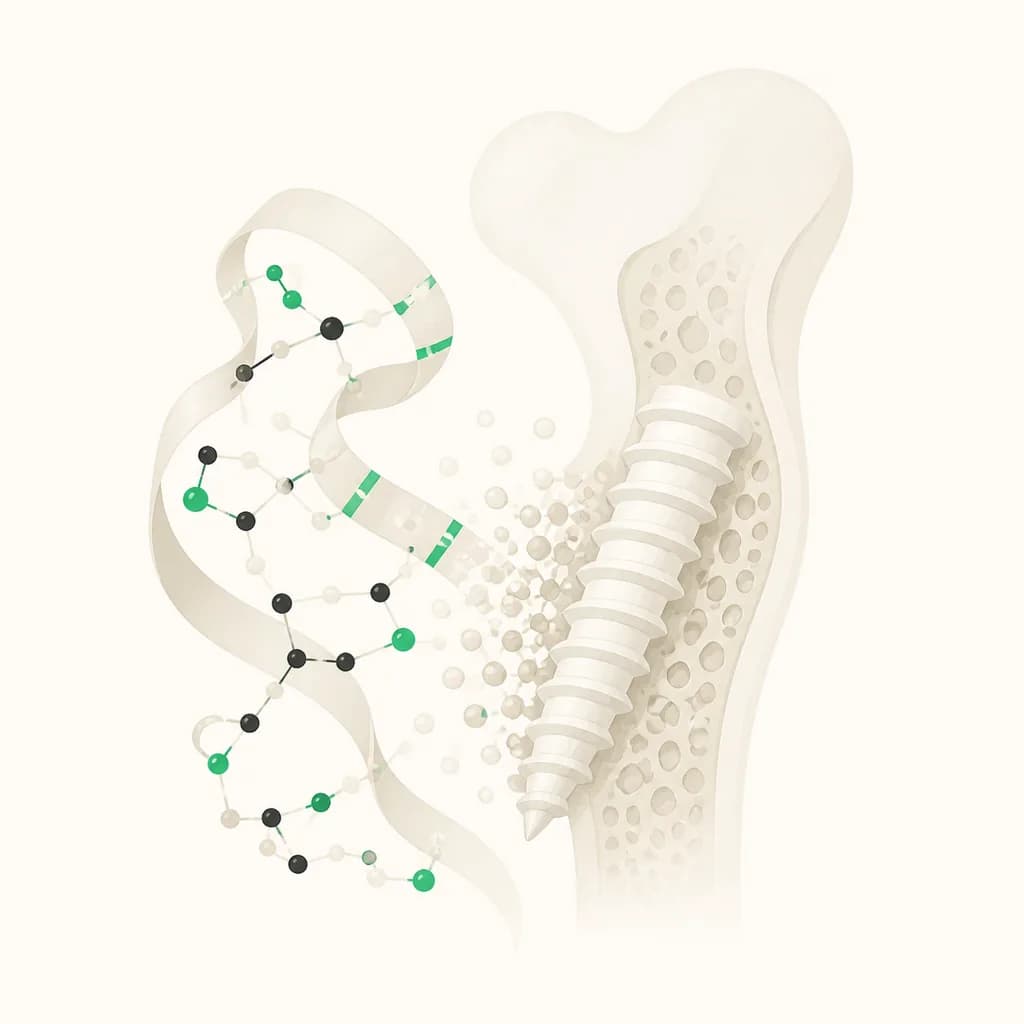
A bioabsorbable screw is an implant designed to hold healing tissue or bone while gradually breaking down inside the body.
Surgeons place these screws into bone or through a tendon or ligament graft when a temporary fixation point is needed. They are made from materials that the body can gradually process, rather than from metal intended to remain in place indefinitely. The exact material and design vary by implant and procedure.
The screw provides early mechanical support while the repaired tissue attaches and strengthens. Its presence does not replace the healing process: protection, movement restrictions, and rehabilitation still depend on the operation and the clinician's plan.
Key properties
A bioabsorbable screw is selected for how it behaves during fixation and how its material changes over time. Strength, insertion control, visibility on scans, and the pattern of breakdown can all matter.
Where are they used?
These screws may be used in selected sports and orthopaedic procedures to secure a ligament or tendon graft, or to hold a small bone fragment while it heals. One recognised setting is ACL reconstruction, where a graft is fixed in prepared bone tunnels.
The choice depends on the location, the tissue being fixed, the surgeon's technique, and the patient's anatomy. A bioabsorbable option is not suitable for every repair. The implant's role is temporary fixation; it does not itself rebuild a torn ligament or speed every part of recovery.
What are the alternatives?
Metal screws are a common alternative and can provide durable fixation. Other absorbable designs may use different polymers or composite materials. In some procedures, fixation may also involve buttons, anchors, plates, or more than one device.
The alternative depends on the repair site and the forces the fixation must withstand. During a surgical consultation, ask which device is planned, why it fits the repair, and whether it could affect future imaging or another operation.
What does this mean for a patient?
You may not feel the screw itself. Early symptoms after surgery usually relate to the operation and healing tissues, such as swelling, stiffness, or soreness. Follow the prescribed weight-bearing, brace, wound-care, and exercise instructions because fixation can be protected even when pain is settling.
Tell your surgical team about increasing warmth, spreading redness, drainage, fever, a new loss of movement, or sudden worsening pain. These symptoms need clinical assessment and should not be attributed automatically to the implant.
Before another scan or procedure, mention that you have had orthopaedic fixation and provide the operation details if available. Your clinician can explain the implant material and whether any follow-up imaging is appropriate.
Longevity and safety
The screw is intended to support the repair during a defined phase of healing, then gradually lose its original form as the material breaks down. The pace and appearance of this process vary with the material, implant size, location, and individual healing. A clinician may use examination or imaging if symptoms or the procedure call for review.
Like any implanted device, it can be associated with issues such as irritation, inflammation, breakage, migration, infection, or a reaction to the material. These possibilities are not a prediction of what will happen to you. Contact the surgical team promptly if your wound changes, pain escalates, or function worsens after initial improvement.
Find care
General Clinics & Polyclinics in Abu Dhabi
Licensed general clinics & polyclinics listed in Abu Dhabi, for the reader who wants this looked at in person.
27 Ar Ruwwad St - Shakhbout City - MSH4 - Abu Dhabi - United Arab Emirates
Accepts: Daman, Thiqa, Cigna, MetLife +20 more
Al Ruwais, Al Dhafrah
Accepts: Daman, Thiqa, AXA, Cigna +16 more
Al Bahyah - Al Bahyah Old - Abu Dhabi - United Arab Emirates
Accepts: Daman, Thiqa, Cigna, Allianz Care +18 more
Abu Dhabi
Accepts: Daman, Thiqa, AXA, Cigna +27 more
Ordered by verification status and how complete each clinic's public record is, then alphabetically. This is a directory listing, not a ranking — Zavis does not rate or recommend providers.
A factual listing drawn from the DHA, DOH and MOHAP licence registers. It is not a referral, an endorsement, or advice that any of these providers is right for you.
Questions people ask
Will a bioabsorbable screw need to be removed?
It is designed to break down gradually, so routine removal is not usually the purpose of choosing it. Your surgeon decides whether follow-up is needed if symptoms or healing concerns arise.
Can I have an MRI with a bioabsorbable screw?
Many bioabsorbable screws are selected partly because they may interfere less with some imaging than metal, but the exact implant matters. Tell the imaging team about your surgery before the scan.
Does the screw make recovery faster?
The screw holds tissue in position; it does not by itself determine healing speed. The repair, protection plan, rehabilitation, and individual recovery all affect progress.
Related
Related reading
Keep reading
Medical disclaimer. This page is general health information, not medical advice, and it cannot diagnose you. Always consult a licensed healthcare provider about your own symptoms and treatment. In an emergency in the UAE, call 998 for an ambulance.