
UOS and Gulf Drug sign 2026 pharmacy automation MoU for UAE training pipeline
UOS and Gulf Drug will build pharmacy automation training capacity. UAE clinics, insurers and patients should watch workforce readiness and dispensing safety.
How Zavis verifies this coverage
Editorial standards, source rules, methodology, and review provenance are public.
University of Sharjah (UOS) has signed a memorandum of understanding with Gulf Drug LLC to train pharmacy students on automation and digital pharmacy, according to Sharjah24 on 26 September 2026.
The highest-stakes readers are COOs, CIOs and medical directors. For UAE clinics and hospital pharmacies, the agreement points to a practical gap: automation projects fail when staff cannot operate dispensing systems, barcode workflows, stock controls and pharmacy data tools under regulator scrutiny. Dubai providers answer to the Dubai Health Authority (DHA), Abu Dhabi and Al Ain providers answer to the Department of Health Abu Dhabi (DOH), and pharmacies in Sharjah and the northern emirates operate under the Ministry of Health and Prevention (MOHAP) licensing framework.
What UOS and Gulf Drug agreed
The MoU was signed for UOS by Dr Salah Taher Al Haj, Vice Chancellor for Community Affairs, and for Gulf Drug by David Mazhar, General Manager. Sharjah24 said the agreement covers student training, seminars, workshops, lectures and support for academic course development in pharmacy automation and digital pharmacy.
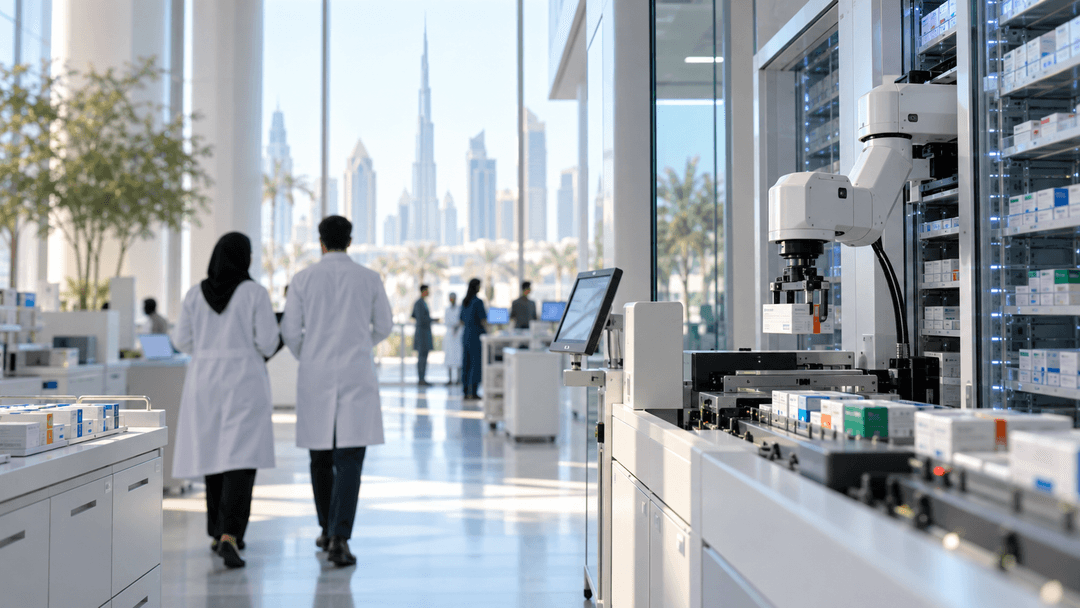
The central asset is an advanced pharmacy simulation laboratory. UOS said the lab will give students and faculty hands-on exposure to pharmacy automation and digital technologies in an educational setting. Prof. Karim El-Zu’bi, Dean of the College of Pharmacy, attended for UOS. Mohammed Othman, Senior Pharmacy Automation Sales Specialist, attended for Gulf Drug.
This is the second visible UOS-Gulf Drug activity in 2026. On 27 January 2026, UOS hosted a Pharmacy Automation and Digital Health Seminar with Gulf Drug and the Emirates Clinical Pharmacy Society, covering automation, digital transformation and artificial intelligence in pharmacy practice, according to Sharjah24.
Why Dubai clinics and insurers should care
Dubai pharmacy operators face the fastest commercial pressure because the emirate has dense private outpatient demand, large pharmacy chains and insurer-led cost controls. DHA licensing and Dubai Medical Registry data remain the first checkpoints for whether a facility or pharmacist can provide regulated care. The DHA describes Sheryan as the licensing system for facilities and professionals, and its Dubai Medical Registry as a public directory of registered facilities and professionals.
For CFOs and CIOs, the MoU is less about a university partnership and more about the labour cost of digital pharmacy. No AED value was disclosed for the simulation lab, and neither UOS nor Gulf Drug published a procurement amount. Operators pricing similar projects should ask vendors for written quotes across four line items:
- automation hardware and installation for each pharmacy site;
- software licences, annual maintenance and service-level terms;
- integration with the clinic information system, electronic medical record and insurer e-claims workflow;
- training hours, competency sign-off and post-go-live support.
Insurers such as Daman, Thiqa and Sukoon have different networks and reimbursement rules, so pharmacy automation has to connect with payer operations as well as dispensing practice. Before buying systems, clinics should confirm whether the pharmacy is in-network, whether prior authorisation workflows apply, and whether medicine claims need specific electronic fields. Those answers sit in payer provider portals and contracts, not in the UOS announcement.
What changes for patients and pharmacy teams
Patients are unlikely to see an immediate change at the counter. The short-term effect is workforce preparation. UOS pharmacy students who train on automated dispensing, digital inventory tools and simulated medication workflows may enter UAE clinics with fewer basic training gaps. That matters for operators hiring junior pharmacists in Dubai, Abu Dhabi, Sharjah, Ajman, Ras Al Khaimah, Fujairah and Umm Al Quwain.
For medical directors, the liability question is supervision. Automation can reduce manual handling errors only when formularies, user permissions, barcode checks, override rules and audit trails are configured correctly. Those controls should be documented before go-live and tested again after any software update. A clinic should keep records showing who was trained, on which date, and on which system version.
For patients, the practical benefits are narrower queues, cleaner stock visibility and fewer avoidable dispensing delays. The risks are also practical: wrong item mapping, incomplete medicine histories and poor handover between prescriber, pharmacist and insurer. Patients should verify that a pharmacy is licensed before using home delivery or digital refill services, especially when the provider operates across emirates.
The next point to watch is whether UOS and Gulf Drug publish the lab opening date, equipment scope or student intake numbers. Until then, UAE operators should treat the MoU as a workforce signal, not a procurement benchmark. To check licensed pharmacy providers, start with the UAE Open Healthcare Directory, which lists licensed healthcare providers across the seven emirates and includes pharmacy as a searchable category.
Zavis Intelligence
Healthcare Industry Desk
Contributing to UAE healthcare industry coverage
Related coverage

FAQ
What is happening in UAE healthcare industry?
UOS and Gulf Drug will build pharmacy automation training capacity. UAE clinics, insurers and patients should watch workforce readiness and dispensing safety.