

Sudden cardiac arrest in under-35s: the 7-minute Dubai response that matters
A numbers-led explainer on sudden cardiac arrest in young adults. Dubai readers get response times, screening limits and insurer checks.
How Zavis verifies this coverage
Editorial standards, source rules, methodology, and review provenance are public.
Sudden cardiac arrest in a young adult is an electrical failure, and the first operational number is 998, the UAE ambulance number that applies in Dubai, Abu Dhabi and the northern emirates.
For Dubai employers, gyms, schools and sports clubs, the practical issue is response design. The American Heart Association says immediate CPR can double or triple survival after cardiac arrest. A review in Critical Care reported that survival from witnessed ventricular fibrillation falls by 7% to 10% for every minute without CPR or defibrillation. That means the AED location, trained bystander and ambulance call script are board-level controls, not wellness extras.
What happens in the first minutes
Cardiac arrest is different from a heart attack. In arrest, the heart stops pumping effectively. The person collapses, becomes unresponsive and usually stops breathing normally. In a heart attack, a blocked artery injures heart muscle, but the person may remain awake and breathing.
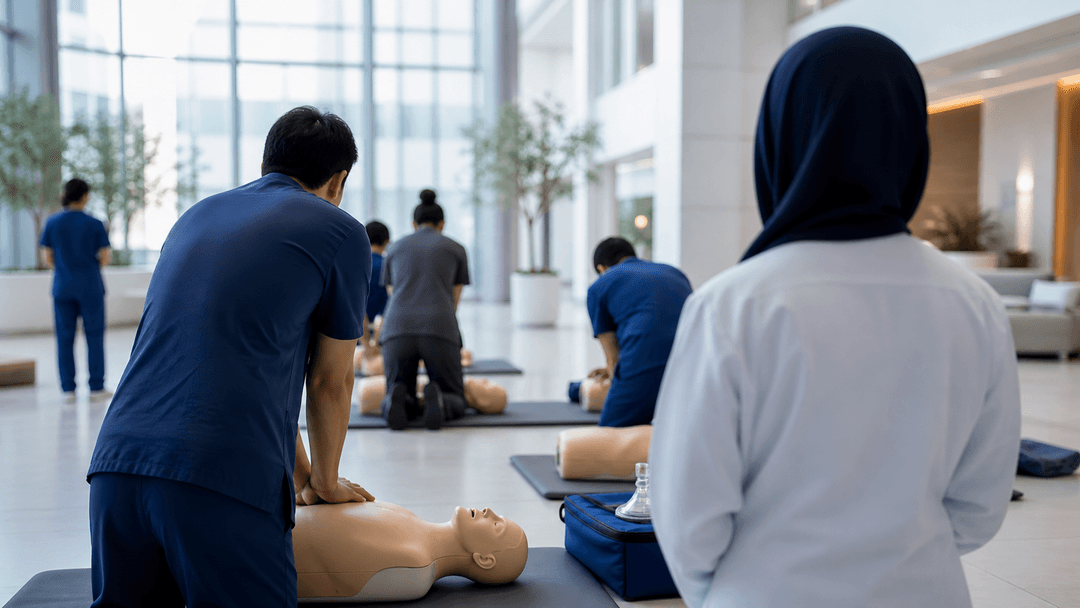
The workflow in Dubai should be simple enough for a receptionist, coach or colleague to execute under stress: call 998, start chest compressions, send one person for the AED, follow the AED voice prompts, and continue until Dubai Corporation for Ambulance Services or emergency clinicians take over. The same emergency number is listed by the UAE Government portal for ambulance access anywhere in the UAE.
- 0 minutes: collapse, no normal breathing, call 998.
- 1 to 2 minutes: start CPR and locate the AED.
- 3 to 5 minutes: attach AED pads and shock if advised.
- 10 minutes: survival odds are materially lower without earlier CPR.
Why young adults still arrest
The risk is low, but it is real. A prospective US study of 331 athlete sudden cardiac arrest or death cases, published in the British Journal of Sports Medicine, found common causes included hypertrophic cardiomyopathy at 20.6%, idiopathic left ventricular hypertrophy at 13.4%, coronary artery anomalies at 12.0% and autopsy-negative sudden unexplained death at 9.6%.
Those numbers matter for medical directors in Dubai clinics because a normal-looking young adult can still have inherited or structural disease. Screening usually starts with history, family history, examination and ECG. Echocardiography, exercise testing, Holter monitoring, cardiac MRI or genetic review may follow when symptoms or family history justify it.
Screening has limits. Some events come from conditions that can be missed between tests, including myocarditis after viral illness, channel disorders with intermittent ECG findings, and commotio cordis after a chest blow at a precise point in the heartbeat. A sports club cannot buy its way out of risk with one pre-season form. It needs emergency drills and documented AED checks.
What Dubai operators should price and document
Dubai Health Authority (DHA) regulates Dubai providers. Department of Health Abu Dhabi (DOH Abu Dhabi) regulates Abu Dhabi and Al Ain. Ministry of Health and Prevention (MOHAP) covers the northern emirates. Operators should keep cardiology referrals inside the correct licensed network and document emergency incidents in the patient record.
Cash prices vary by provider and package design. Publicly advertised Dubai cardiac check packages range from AED 899 for a basic package at one hospital to AED 3,200 for a comprehensive cardiac check at another provider. That is a market signal, not a tariff. For insured patients, Daman, Thiqa and Sukoon members should check network status, co-payment and pre-approval requirements before non-urgent echo, treadmill testing, Holter monitoring or cardiac MRI. Emergency care is handled differently from elective work; the insurer card and table of benefits decide the bill.
COOs should audit four items before the next sports season or corporate fitness event: AED location, monthly AED battery and pad expiry checks, named CPR-trained staff on each shift, and a written 998 call protocol with the facility address in English and Arabic. CIOs in Dubai should confirm that incident documentation and cardiology follow-up can move through the clinic EMR and DHA’s NABIDH health information exchange where applicable.
For patients and operators choosing follow-up care, start with licensed cardiology providers rather than social media recommendations. The UAE Open Healthcare Directory lists 12,384+ licensed providers across all seven emirates, with cardiology as one of its covered specialties.
Zavis Intelligence
Healthcare Industry Desk
Contributing to UAE healthcare industry coverage
Related coverage



FAQ
What is happening in UAE healthcare industry?
A numbers-led explainer on sudden cardiac arrest in young adults. Dubai readers get response times, screening limits and insurer checks.