
SEC reviews 5 University Hospital Sharjah projects as AED 300m expansion moves ahead
Sharjah reviewed UHS expansion plans covering beds, emergency care, pharmacy and elderly care. Clinics and insurers should track referral and network effects.
How Zavis verifies this coverage
Editorial standards, source rules, methodology, and review provenance are public.
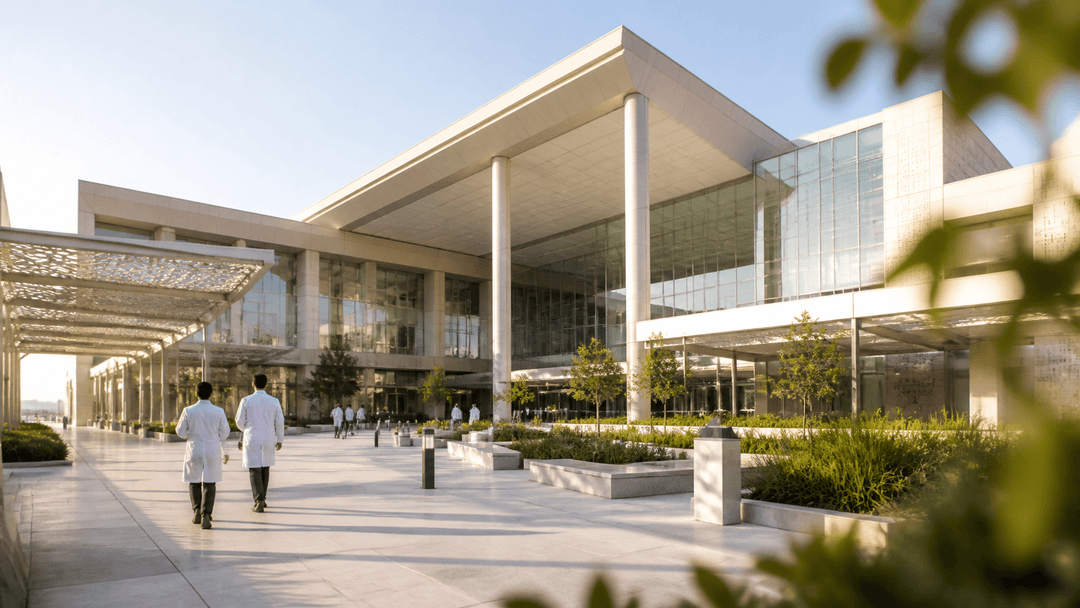
Sharjah Executive Council (SEC) reviewed operational and expansion projects at University Hospital Sharjah on 1 September 2026, including an automated pharmacy, hospital building expansion, a physiotherapy building, an elderly care centre and upgrades to emergency, radiology and electronic systems.
The highest-stakes readers are hospital COOs, insurer network heads and clinic owners. UHS is a tertiary teaching hospital in the northern emirates, regulated through the Ministry of Health and Prevention (MOHAP) framework rather than Dubai Health Authority (DHA) or Department of Health Abu Dhabi (DOH Abu Dhabi). More capacity in Sharjah can shift referrals that now move into Dubai for diagnostics, interventional radiology, rehabilitation and complex elderly care.
What SEC reviewed
The SEC meeting was chaired by Sheikh Abdullah bin Salem bin Sultan Al Qasimi, Deputy Ruler of Sharjah and Vice Chairman of SEC, with Sheikh Sultan bin Ahmed bin Sultan Al Qasimi, Deputy Ruler of Sharjah and Vice Chairman of SEC, according to UAE Barq. The hospital report covered projects intended to increase capacity and improve patient movement through departments and facilities.
The published SEC account named several workstreams, but gave no tender value, commissioning date or contractor name for the latest review. Operators should separate confirmed scope from assumptions. The checkable items are:
- Emergency Department development, relevant to ambulance diversion, triage times and walk-in overflow.
- Pharmacy development and an automated pharmacy, relevant to dispensing speed, stock control and medication safety.
- Interventional Radiology Department expansion, relevant to referrals for minimally invasive procedures.
- Electronic systems upgrades, relevant to staff workflows, patient data entry and claims documentation.
- Physiotherapy Building and Elderly Care Centre, relevant to rehabilitation demand and long-stay care pathways.
The review follows a wider expansion announced in June 2026. Gulf News reported on 17 June 2026 that Sheikh Dr Sultan bin Mohammed Al Qasimi ordered an AED 300 million UHS expansion to raise capacity by 100%. That project was reported to include 72 doctors' rooms, 22 assessment rooms, 48 standard patient rooms with 72 beds, 14 intensive care rooms, a helipad and 300 parking spaces, taking total parking above 1,200 spaces.
Why Dubai clinics and insurers should care
For Dubai clinics, the practical issue is leakage. A stronger Sharjah tertiary hospital gives patients in Al Nahda, Muhaisnah, Mirdif and Deira another route for imaging-led procedures, emergency follow-up and rehabilitation. DHA-licensed providers should watch whether referral coordinators see fewer Sharjah patients travelling into Dubai for diagnostics or specialist consults once the UHS projects open.
For insurers and third-party administrators, the relevant question is network design. If UHS adds beds, assessment rooms and interventional radiology capacity, payers may need to revisit authorisation rules, bundled rehabilitation pricing and preferred-provider routing for Sharjah members. The SEC statement did not publish tariff changes. Finance teams should verify contracted rates directly through provider relations teams and compare them with DHA and DOH Abu Dhabi network benchmarks before changing referral rules.
For patients, the clearest effect is access. A larger emergency and assessment footprint can reduce the need to cross emirate lines for acute care. An elderly care centre and a physiotherapy building can also shorten the distance between discharge, rehabilitation and family support. Those gains depend on staffing, licensing and insurer approvals, none of which were detailed in the SEC release.
What operators should monitor next
Hospital COOs should track three dates: MOHAP licensing updates for any new UHS facility unit, procurement or contractor disclosures tied to the AED 300 million project, and the first public commissioning date for the emergency, pharmacy, radiology and rehabilitation workstreams. CIOs should ask whether the electronic systems upgrade creates new referral, discharge-summary or claims-documentation requirements for external clinics.
Clinic owners in Dubai, Abu Dhabi and the northern emirates should treat the UHS review as a capacity signal rather than a completed opening. The near-term action is to map which service lines depend on Sharjah patient flows. Orthopaedics, cardiology, oncology, interventional radiology, rehabilitation and geriatric medicine are the areas most exposed if UHS adds capacity on schedule.
To verify licensed hospitals and compare nearby providers, use the UAE Open Healthcare Directory, which lists 12,386+ UAE-licensed healthcare providers across all seven emirates.
Zavis Intelligence
Healthcare Industry Desk
Contributing to UAE healthcare industry coverage
Related coverage



FAQ
What is happening in UAE healthcare industry?
Sharjah reviewed UHS expansion plans covering beds, emergency care, pharmacy and elderly care. Clinics and insurers should track referral and network effects.