

King’s Dubai Hills expansion to 200 beds by 2028 raises oncology capacity in Dubai
King’s College Hospital London - Dubai has started Phase 2 at Dubai Hills. Clinics, insurers and patients should watch oncology capacity and referral flows.
How Zavis verifies this coverage
Editorial standards, source rules, methodology, and review provenance are public.
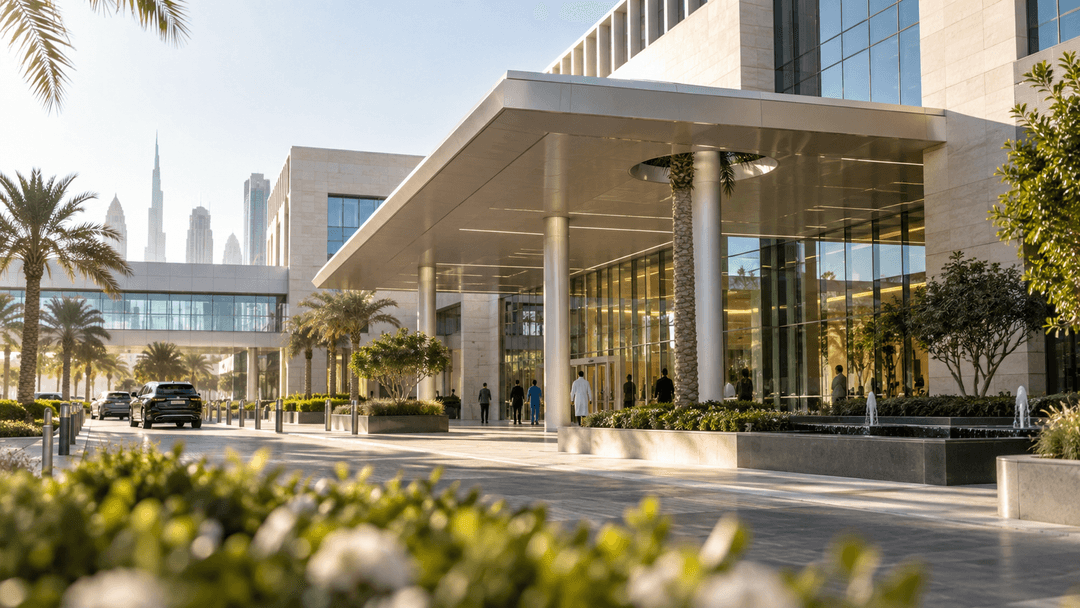
King’s College Hospital London - Dubai broke ground on 23 September 2026 on a Phase 2 expansion at Dubai Hills that is scheduled for completion in 2028 and will raise the hospital to 200 beds.
The highest-stakes readers are hospital CEOs, insurer network teams and clinic operators. More private tertiary capacity in Dubai changes where complex medical, surgical, critical care and cancer patients may be referred. It also gives insurers another high-acuity contracting point under the Dubai Health Authority (DHA), while patients may see more specialist care concentrated in one Dubai Hills site.
What King’s is adding
The announcement, published by Emirates 24|7 on 24 September 2026, said the new phase will add medical, surgical and critical care capacity. King’s also said the development will add radiation oncology, a service line that matters for cancer pathways because it can reduce transfers between diagnosis, surgery, systemic therapy and radiotherapy.
“With the addition of radiation oncology, we will be able to provide an even more complete cancer care pathway at King’s College Hospital Dubai, supporting patients from diagnosis through treatment and ongoing care within one hospital.”
Kimberley Pierce, CEO, King’s College Hospital London - Dubai
The ceremony was attended by Ahmed Humaid Al Tayer, chairman of King’s College Hospital London - Dubai; Kimberley Pierce; Roy Clarke, chief financial officer of King’s College Hospital NHS Foundation Trust; and Mohammed Saeed Al Raqbani, board vice chairman. DCIB Construction LLC is the main contractor, with Menasco Mechanical Contracting LLC as joint venture partner.
Why clinics and insurers should care
For independent clinics, the issue is referral economics. A 200-bed private hospital with oncology, critical care and surgical depth can absorb patients who would otherwise move across several providers. That can help clinics that secure formal referral pathways. It can hurt clinics that depend on episodic specialist work without insurer-approved care coordination.
For insurers, the immediate task is contracting discipline. King’s has not published the new Phase 2 tariff schedule. Network teams should request the hospital’s DHA-approved service scope, insurer-specific rate cards, pre-authorisation rules and package prices once radiation oncology opens. The practical comparison is against existing Dubai oncology and tertiary-care providers, using paid claims data rather than brochure rates.
- Completion: 2028, according to King’s and Emirates 24|7.
- Capacity: 200 beds after Phase 2.
- Regulator: DHA for Dubai facility licensing and professional licensing.
- Service line to watch: radiation oncology, because it drives high-cost outpatient and inpatient claims.
For Abu Dhabi operators, the direct regulator is the Department of Health - Abu Dhabi (DOH), not DHA. The relevance is patient leakage. If Dubai adds oncology and critical-care capacity with a London-linked brand, Abu Dhabi hospitals and insurers should track cross-emirate referrals, especially for privately insured expatriates and self-pay international patients. In Sharjah, Ajman, Ras Al Khaimah, Fujairah and Umm Al Quwain, Ministry of Health and Prevention (MOHAP) operators should watch whether patients bypass local diagnostics for Dubai-based treatment planning.
Operational signals for 2026 to 2028
King’s says the Dubai Hills hospital will remain operational during construction. Its expansion page tells patients to arrive 15 minutes before appointments and says the Emergency Department remains accessible from the south side of the hospital. That is a small detail with operational value: competing providers near Dubai Hills should expect temporary patient friction, but not a service shutdown.
Patients should not assume lower prices from new capacity. They should check three items before booking: whether the doctor and facility are in network, whether the planned procedure needs pre-authorisation, and whether radiology, pathology, anaesthesia or oncology drugs are billed separately. Where a price is not published, the reliable route is a written cost estimate from the provider and written coverage confirmation from the insurer before treatment.
The expansion is part of a wider private-hospital contest in Dubai. DHA remains the relevant licensing authority for Dubai. DOH governs Abu Dhabi and Al Ain. MOHAP is the relevant federal regulator for most private providers in the northern emirates. Operators comparing licensed hospitals, clinics and service categories can start with the UAE Open Healthcare Directory, which lists licensed healthcare providers across the UAE.
Zavis Intelligence
Healthcare Industry Desk
Contributing to UAE healthcare industry coverage
Related coverage



FAQ
What is happening in UAE healthcare industry?
King’s College Hospital London - Dubai has started Phase 2 at Dubai Hills. Clinics, insurers and patients should watch oncology capacity and referral flows.