
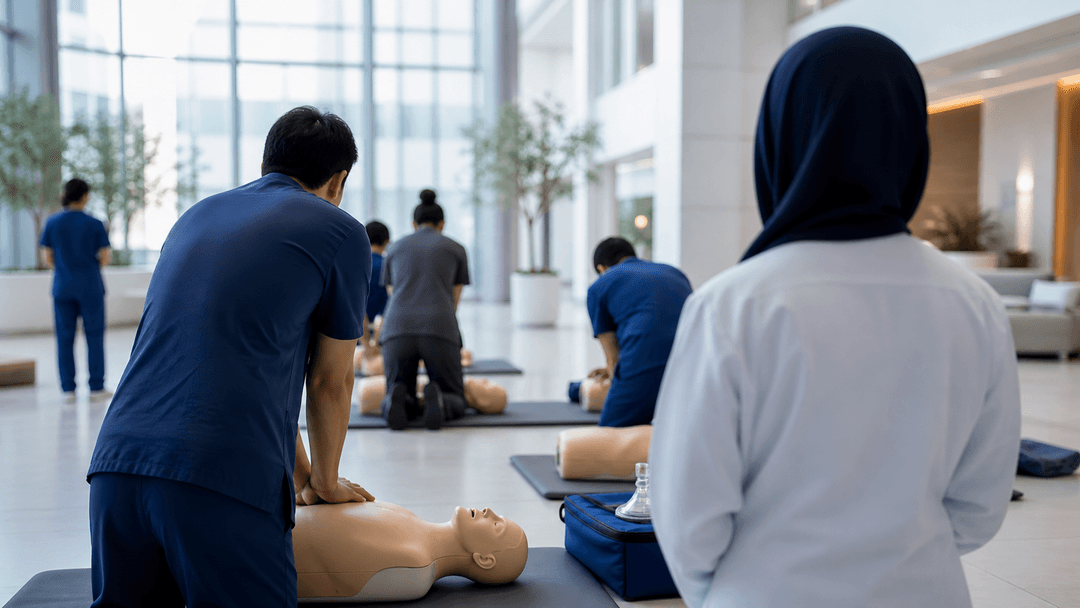
Emirates cardiac society launches 10,000-person CPR programme for UAE facilities
The five-year CPR programme targets healthcare and non-healthcare workers. Clinics, insurers and patients should track training access, AED readiness and regulator guidance.
How Zavis verifies this coverage
Editorial standards, source rules, methodology, and review provenance are public.
Emirates Cardiac Resuscitation Society has launched a national CPR and first aid programme to train 10,000 people and reach 10 million beneficiaries over five years, according to Emirates News Agency (WAM) on 27 August 2026.
The highest-stakes readers are COOs, medical directors and finance heads. Dubai clinics should read the announcement as a workforce readiness signal before any new Dubai Health Authority (DHA) instruction. Abu Dhabi operators should map it against Department of Health Abu Dhabi (DOH Abu Dhabi) standards. Providers in Sharjah, Ajman, Umm Al Quwain, Ras Al Khaimah and Fujairah should track Ministry of Health and Prevention (MOHAP) and Emirates Health Services guidance.
What the programme covers
WAM said the programme is the UAE's first integrated national programme for cardiopulmonary resuscitation and first aid. It is being implemented under the supervision of the Resuscitation Coalition, with government, private and non-profit entities. The initiative is part of the National Medical Preparedness and Response Programme (Jahiziyah), with support from the National Training Foundation (Tadreeb).
The training will cover early recognition of cardiac arrest and stroke, emergency calls, immediate CPR and use of an automated external defibrillator (AED) before ambulance teams arrive. The target groups are broad enough to matter beyond hospitals.
- Healthcare workers: medical, nursing, technical and administrative staff in hospitals and healthcare facilities.
- Employers: government and private entities, factories, shopping centres, hotels, tourism venues and sports facilities.
- Education: school and university staff.
- Community groups: families, youth and women's associations, people with disabilities, caregivers, volunteers and first responders.
"The first few minutes after cardiac arrest are the most critical." Dr. Adel Al-Shamri Al-Ajami, CEO of Jahiziyah, according to WAM
For medical directors, the practical point is content standardisation. WAM said the programme will create a national network of certified trainers, develop train-the-trainer programmes, establish a database of trainers and qualified facilities, and run periodic exercises to assess response times and team efficiency.
Why clinics and insurers should care
For Dubai clinics, the immediate task is to audit current Basic Life Support coverage by role, expiry date and training provider. DHA has not announced a new CPR compliance deadline in the WAM report. Operators should still compare their current training records with DHA facility licensing expectations and the DHA Health Facility Guidelines used for healthcare facility planning and operation in Dubai.
For Abu Dhabi and Al Ain, the same audit should be checked against DOH Abu Dhabi requirements. The DOH Abu Dhabi Standard for Acute Chest Pain (STEMI) Management refers to CPR, AED use and airway obstruction response as relevant capabilities in emergency care. In the northern emirates, MOHAP remains the regulator to watch for facility-level instructions.
Finance teams should budget against verified course quotes rather than assume the national programme will cover every employee. Public listings for UAE Basic Life Support courses commonly show AED 165 to AED 500 for individual BLS training, with some Dubai providers listing individual bookings from AED 299. Course duration is often 4 to 5 hours, and several providers list certification validity of two years. Operators should confirm the issuing body, local regulator acceptance and CME credit before purchase.
Insurers including Daman, Thiqa and Sukoon should treat the programme as a prevention and employer-benefits signal rather than a reimbursement change. WAM did not announce a claims rule, tariff change or coverage mandate. The potential financial issue is earlier response to cardiac arrest in workplaces, malls, schools and clinics, where ambulance response time and AED availability can affect survival and downstream intensive-care costs.
What operators should do next
COOs should build a simple CPR readiness file for each site by Q4 2026. It should list staff trained, certificate expiry dates, AED locations, inspection logs, drill dates, emergency call procedures and the accountable manager. The file should separate Dubai, Abu Dhabi and northern emirate sites because DHA, DOH Abu Dhabi and MOHAP may issue different operational instructions.
CIOs should check whether learning-management systems can record CPR certification, AED serial numbers, expiry dates for pads and batteries, and drill completion. Multi-site groups should avoid spreadsheet-only tracking once training expands across front desk, nursing, security and non-clinical teams.
Patients and employers should ask a narrower question than whether a facility has CPR-trained staff. Ask when the last drill took place, where the nearest AED is, and whether non-clinical staff know the emergency process. For cardiology referral and competitive mapping, use the UAE Open Healthcare Directory to find licensed cardiology providers, compare facility details and identify nearby services.
Zavis Intelligence
Healthcare Industry Desk
Contributing to UAE healthcare industry coverage
Related coverage




FAQ
What is happening in UAE healthcare industry?
The five-year CPR programme targets healthcare and non-healthcare workers. Clinics, insurers and patients should track training access, AED readiness and regulator guidance.