
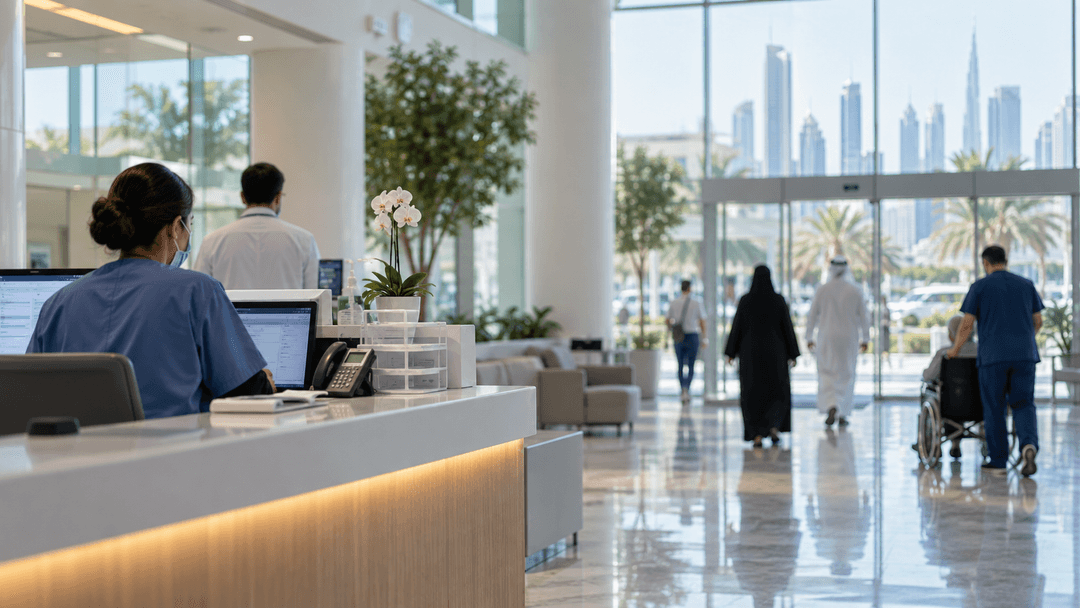
Dubai Police 999 warning on 9 September puts clinic triage scripts back in focus
Dubai Police warned against non-emergency 999 calls. Clinics, pharmacies and insurers need clearer triage routes for patients.
How Zavis verifies this coverage
Editorial standards, source rules, methodology, and review provenance are public.
Dubai Police used UAE Emergency Number Day on 9 September 2026 to warn residents against non-emergency calls to 999, including a caller who asked an operator to join him for lunch, according to Khaleej Times.
For healthcare operators, the warning is a patient-routing issue. Clinics, pharmacies and insurers field calls from residents with fever, pain, medication reactions and minor injuries. When those cases are sent to the wrong public number, emergency capacity is diluted before the patient reaches a clinician. The highest-stakes readers are COOs, pharmacy managers and insurer operations teams.
What Dubai providers should do now
The official UAE emergency sequence is simple enough to put on every reception script and pharmacy counter notice: 999 for police emergencies, 998 for ambulance, 997 for Civil Defence and 901 for Dubai Police non-emergency services. The UAE Government portal lists those emergency contacts, and Dubai Police promotes 901 for non-urgent police services.
Dubai Health Authority (DHA) is the relevant healthcare regulator for Dubai clinics, hospitals and pharmacies outside Dubai Healthcare City. DHA-licensed operators should audit patient-facing channels within 30 days: call-centre scripts, WhatsApp auto-replies, pharmacy counselling prompts, appointment reminders and website footers. The test is practical. A receptionist, pharmacist or bot should know when to tell a patient to call 998, when to advise an emergency department, and when to direct a non-police query back to the provider or insurer.
- For chest pain, stroke symptoms, severe breathing difficulty, major trauma or collapse, route to 998 or the nearest emergency department.
- For public-safety emergencies, crimes in progress or serious road incidents, route to 999.
- For Dubai Police non-emergency services, route to 901.
- For medicine availability, refills, insurance approvals or routine side-effect questions, use the provider, pharmacy or insurer service channel.
Why insurers and pharmacies are exposed
Insurers are affected because poor routing turns minor symptoms into higher-cost emergency claims. Dubai residents are covered under the emirate's mandatory health insurance system, and Abu Dhabi residents sit under Department of Health Abu Dhabi (DOH) rules. Daman, Thiqa and Sukoon members should be directed to plan-specific service numbers or apps for eligibility, pre-authorisation and pharmacy-network checks. Operators should verify exact benefits in the policy schedule rather than quote a generic UAE price.
There is no single public UAE tariff for emergency department use, urgent-care visits or pharmacy counselling across all emirates and insurers. CFOs should ask TPAs and payers for two numbers instead: emergency claims coded as low acuity over the past 12 months, and rejected or delayed pharmacy claims linked to missing approvals. Those two data points show whether public-number confusion is a patient education problem or a benefit-design problem.
Pharmacies have a narrower but immediate exposure. A pharmacy team cannot diagnose an emergency over the counter, but it can identify red flags and avoid sending patients to 999 for medicine questions. Under Ministry of Health and Prevention (MOHAP) oversight in Sharjah, Ajman, Umm Al Quwain, Ras Al Khaimah and Fujairah, the same signage logic applies. The regulator changes by emirate; the emergency numbers do not.
Abu Dhabi and northern emirates context
In Abu Dhabi and Al Ain, DOH regulates healthcare facilities and pharmaceutical premises. DOH's emergency and urgent-care standards use triage to separate the most urgent cases from lower-acuity cases. That matters during influenza waves, heat-related illness peaks and any outbreak response, when call-centre delay can move from inconvenience to clinical risk.
In the northern emirates, MOHAP-licensed clinics and pharmacies should use the same patient scripts but check local police-service channels before printing non-emergency numbers beyond 901. A chain with branches in Dubai, Abu Dhabi and Sharjah should avoid one national poster unless it has been reviewed against DHA, DOH and MOHAP licensing responsibilities.
The next operational step is small. Assign one owner this week to review emergency-routing language across reception, pharmacy, digital booking and insurer-facing materials. For licensed pharmacy options and regulator-verified provider searches, readers should use the UAE Open Healthcare Directory.
Zavis Intelligence
Healthcare Industry Desk
Contributing to UAE healthcare industry coverage
Related coverage



FAQ
What is happening in UAE healthcare industry?
Dubai Police warned against non-emergency 999 calls. Clinics, pharmacies and insurers need clearer triage routes for patients.