
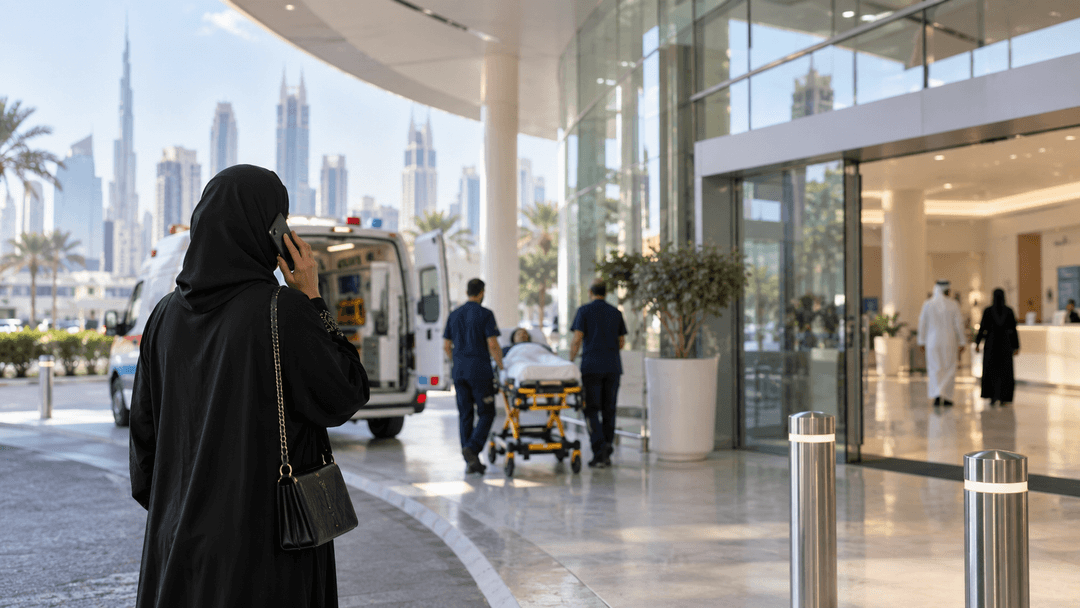
DHA route after FZ1073: Dubai patients should call 998 before choosing a hospital
Dubai patients should use 998 first in emergencies, then check insurance and licensed providers. Here is what applies across the UAE.
How Zavis verifies this coverage
Editorial standards, source rules, methodology, and review provenance are public.
For patients in Dubai, the Flydubai FZ1073 incident is a reminder that the first medical decision after any aviation or travel emergency in the UAE is simple: call 998 for an ambulance and let licensed emergency services route the case.
The incident reported by KOHA.net on 30 September 2026 involved a Dubai to Tel Aviv flight diverted to Tabuk, Saudi Arabia, with both pilots taken to hospital. It should not change how a Dubai resident chooses a hospital after trauma, chest pain, stroke symptoms, severe bleeding or loss of consciousness. The relevant authority in Dubai is the Dubai Health Authority (DHA). In Abu Dhabi and Al Ain it is the Department of Health Abu Dhabi (DOH). In the northern emirates, the relevant federal regulator is the Ministry of Health and Prevention (MOHAP).
What patients should do first
The UAE Government portal states that patients anywhere in the UAE should call 998 for an ambulance, with 999 for police and 997 for civil defence. In Dubai, the Dubai Corporation for Ambulance Services also provides the DCAS SOS app for ambulance requests.
That matters because self-directing to a favourite private hospital can cost time. The UAE Government says hospitals can handle medical emergencies, and a hospital will accept a patient for initial treatment and may transfer the patient to a facility better equipped for the case. It also states that emergency treatment to stabilise the case is free, while other treatment must be paid by cash, card or insurance.
- Call 998 for ambulance response anywhere in the UAE.
- Carry Emirates ID and an insurance card or app login when travelling.
- Ask for the treating hospital name, case number and discharge documents before leaving.
- Contact the insurer within the same day once the patient is stable, especially if transfer or admission is discussed.
What insurance should cover
Dubai’s mandatory insurance regime is the practical issue for residents. The Dubai legal framework for health insurance says that in an emergency, a health service provider must provide the relevant services until the patient is stable, even if the provider is outside the insurer’s contracted network. The Dubai Health Insurance Corporation policy also puts transfer responsibility on the insurer once the treating provider says the policyholder is stable and fit for transfer.
For a patient, that creates a sequence. Emergency care comes first. Network questions come second. A Dubai resident with a policy from insurers such as Sukoon, where applicable, should check the policy’s emergency terms, co-payment rules and claims window after stabilisation. Abu Dhabi residents using Daman or Thiqa should check DOH-linked coverage rules and the insurer’s emergency claims process. The article should not be read as a promise that every test, admission day or private-room charge will be paid in full.
The actionable number is the insurer’s own authorisation line, which is printed on the insurance card or shown in the app. Patients should ask three questions: whether the hospital is in network, whether admission needs authorisation after stabilisation, and what documents are needed for reimbursement if the emergency occurred outside the UAE.
What this means after a flight or travel incident
For UAE residents injured during travel, the difference between emergency care and follow-up care can affect the bill. Emergency stabilisation is usually treated differently from elective review, imaging, physiotherapy or specialist follow-up. The exact AED amount depends on the hospital tariff, insurer network and policy benefits. Patients should ask the hospital billing office for an itemised estimate before non-emergency follow-up begins.
Patients returning to Dubai after treatment abroad should bring the medical report, medication list, imaging files, discharge summary and receipts. A UAE hospital or clinic can then continue care under local licensing and insurance rules. For trauma, head injury, burns or chest symptoms, the safer route remains 998 or an emergency department rather than a routine outpatient appointment.
For operators, the practical lesson is patient communication. Hospitals, clinics and travel medicine providers should publish one clear emergency pathway on their websites: 998 first, documents to bring, insurance authorisation contacts, and how to obtain follow-up records. That is a compliance and patient-acquisition issue, because patients search for instructions during stress.
Before choosing a hospital for follow-up in Dubai, Abu Dhabi, Sharjah, Ajman, Ras Al Khaimah, Fujairah or Umm Al Quwain, patients should check whether the provider is licensed. The UAE Open Healthcare Directory lists more than 12,390 licensed healthcare providers across all seven emirates and is a useful first check before booking non-emergency care.
Zavis Intelligence
Healthcare Industry Desk
Contributing to UAE healthcare industry coverage
Related coverage




FAQ
What is happening in UAE healthcare industry?
Dubai patients should use 998 first in emergencies, then check insurance and licensed providers. Here is what applies across the UAE.