

Sharjah’s first PET/CT at Burjeel gives Dubai cancer patients 1 more scan option
Dubai patients now have another PET/CT route in Sharjah. Here is when it matters, what to check, and how approvals work.
How Zavis verifies this coverage
Editorial standards, source rules, methodology, and review provenance are public.
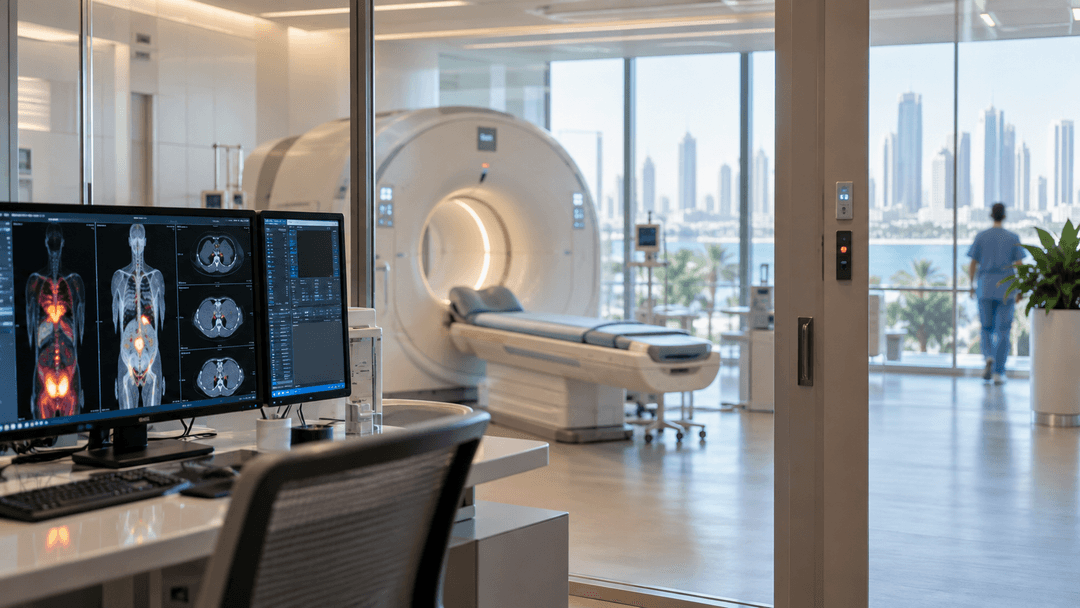
Dubai cancer patients now have one more PET/CT option within a normal inter-emirate drive, after Burjeel Specialty Hospital Sharjah launched Sharjah’s first PET/CT service on 7 September 2026.
The practical question is simple: should a patient in Dubai use it? The answer depends on referral urgency, insurance network access, radiotracer availability and whether the treating oncologist can receive images and reports fast enough to change a treatment decision. Dubai providers remain regulated by the Dubai Health Authority (DHA). Sharjah facilities sit under the Ministry of Health and Prevention (MOHAP), with radiation safety also involving the Federal Authority for Nuclear Regulation (FANR).
What changes for Dubai patients
PET/CT is usually ordered for cancer staging, treatment-response checks, suspected recurrence and selected prostate, neuroendocrine, brain, breast and endocrine indications. Burjeel said the Sharjah service uses a GE Discovery IQ PET/CT system and is integrated with Burjeel Cancer Institute. Its published tracer list includes 18F-FDG, PSMA and DOTA-peptide, according to Burjeel’s 7 September announcement and coverage by MedEdge MEA.
For a Dubai patient, the main benefit is scheduling optionality. A PET/CT slot in Sharjah may be useful when a Dubai appointment is delayed, when a specific tracer is available earlier, or when a family lives in Deira, Mirdif, Al Qusais or Dubai Silicon Oasis and can reach Sharjah faster than a hospital on the far side of Dubai. Patients should compare door-to-door time, waiting time and report turnaround before switching providers.
- Ask whether the scan is FDG PET/CT, PSMA PET/CT or another tracer, because approvals and preparation differ.
- Ask for report turnaround in writing, with the expected date and format for images.
- Confirm whether the imaging centre can share DICOM files with the treating oncologist.
- Check whether the scan will be billed as outpatient radiology or oncology-linked diagnostics.
What to check before booking
A PET/CT appointment commonly takes several hours because the patient receives a radiotracer, rests while it distributes through the body, then completes the scan. CMC Hospital Dubai tells patients that PET/CT exams need prior insurance approval before booking and that diet instructions are given at booking. Other UAE centres describe similar preparation, including fasting instructions and diabetes-specific guidance.
Self-pay prices are rarely posted in full by UAE hospitals. Patients should request an all-inclusive written quote before attending. That quote should state the tracer, radiologist fee, contrast use, CD or digital image fee, report fee, VAT treatment and whether a repeat image is charged if the clinical team needs delayed views. If a provider will not quote by phone, ask for the billing code and send the referral letter through the booking desk.
Insurance is the bigger variable. Thiqa publishes that MRI, CT, PET scans and similar tests are covered at 100% but require authorisation in private-network providers. For Daman, Sukoon and Dubai employer plans, coverage depends on the policy network, annual limit, diagnosis, pre-authorisation and whether the ordering doctor is in network. A Dubai resident should ask the insurer three questions before choosing Sharjah: is Burjeel Specialty Hospital Sharjah in network, is PET/CT covered for this diagnosis, and does cross-emirate outpatient imaging need a separate approval?
How this affects care choices
The new Sharjah service is most relevant for oncology pathways where timing changes the next step. A baseline staging scan before surgery or chemotherapy can affect treatment selection. A response scan after chemotherapy can affect whether a regimen continues. A recurrence scan can affect referral to surgery, radiotherapy or systemic therapy.
Abu Dhabi patients already have advanced oncology and nuclear medicine capacity under the Department of Health Abu Dhabi (DOH), including large tertiary hospitals and specialist cancer services. Northern Emirates patients gain the more direct benefit because Sharjah is closer than Dubai or Abu Dhabi for many families in Ajman, Umm Al Quwain, Ras Al Khaimah and Fujairah.
“With this capability now available in Sharjah, we can support timely diagnosis, accurate staging and treatment-response assessment while keeping patient safety and comfort at the center of care,” said Dr. Firuz Ibrahim, Head of Department, Nuclear Medicine, Burjeel Specialty Hospital, Sharjah.
Dubai patients should treat the launch as a new access point, with the same clinical safeguards. Get a referral from the treating oncologist, confirm the exact tracer, secure insurer approval before booking, and make sure images reach the clinical team before the next consultation. To compare licensed hospitals and providers, start with the UAE Open Healthcare Directory and the official DHA, DOH Abu Dhabi and MOHAP facility directories.
Zavis Intelligence
Healthcare Industry Desk
Contributing to UAE healthcare industry coverage
Related coverage


FAQ
What is happening in UAE healthcare industry?
Dubai patients now have another PET/CT route in Sharjah. Here is when it matters, what to check, and how approvals work.