
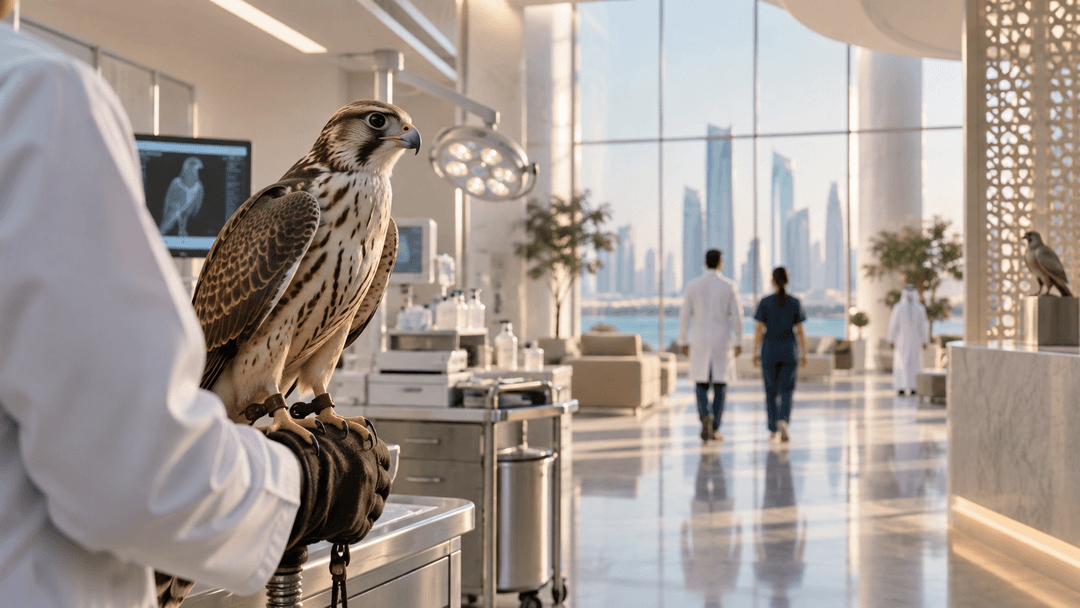
Abu Dhabi Falcon Hospital draws 185,000 visitors, with lessons for UAE specialty clinics
Abu Dhabi Falcon Hospital has treated 170,000-plus patients since 1999. UAE operators can read it as a specialty-care and biosecurity case study.
How Zavis verifies this coverage
Editorial standards, source rules, methodology, and review provenance are public.
Abu Dhabi Falcon Hospital has turned a specialist veterinary service into a public-facing care model, with 185,000-plus visitors since tours opened in 2007, according to What’s On.
The highest-value readers are COOs, CMOs and medical directors. For Dubai clinics regulated by the Dubai Health Authority (DHA), the lesson is operational: a narrow clinical service can support education, tourism and trust when the pathway is controlled. For Abu Dhabi operators under the Department of Health Abu Dhabi (DOH), it is a local benchmark for specialty access and visitor experience. For providers in Sharjah, Ajman, Ras Al Khaimah, Fujairah and Umm Al Quwain under the Ministry of Health and Prevention (MOHAP), it shows how a licensed service can build demand beyond a single emirate.
What the hospital is selling
ADFH opened on 3 October 1999 as a public institution for falcon medicine. The hospital says it has handled 170,000-plus patients since opening, while Abu Dhabi’s tourism portal describes it as the world’s first and largest hospital dedicated to falcons. The same portal says about 6,000 birds pass through each year and that the site has 200 air-conditioned treatment rooms.
The What’s On feature reports that public tours run Sunday to Thursday at 10am and 2pm, and Friday at 10am. The listed starting price is Dhs178.50. Individual visitors are told to book at least two days in advance, while groups must book up to one week ahead. Those numbers matter because they convert a clinical back-of-house service into a scheduled, priced consumer product.
“It is impossible to describe it fully as this has to be experienced,” said Dr. Margit Gabriele Müller, Executive Director of Abu Dhabi Falcon Hospital.
Why UAE clinics should pay attention
The direct healthcare read-across is limited. A falcon hospital does not create a new human reimbursement pathway. Daman, Thiqa and Sukoon should not be assumed to cover any veterinary or tourism component unless a published policy says so. For CFOs, the relevant issue is private-pay design: price, booking window, patient flow and the bundling of education with a paid service.
For COOs, ADFH shows a controlled way to open a clinical environment to the public. The tour passes through a museum, registration education, examination-room viewing and falcon interaction. Human providers considering hospital tours, wellness education, fertility open days, rehabilitation demonstrations or medical tourism previews need the same operating questions answered before launch:
- Which areas are visitor-facing, and which remain clinical-only?
- What consent, infection-control and photography rules apply?
- Which staff are allocated to tours without disrupting appointments?
- Which regulator reviews advertising claims: DHA, DOH or MOHAP?
For medical directors, the sharper point is biosecurity. What’s On reports that ADFH is the UAE reference laboratory for avian influenza on behalf of the Ministry of Climate Change and Environment (MOCCAE). That role sits outside human hospital licensing, but it is relevant to infection surveillance. Operators with zoonotic-risk exposure, including emergency departments, occupational-health clinics and laboratories, should know which public authority owns the escalation route before a case appears.
Patients, insurers and the next commercial signal
Patients are already buying healthcare-adjacent experiences in the UAE. ADFH’s tour price gives providers a live benchmark for what a two-hour specialist education visit can command when the setting is scarce and the story is local. Dubai operators should compare it with DHA-permitted wellness events and medical tourism packages. Abu Dhabi operators should check DOH advertising rules before using clinical access as a consumer acquisition tool. Northern emirate operators should check MOHAP licensing and advertising requirements before offering paid tours or screening-led public events.
CMOs should avoid copying the falcon theme. The useful asset is the operating model: a niche service, named expertise, fixed tour times, advance booking and a tangible patient interaction. That model can translate into orthopaedic movement labs, dental implant planning sessions, women’s health education days or rehabilitation open clinics, provided the clinical claims are licensed and auditable.
The next signal to watch is whether more UAE specialty providers price access to clinical expertise separately from treatment. If they do, insurers will need clear exclusions, clinics will need regulator-cleared materials, and patients will need to know when an event is education rather than diagnosis. Readers checking licensed hospitals and clinics can start with the UAE Open Healthcare Directory, then verify Dubai facilities in the DHA medical registry, Abu Dhabi facilities through DOH, and northern emirate facilities through MOHAP.
Zavis Intelligence
Healthcare Industry Desk
Contributing to UAE healthcare industry coverage
Related coverage



FAQ
What is happening in UAE healthcare industry?
Abu Dhabi Falcon Hospital has treated 170,000-plus patients since 1999. UAE operators can read it as a specialty-care and biosecurity case study.