
Narrowband UVB Phototherapy vs PUVA Therapy
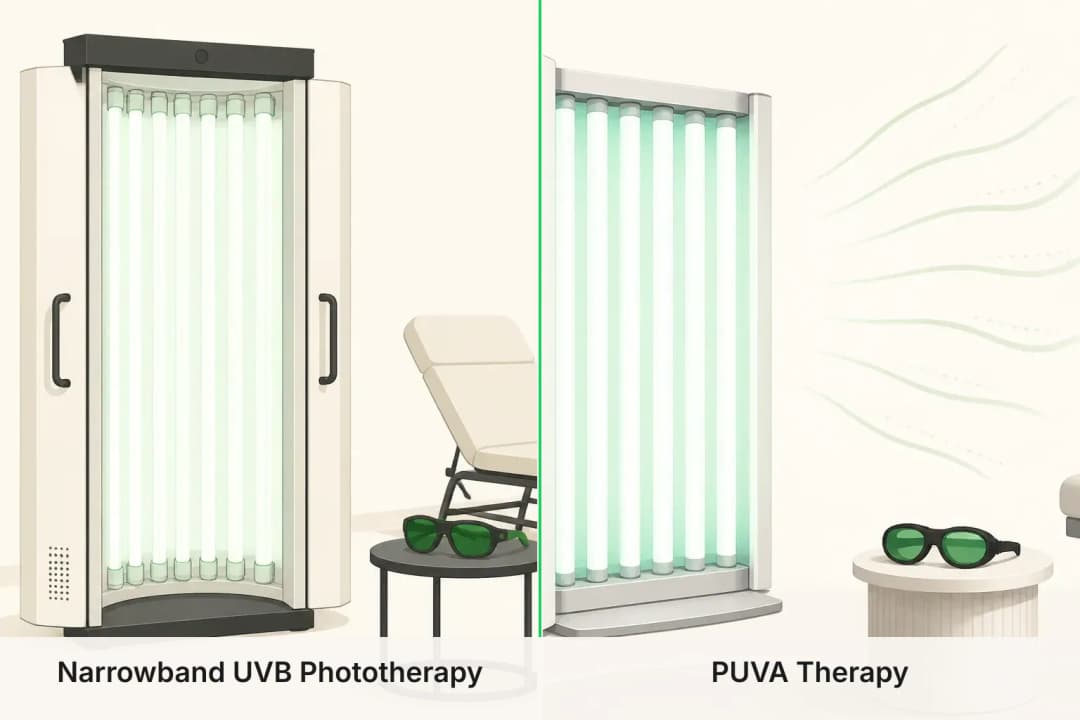
At a glance
- Main distinction
- PUVA adds psoralen before UVA exposure.
- Shared feature
- Both require supervised dose adjustment and protective measures.
- Decision driver
- Diagnosis, affected area, medicines and light sensitivity.
Find care
Dermatology & Skin Care in Dubai
Licensed dermatology & skin care listed in Dubai. Appearing here means a provider holds a UAE licence in this category — not that it offers narrowband UVB phototherapy vs PUVA therapy, which is worth confirming with the clinic before you book.
Wafi Mall - 1st Floor - Code “B”/ Entrance - Gate 3 Oud Metha Rd - inside the mall - Umm Hurair Second - Dubai Healthcare City - Dubai - United Arab Emirates
Accepts: Insurance Accepted
Al Ferdous 4, Al Wasl Road 603, AL SAFFA FIRST, Dubai
Accepts: Daman, Thiqa, AXA, Cigna +24 more
The mall, Jumeira Street 856a, UM SUQAIM SECOND, Dubai
Accepts: Thiqa, AXA, Bupa Global, Dubai Insurance Company +10 more
The Arcade, 4 Street 8, Al Garhoud, Dubai
Accepts: Daman, Thiqa, AXA, Cigna +26 more
Office # 102, SMJ-1, 1st Floor - شارع الشيخ زايد - الصفا 1 - الصفا - دبي - United Arab Emirates
Accepts: AXA, Cigna, MetLife, Allianz Care +19 more
Commercial Entrance, The Onyx Tower - 2 Sheikh Zayed Rd - Al Thanyah Third - The Greens - Dubai - United Arab Emirates
Accepts: Daman, Thiqa, AXA, Cigna +23 more
Ordered by verification status and how complete each clinic's public record is, then alphabetically. This is a directory listing, not a ranking — Zavis does not rate or recommend providers.
A factual listing drawn from the DHA, DOH and MOHAP licence registers. It is not a referral, an endorsement, or advice that any of these providers is right for you.
How the treatments compare
Narrowband UVB is often the simpler light treatment, while PUVA combines a sensitising medicine with UVA and may suit selected conditions after specialist assessment.
Both treatments are delivered in planned sessions under dermatology supervision. Narrowband UVB uses a focused part of the UVB spectrum. PUVA uses psoralen, a medicine that makes skin more responsive to UVA, followed by UVA exposure. That added medicine changes preparation, precautions and aftercare.
When narrowband UVB may be considered
Narrowband UVB may be a practical option when several areas need treatment, when avoiding a photosensitising medicine is preferable, or when the treatment plan needs straightforward preparation. It can be useful when the clinician wants to adjust exposure gradually and review the skin between visits. A treatment team will still consider medicines, previous light exposure and any history of unusual reactions to sunlight.
When PUVA may be considered
PUVA may be discussed when a specialist believes UVA combined with psoralen could address the particular skin condition or pattern of disease. It can require more detailed planning because psoralen can affect light sensitivity beyond the treatment booth. The clinician may choose a soak or applied form when the affected area is limited, or another method when broader skin is involved.
Risks and practical burdens
Either treatment can cause redness, warmth, dryness or an overexposure reaction if the dose is too high. Eye protection and careful dose adjustment matter. PUVA has additional concerns linked to psoralen, including nausea with some forms and heightened sensitivity to ordinary light for a period after dosing. Tell the clinic about medicines, pregnancy, liver problems, eye conditions and any history of light-triggered illness before treatment.
When neither may be the right first step
Light treatment may be deferred when the diagnosis is uncertain, the skin is acutely infected or badly sunburned, or a medicine makes ultraviolet exposure unsafe. A small-area problem may be better approached with a local treatment, while a rapidly changing or concerning lesion needs assessment rather than routine phototherapy. The plan can also change if the skin repeatedly reacts despite dose adjustments.
How a clinician makes the recommendation
The clinician first confirms what is being treated and how much skin is involved. Next they review prior treatments, medicines, sun sensitivity, eye health and the ability to attend repeated sessions. They then explain preparation, shielding, expected skin reactions and follow-up. The decision is shared: the treatment that is medically suitable also needs to be workable for your schedule and aftercare routine.
Questions people ask
Can narrowband UVB and PUVA be used together?
They are not automatically combined. A dermatologist decides whether one treatment should replace the other or whether a different sequence is appropriate.
Is PUVA more suitable for everyone with widespread skin disease?
No. PUVA has extra medicine-related precautions, so suitability depends on the diagnosis, health history, medicines and ability to follow light-protection advice.
Related
Related reading
Keep reading
Medical disclaimer. This page is general health information, not medical advice, and it cannot diagnose you. Always consult a licensed healthcare provider about your own symptoms and treatment. In an emergency in the UAE, call 998 for an ambulance.