
What should you know about periosteal chondroma?
Short answer
Periosteal chondroma is a usually non-cancerous cartilage-forming growth that develops beside the outer surface of a bone.
This answers one question. It is not a diagnosis and does not replace an assessment by a licensed doctor.
At a glance
- Tissue type
- Cartilage-forming growth
- Typical location
- Beside the outer surface of a bone
- Assessment
- Imaging, with biopsy when needed
What the term means
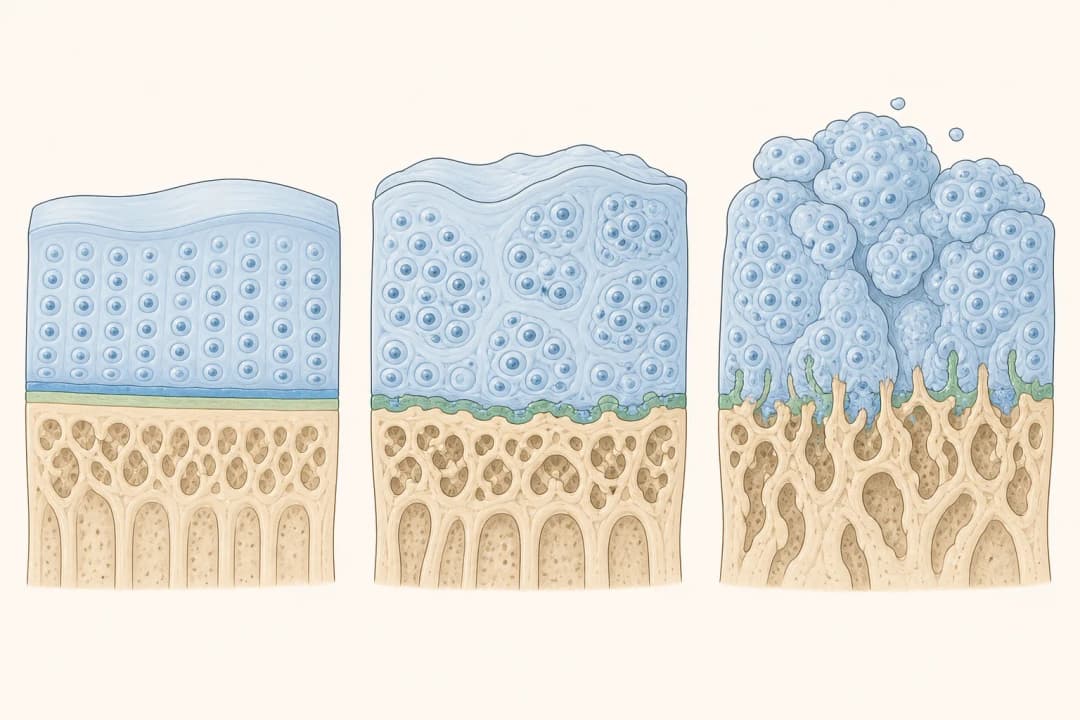
Periosteal refers to the thin tissue covering the outside of bone. Chondroma describes a growth made from cartilage-like tissue. The lesion may press into the nearby bone and can be found in an arm, leg, hand or foot. Some people notice a firm lump, local tenderness or discomfort that persists; others have no symptoms and learn about it after an imaging test for another reason.
An X-ray may show a surface-based lesion with characteristic mineralisation. MRI can clarify its relationship to the bone, muscles, tendons and nerves. Imaging cannot always distinguish a benign cartilage growth from a more active cartilage tumour, so the specialist considers its size, borders, symptoms and change over time.
How it is assessed and managed
An orthopaedic or musculoskeletal tumour team may review the scans and compare them with earlier images. If the appearance is uncertain, a biopsy can provide tissue for a pathologist. Small, stable lesions without troublesome symptoms may be monitored with planned examinations and imaging. Removal may be discussed when the growth causes pain, affects movement, enlarges or cannot be confidently characterised.
If surgery is advised, ask how much bone and surrounding tissue would be removed and how recovery could affect strength or movement. Tumour removal surgery may be part of that discussion. Proton therapy is not a routine treatment for every cartilage lesion, but a specialist can explain whether radiation-based care has any role in an individual case.
When to seek care
Arrange a clinical review for a new or enlarging hard lump near a bone, persistent focal pain, night discomfort, or reduced movement. Seek urgent help after sudden severe pain, a new inability to use the limb, marked swelling, numbness, or a limb that becomes cold or changes colour.
Questions for your doctor
What features on my scan support periosteal chondroma? Do I need an MRI or biopsy? Is observation reasonable for this lesion? If removal is recommended, what function and recovery should I expect?
Questions people ask
Is periosteal chondroma cancer?
It is usually a non-cancerous cartilage growth, but the diagnosis depends on the clinical, imaging and sometimes tissue findings.
Does every periosteal chondroma need surgery?
No. A stable lesion without troublesome symptoms may be monitored; removal is considered when symptoms, growth or uncertainty make it appropriate.
Related
Related reading
Keep reading
Cancer care in the UAE
Hospitals & Medical Centers in Abu Dhabi
Most UAE cancer care is delivered inside hospital services rather than by standalone oncology clinics, so these are licensed hospitals & medical centers listed in Abu Dhabi. Confirm the specific cancer service exists before you travel, and know that asking for a second opinion is routine.
Ahalia Hospital Musaffah Building - Musaffah - Musaffah Industrial - Abu Dhabi - United Arab Emirates
Accepts: Daman, Thiqa, AXA, Cigna +26 more
Al Ruwais Industrial City - Abu Dhabi - United Arab Emirates
Accepts: Daman, Thiqa, AXA, Cigna +30 more
Abu Dhabi, Abu Dhabi
Accepts: Daman, Thiqa, AXA, Cigna +30 more
Second opinions are routine in cancer care and asking for one does not affect your treatment. How to arrange a second opinion in the UAE.
Ordered by verification status and how complete each clinic's public record is, then alphabetically. This is a directory listing, not a ranking — Zavis does not rate or recommend providers.
A factual listing drawn from the DHA, DOH and MOHAP licence registers. It is not a referral, an endorsement, or advice that any of these providers is right for you.
Medical disclaimer. This page is general health information, not medical advice, and it cannot diagnose you. Always consult a licensed healthcare provider about your own symptoms and treatment. In an emergency in the UAE, call 998 for an ambulance.