
What should you know about dedifferentiated chondrosarcoma pathology outlines?
Short answer
Dedifferentiated chondrosarcoma contains a cartilage-forming tumour next to a distinctly high-grade, non-cartilage sarcoma, and both components shape diagnosis and treatment planning.
This answers one question. It is not a diagnosis and does not replace an assessment by a licensed doctor.
At a glance
- Defining pattern
- Cartilage tumour beside a high-grade non-cartilage sarcoma
- Why scans matter
- They show the tumour's full extent and help target representative tissue
- Care team
- A multidisciplinary bone sarcoma service
Direct answer
A pathology outline describes the microscopic appearance, grade, sample edges and any supporting tests. The report should be combined with scans because a small biopsy may capture only one part of this mixed tumour.
How to understand the pathology
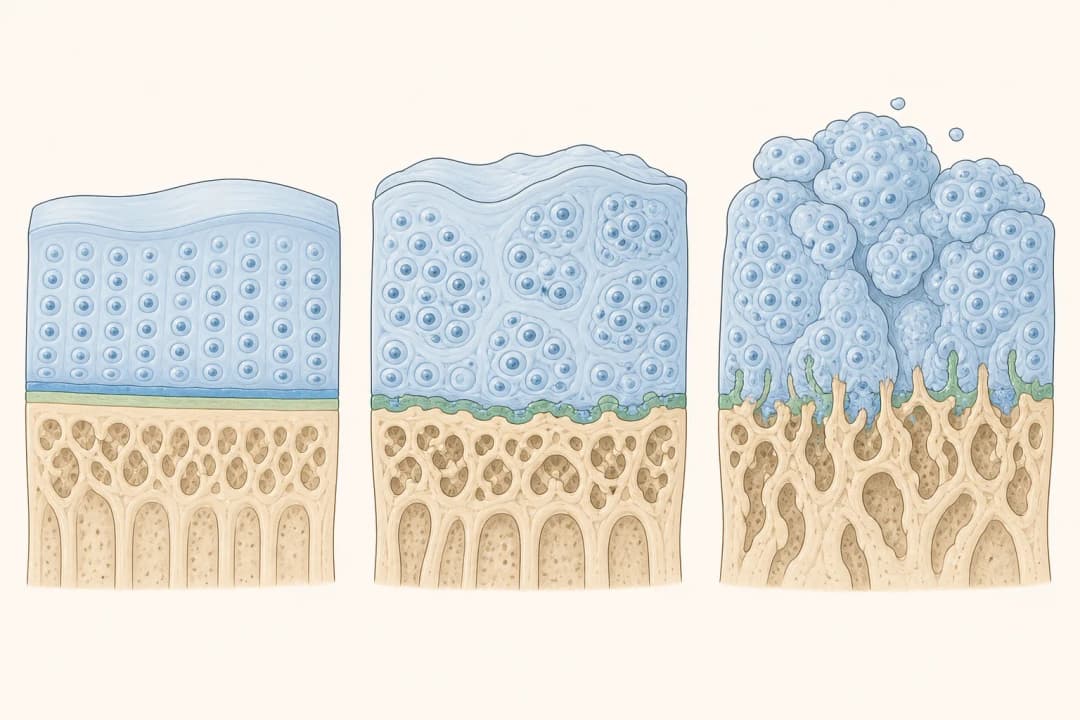
The defining feature is an abrupt boundary between a conventional cartilage-forming component and a more aggressive-looking sarcoma that no longer makes cartilage. The high-grade component may resemble several other sarcoma patterns, so the pathologist interprets it in the context of the adjacent cartilage tumour and the bone imaging.
A report may state the tumour's site, size in the removed specimen, grade, bone or soft-tissue involvement, treatment effect and margin status. A clear margin means no tumour is seen at the cut surface; an involved margin means tumour reaches it. These details help the multidisciplinary team assess local treatment and follow-up needs.
What happens after diagnosis
Care is usually planned by a specialist bone sarcoma team after pathology review and imaging of the tumour and relevant distant sites. Surgery is commonly considered for a removable tumour, with the operation designed around its location, nearby nerves and blood vessels, and the ability to obtain an adequate margin.
Radiation, including highly focused techniques in selected situations, may be discussed when anatomy or margins make local control difficult. The value of drug treatment depends on the individual case. Ask whether the biopsy and scans agree and whether more sampling or expert pathology review is needed before a major operation.
When symptoms need prompt care
Contact the sarcoma team promptly for rapidly worsening deep bone pain, new swelling, a sudden change in limb function or pain that is no longer controlled by the prescribed plan. Seek urgent assessment for a new weak or numb limb, loss of bladder or bowel control, inability to bear weight after sudden pain, chest pain, or breathlessness. These features can signal pressure on nerves, a weakened bone or another complication that requires assessment.
Questions for the sarcoma team
Ask whether both tumour components were present in the sample, which component determined the grade and whether the specimen edges are clear. Other useful questions cover the operation's goal, expected effect on movement, reconstruction options, the purpose of any radiation or medicines, and the schedule for scans after treatment.
Questions people ask
What does dedifferentiated mean in this diagnosis?
It means part of a cartilage-forming tumour has a sharply separate high-grade sarcoma component that does not form cartilage. It does not describe how a person feels.
Can a needle biopsy miss one component?
Yes. The components may occupy different areas, so image-guided targeting and comparison with scans are important when the sample and imaging do not match.
Why is margin status included after surgery?
Margin status shows whether tumour reaches the edge of removed tissue and helps the team consider whether further local treatment should be discussed.
Related
Related reading
Keep reading
Cancer care in the UAE
Hospitals & Medical Centers in Abu Dhabi
Most UAE cancer care is delivered inside hospital services rather than by standalone oncology clinics, so these are licensed hospitals & medical centers listed in Abu Dhabi. Confirm the specific cancer service exists before you travel, and know that asking for a second opinion is routine.
Ahalia Hospital Musaffah Building - Musaffah - Musaffah Industrial - Abu Dhabi - United Arab Emirates
Accepts: Daman, Thiqa, AXA, Cigna +26 more
Al Ruwais Industrial City - Abu Dhabi - United Arab Emirates
Accepts: Daman, Thiqa, AXA, Cigna +30 more
Abu Dhabi, Abu Dhabi
Accepts: Daman, Thiqa, AXA, Cigna +30 more
Second opinions are routine in cancer care and asking for one does not affect your treatment. How to arrange a second opinion in the UAE.
Ordered by verification status and how complete each clinic's public record is, then alphabetically. This is a directory listing, not a ranking — Zavis does not rate or recommend providers.
A factual listing drawn from the DHA, DOH and MOHAP licence registers. It is not a referral, an endorsement, or advice that any of these providers is right for you.
Medical disclaimer. This page is general health information, not medical advice, and it cannot diagnose you. Always consult a licensed healthcare provider about your own symptoms and treatment. In an emergency in the UAE, call 998 for an ambulance.