
What should you know about cradle cap when does it go away?
Short answer
Cradle cap often settles during infancy, though some children have lingering or recurring scale that needs review.
This answers one question. It is not a diagnosis and does not replace an assessment by a licensed doctor.
At a glance
- Course
- Often gradual improvement during infancy
- Possible pattern
- Lingered or recurring scale
- Review needed
- Persistent, widespread, painful, or wet changes
The usual course
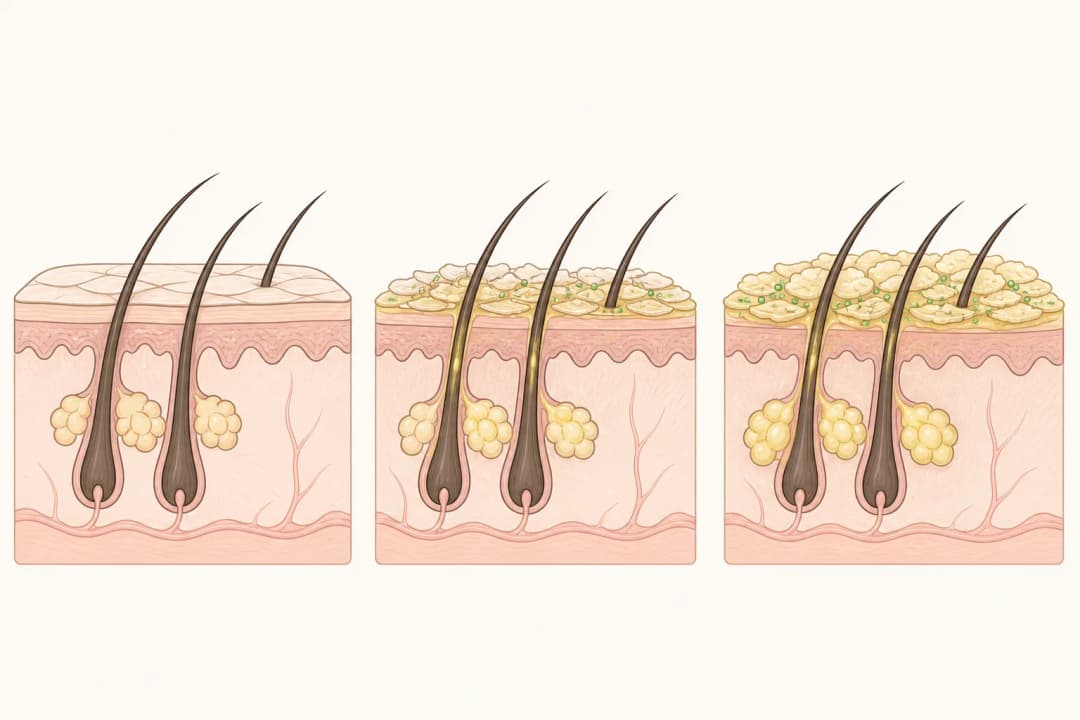
Cradle cap tends to become less noticeable as oil-gland activity changes with growth. The scalp may improve gradually rather than clear after one wash. Scale can return after it has improved, especially when the scalp becomes oily or irritated. Mild, dry-looking flakes without discomfort are often less urgent than a rash that is raw or inflamed. If the appearance is unusual, extends beyond typical areas, or continues strongly as a child gets older, another condition such as eczema, psoriasis, or a fungal problem may need consideration.
While you are waiting for improvement
Keep washing gentle and regular enough to remove loose scale, using fingertips and lukewarm water. Do not pick, scrape, or brush forcefully. For stubborn patches, ask whether [Emollient Therapy](/treatments/medical-dermatology/emollient-therapy/) is suitable before shampooing. Persistent redness or thick scale may lead a clinician to discuss [Topical Antifungal Treatment](/treatments/medical-dermatology/topical-antifungal-therapy/). Take a photograph when the rash is active if it comes and goes, so the clinician can compare changes without repeated irritation.
When to seek care
Book a review if there is no gradual improvement, if the rash keeps returning, or if it affects the eyebrows, ears, face, or body. Seek prompt care for increasing redness, warmth, swelling, tenderness, oozing, pus-like crust, bleeding, or fever. A baby who feeds poorly or seems unusually sleepy should be assessed urgently, regardless of how long the scalp scale has been present.
Questions for your doctor
Ask what improvement should look like, how long to continue gentle care, whether the diagnosis is certain, and which warning signs mean you should return sooner.
Find care
General Clinics & Polyclinics in Abu Dhabi
That answer is general. If you want it applied to your own case, these are licensed general clinics & polyclinics listed in Abu Dhabi.
27 Ar Ruwwad St - Shakhbout City - MSH4 - Abu Dhabi - United Arab Emirates
Accepts: Daman, Thiqa, Cigna, MetLife +20 more
Al Ruwais, Al Dhafrah
Accepts: Daman, Thiqa, AXA, Cigna +16 more
Al Bahyah - Al Bahyah Old - Abu Dhabi - United Arab Emirates
Accepts: Daman, Thiqa, Cigna, Allianz Care +18 more
Abu Dhabi
Accepts: Daman, Thiqa, AXA, Cigna +27 more
Ordered by verification status and how complete each clinic's public record is, then alphabetically. This is a directory listing, not a ranking — Zavis does not rate or recommend providers.
A factual listing drawn from the DHA, DOH and MOHAP licence registers. It is not a referral, an endorsement, or advice that any of these providers is right for you.
Questions people ask
Can cradle cap come back after it clears?
Yes. Scale may recur, but repeated or strongly inflamed episodes deserve a clinician's review to confirm the diagnosis and treatment.
Should I wait for cradle cap to disappear on its own?
Mild scale can often be managed gently, but do not wait if the skin is painful, wet, spreading, swollen, or associated with fever or poor feeding.
Related
Related reading
Keep reading
Medical disclaimer. This page is general health information, not medical advice, and it cannot diagnose you. Always consult a licensed healthcare provider about your own symptoms and treatment. In an emergency in the UAE, call 998 for an ambulance.