
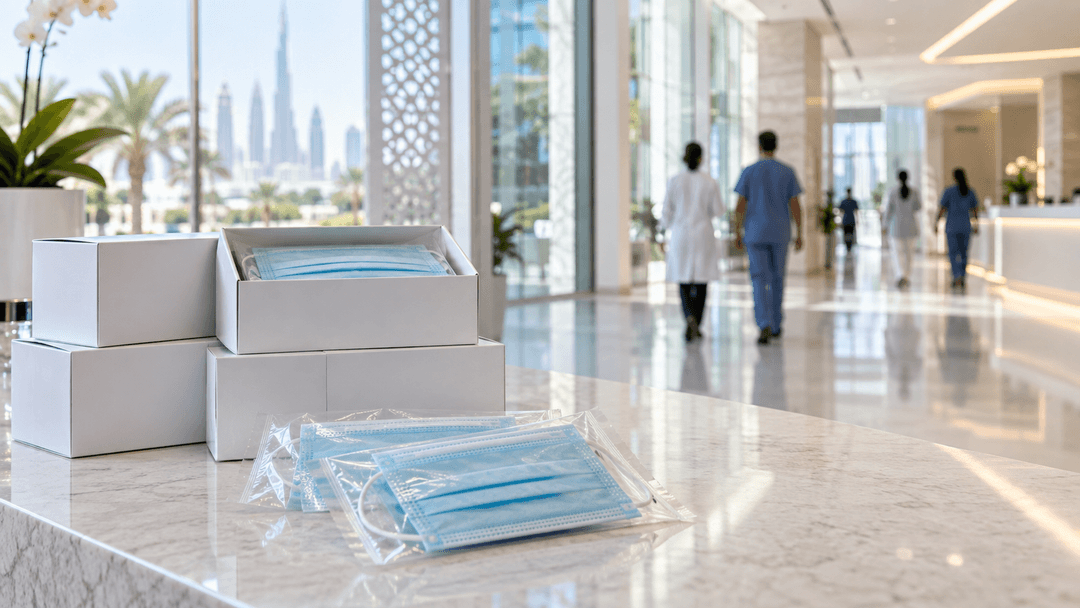
EDE face-mask recall: who is at risk from Batch 20251015 in Dubai pharmacies
Contaminated masks create a batch-control problem. Dubai operators need stock checks, quarantine records and patient advice.
How Zavis verifies this coverage
Editorial standards, source rules, methodology, and review provenance are public.
Dubai pharmacies and clinics should treat contaminated face masks as a batch-traceability event: the main risk is direct use of an affected mask by patients, staff or immunocompromised people, rather than wider person-to-person spread.
The highest-value readers are COOs, pharmacy owners and medical directors. Their practical question is narrow: can the facility identify every box of Nin 160 FMB-NML Facemask C G blue 3PLY, Batch No. 20251015, stop use the same day, document quarantine, and tell exposed users what symptoms or quality concerns to report?
How contamination reaches a patient
The recall reported by Gulf News on 12 October 2026 concerns foreign material and signs of contamination in one affected batch. That means the operational route is product handling: distributor to pharmacy shelf, clinic store, procedure room or patient purchase.
A three-ply mask sits against the nose and mouth. If contamination is present, exposure can occur through skin contact, contact with lips or mucosa, or hand contact followed by touching the eyes, nose or mouth. The World Health Organization advises users to inspect masks for damage and avoid touching the front during use. The US CDC says disposable face masks should be thrown away after one use or when wet or dirty.
For pharmacies, the commercial exposure is small per unit but large across branches. Current UAE retail listings show 50-piece three-ply mask boxes at about AED 8.10 on Nahdi, AED 10.50 on Gulf Pharmacy, and AED 20 on Oasis Pharmacy listings. The cash cost is limited. The compliance cost is staff time, stock reconciliation and complaint handling.
Who is actually at risk
The risk is highest for people who used the affected batch close to a clinical procedure, people with open facial skin lesions, and patients with reduced immunity. Healthcare workers using masks during patient contact also have a higher exposure frequency than ordinary retail buyers.
- Patients: ask for the box or pouch batch number before using masks bought after 12 October 2026.
- Pharmacies: quarantine all matching stock and keep invoices, transfer notes and return records.
- Clinics: check store rooms, nursing stations, procedure trolleys and pharmacy shelves.
- Medical directors: record any irritation, unexpected reaction or quality defect as a product complaint.
Routine shoppers who bought other brands or other batches have a lower risk. A recall of one batch does not prove that all three-ply masks are unsafe. It does mean operators should avoid substituting unregistered or poorly documented stock when replacing recalled inventory.
What Dubai operators should do now
In Dubai, the immediate regulator-facing document is the Dubai Health Authority (DHA) circular CIR-2026-00000180, dated 12 October 2026. DHA told health facilities to follow the Emirates Drug Establishment recall instructions. The federal regulator is the Emirates Drug Establishment (EDE), which is responsible for medical and pharmaceutical products in the UAE.
Abu Dhabi and Al Ain providers should check Department of Health Abu Dhabi (DOH) notices and internal supply-chain records. DOH says its pharmacovigilance programme receives medical-device reports involving manufacturing quality and product contamination through its reporting channels. Providers in Sharjah, Ajman, Umm Al Quwain, Ras Al Khaimah and Fujairah should watch Ministry of Health and Prevention (MOHAP) facility communications and EDE recall channels.
A practical same-day control has four steps: run a batch search across branch stock systems, physically inspect shelves and back rooms, isolate matching items in a labelled quarantine area, and return them to the supplier or local distributor. EDE’s medical product quality report service lists a 30-working-day laboratory completion duration and an AED 500 service fee for eligible applicants, including drug warehouses, through the EDE portal.
The next watchpoint is whether EDE or DHA names more batches, distribution locations or complaint channels. Until then, Dubai operators should replace stock through licensed pharmacies and verified suppliers. Readers can check licensed pharmacy providers through the UAE Open Healthcare Directory.
Zavis Intelligence
Healthcare Industry Desk
Contributing to UAE healthcare industry coverage
Related coverage



FAQ
What is happening in UAE healthcare industry?
Contaminated masks create a batch-control problem. Dubai operators need stock checks, quarantine records and patient advice.