
What to Expect from Strength Training Rehabilitation for Patellar Tendinitis
Short answer
Expect progressive knee loading that starts with manageable exercises and advances toward jumping, running or sport-specific demands when control improves.
This answers one question. It is not a diagnosis and does not replace an assessment by a licensed doctor.
At a glance
- Early emphasis
- Manageable knee loading
- Later emphasis
- Sport or task-specific control
Understanding the training plan
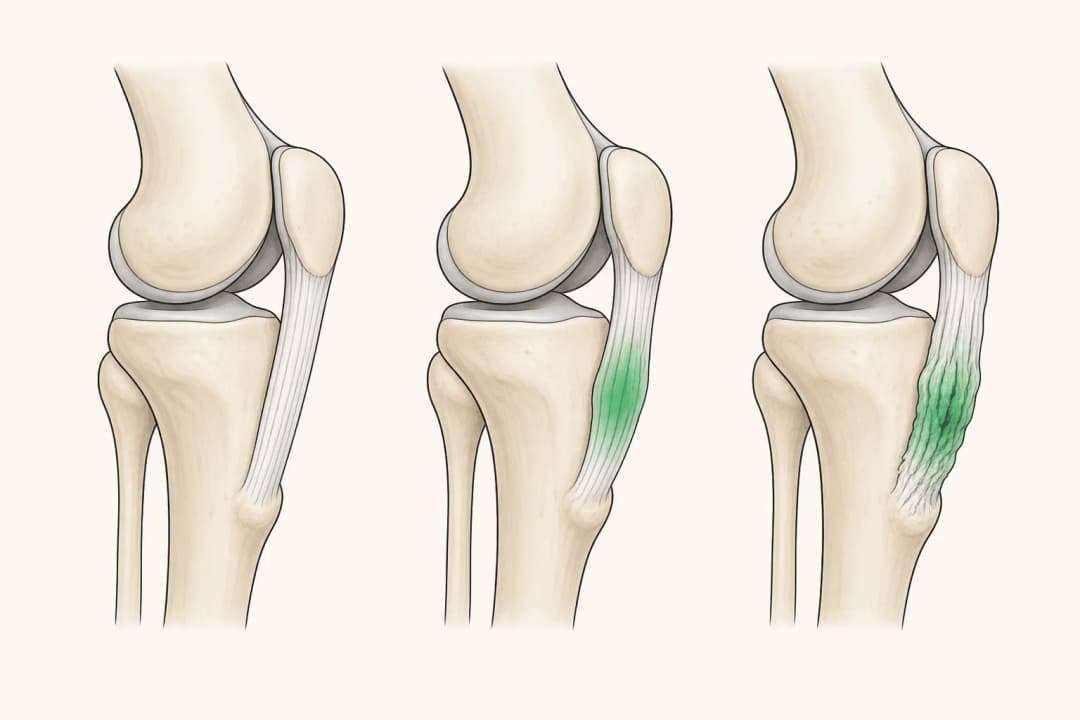
Patellar tendinitis affects the tendon below the kneecap, often producing pain with jumping, squatting, stairs or rising from a chair. Your physiotherapist may assess knee movement, hip and ankle strength, landing control and the recent change in training load. Early work can include isometric contractions, supported squats or slow resistance exercises before more demanding tasks are added.
The tendon needs a gradual challenge to rebuild tolerance. Symptoms are tracked across the session and the following day, while strength, confidence and functional tasks show whether the plan is moving forward. A temporary reduction in jumping or running may be part of the programme.
Using the exercises
Warm up as advised, keep the knee aligned over the foot and use the tempo your therapist teaches. Do not add gym weight, extra jumps and a harder sports session at the same time. Keep a simple record of pain during activity and recovery afterward. If stairs, sitting or walking become harder, tell your clinician before progressing the exercise.
When to seek care
Arrange assessment if swelling, weakness or pain continues to increase, or if the knee repeatedly buckles. Seek urgent care after a sudden pop with inability to straighten the knee, major swelling, a direct injury, or inability to bear weight.
Questions for your doctor
Ask which stage fits your current symptoms, how to progress resistance, and when running or jumping can return. Clarify whether footwear, training volume, hip strength or landing technique needs attention.
Find care
General Clinics & Polyclinics in Abu Dhabi
That answer is general. If you want it applied to your own case, these are licensed general clinics & polyclinics listed in Abu Dhabi.
27 Ar Ruwwad St - Shakhbout City - MSH4 - Abu Dhabi - United Arab Emirates
Accepts: Daman, Thiqa, Cigna, MetLife +20 more
Al Ruwais, Al Dhafrah
Accepts: Daman, Thiqa, AXA, Cigna +16 more
Al Bahyah - Al Bahyah Old - Abu Dhabi - United Arab Emirates
Accepts: Daman, Thiqa, Cigna, Allianz Care +18 more
Abu Dhabi
Accepts: Daman, Thiqa, AXA, Cigna +27 more
Ordered by verification status and how complete each clinic's public record is, then alphabetically. This is a directory listing, not a ranking — Zavis does not rate or recommend providers.
A factual listing drawn from the DHA, DOH and MOHAP licence registers. It is not a referral, an endorsement, or advice that any of these providers is right for you.
Questions people ask
Should you stop all sport?
Your clinician may temporarily reduce provocative jumping or running while maintaining suitable strengthening and other activity.
Is soreness after exercise expected?
A response can occur, but persistent or escalating symptoms indicate that the load or technique needs review.
Related
Related reading
Keep reading
Medical disclaimer. This page is general health information, not medical advice, and it cannot diagnose you. Always consult a licensed healthcare provider about your own symptoms and treatment. In an emergency in the UAE, call 998 for an ambulance.