
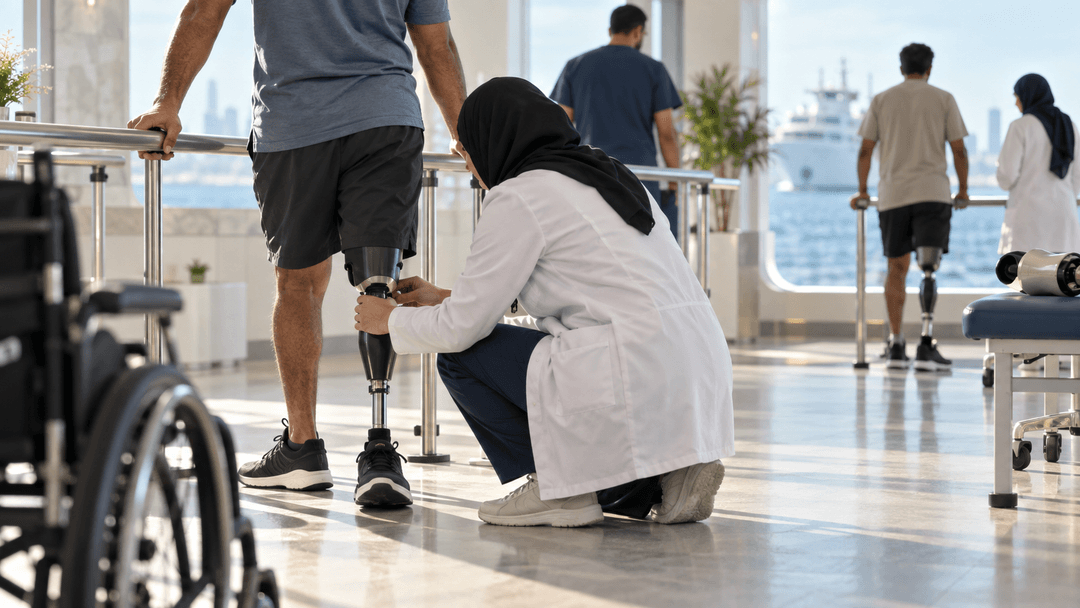
UAE Floating Hospital fits 42 Palestinians with prosthetics, lifting Step of Hope total to 198
The UAE Floating Hospital fitted 42 Palestinian amputees in Al Arish. UAE clinics and insurers should watch rehab capacity, prior approvals and licensed provider checks.
How Zavis verifies this coverage
Editorial standards, source rules, methodology, and review provenance are public.
The UAE Floating Hospital in Al Arish, Egypt, has fitted prosthetic limbs for 42 injured Palestinian amputees, taking the Step of Hope programme to 198 beneficiaries since launch, according to the Emirates News Agency on 25 September 2026.
The highest-stakes readers are COOs, CFOs and medical directors. For UAE operators, the story is less about a single humanitarian milestone than about the service chain behind amputation care: surgical readiness, prosthetic fabrication, physiotherapy, gait training, psychological support and long-term follow-up. In Dubai, that chain sits under the Dubai Health Authority (DHA). In Abu Dhabi and Al Ain it sits under the Department of Health Abu Dhabi (DOH). In Sharjah, Ajman, Ras Al Khaimah, Fujairah and Umm Al Quwain it sits under the Ministry of Health and Prevention (MOHAP).
What the UAE programme is doing
Step of Hope was launched on 11 June 2026 under Operation Chivalrous Knight 3, in cooperation with the International Charity Organisation. The first phase uses the UAE Floating Hospital in Al Arish for clinical assessment, measurement, fabrication and fitting. A second phase uses 3D digital scanning inside Gaza to transmit residual-limb measurements to Al Arish. A third phase is planned around local prosthetics manufacturing capacity in Gaza, according to WAM.
The 25 September announcement names seven UAE organisations supporting the programme: International Charity Organisation, Sharjah Charity International, The Big Heart Foundation, Dar Al Ber Society, Zayed Authority for People of Determination, Ma'an, and Ahmed bin Zayed Al Nahyan Foundation for Humanitarian and Charitable Works.
For medical directors, the clinical signal is the rehabilitation model. WAM describes an integrated pathway with medical assessment, custom prosthetic manufacture, fitting, physiotherapy, mobility rehabilitation and continuing follow-up. That is the same sequence UAE hospitals and rehabilitation clinics must document when they seek payer approval for complex prosthetic care.
Why Dubai clinics and insurers should watch it
Dubai providers should treat the story as a reminder that prosthetic care is a multi-visit service line, not a one-off device sale. DHA's public physical medicine and rehabilitation service guide lists prosthetics, orthotics and anaplastology as services for UAE nationals, residents and expatriates. The same guide states that prosthetics service delivery time depends on each case, with service charges free for UAE nationals and expatriate charges dependent on the service, usually covered by insurance companies.
That variability matters for finance teams. Public UAE price transparency for prosthetic limbs remains limited. One Dubai prosthetics provider's published 2026 guide gives a useful market check, with basic below-knee devices starting around AED 5,000 to AED 15,000 and microprocessor-controlled above-knee devices reaching about AED 80,000 to AED 150,000. Operators should use those figures as a quotation benchmark, then obtain written device, socket, component, physiotherapy and follow-up pricing from a licensed provider before giving a patient estimate.
- Clinics should confirm the prosthetist, physiotherapist and facility licences in the relevant regulator register before accepting referrals.
- Insurers should separate device cost, socket changes, rehabilitation sessions and repair or replacement rules in pre-authorisation letters.
- Patients should ask whether the quoted price includes assessment, trial fitting, gait training and follow-up adjustments.
- Employers should check whether staff policies cover external prosthetic devices or only short-term durable medical equipment.
Coverage is the hard commercial question
The payer issue will differ by emirate and policy tier. Dubai residents should check policy wording with Sukoon or any DHA-permitted insurer before treatment starts. Abu Dhabi patients using Daman or Thiqa channels should check network eligibility, medical necessity rules and whether the case requires DOH-linked approvals. Patients in the northern emirates should check MOHAP-licensed providers and the benefit table attached to their insurer's policy.
For CFOs, the practical risk is an incomplete authorisation. A prosthetic limb episode can include the component, socket fabrication, liners, replacement parts, physiotherapy, occupational therapy, stump care and periodic refitting. A patient may receive approval for the device and still face out-of-pocket bills for rehabilitation or adjustments if those items are excluded from the approval letter.
For COOs, the operational question is capacity. Clinics planning to build or expand prosthetics services in Dubai need DHA-licensed allied health staff, documented referral pathways and coordination with orthopaedics, rehabilitation medicine and physiotherapy. Abu Dhabi operators need the same discipline under DOH rules. Northern emirates providers should verify MOHAP licensing scope before marketing prosthetics, orthotics or rehabilitation services.
The Step of Hope announcement is a humanitarian story, but it also gives UAE operators a practical test: can a patient move from amputation to measurement, fitting, rehabilitation and follow-up without losing time at each handoff? Patients and referring clinicians can start by checking licensed hospitals, rehabilitation centres and allied health providers in the UAE Open Healthcare Directory, which lists licensed providers across all seven emirates.
Zavis Intelligence
Healthcare Industry Desk
Contributing to UAE healthcare industry coverage
Related coverage



FAQ
What is happening in UAE healthcare industry?
The UAE Floating Hospital fitted 42 Palestinian amputees in Al Arish. UAE clinics and insurers should watch rehab capacity, prior approvals and licensed provider checks.